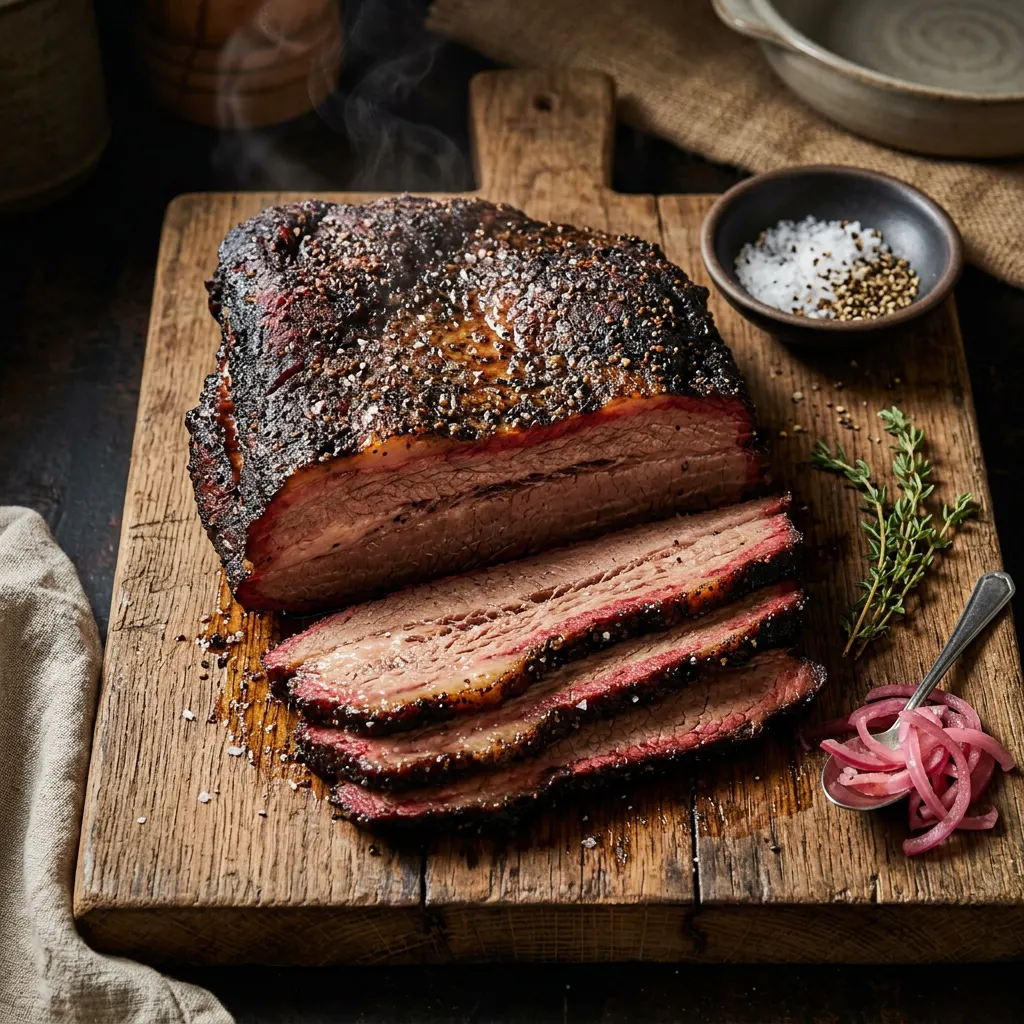
Apple-Smoked Central Texas Salt-and-Pepper Brisket
16-hour low and slow brisket with just kosher salt and 16-mesh pepper.
Cook Mode
One step at a time, big text, timers, and your screen stays awake. 0/8 steps done.
Ingredients
Tap to tick off · 0/8 gathered
Method
- 30 min
Carefully trim the brisket, removing hard fat and silver skin from the flat. Shape the fat cap on the point to about 1/4 inch thickness. Trim off any overly thin or ragged edges that will burn during the cook. Square up the brisket as much as possible for even cooking.
Why it matters
Proper trimming ensures even cooking, renders fat efficiently, and prevents burnt 'bark' on thin edges. The 1/4 inch fat cap protects the meat and slowly bastes it as it renders.
Common mistake
Removing too much fat, especially from the flat, leading to a dry brisket, or not trimming enough hard fat which won't render.
- 15 min
Mix the kosher salt and 16-mesh black pepper thoroughly. Generously apply the rub to all surfaces of the trimmed brisket. Ensure an even, thick coating. Let the brisket sit at room temperature while you prepare the smoker.
Why it matters
The simple salt and pepper rub is classic Central Texas style, allowing the beef flavor to shine. The coarse grind of the pepper is crucial for forming a great 'bark' (crust).
Common mistake
Using pre-ground, fine pepper which can turn bitter and burnt during a long cook, or not applying enough rub for a good bark.
- 225°F45 min
Load your smoker with Post Oak wood. Bring the smoker up to a stable temperature of 225°F. Ensure you have a clean, steady blue smoke. Place a water pan inside the smoker if your model allows, to help maintain humidity.
Why it matters
A stable 225°F is ideal for low and slow cooking, allowing connective tissues to break down and fat to render slowly. Post Oak provides a clean, mild smoke profile that complements beef perfectly without overpowering it.
Common mistake
Starting the cook before the smoker is at a stable temperature, or using too much wood/wrong wood, resulting in 'dirty' white smoke which can impart bitter flavors.
- 225°F8h
Place the brisket fat-side up (if your heat source is from below) on the grates. Insert a probe thermometer into the thickest part of the flat, avoiding large pockets of fat. Close the lid and begin the smoking process. Resist the urge to open the lid frequently.
Why it matters
The first 6-8 hours are crucial for smoke absorption and bark development. Keeping the lid closed maintains consistent temperature and smoke concentration, which is vital for flavor and texture.
Common mistake
Constantly opening the smoker lid, which prolongs cooking time, causes temperature fluctuations, and interferes with smoke penetration and bark formation.
- 225°F4h
After 4-6 hours, or when the bark has set and reached a desirable color, begin spritzing the brisket every 60-90 minutes with a 50/50 mixture of apple cider vinegar and water. Continue smoking until the internal temperature reaches 165-175°F (the 'stall').
Why it matters
Spritzing helps keep the surface moist, promoting better bark development and preventing it from becoming too dry or burnt. The 'stall' is when moisture evaporation cools the meat; spritzing can help push through it while maintaining bark integrity.
Common mistake
Spritzing too early or too frequently before the bark has set, washing off the rub, or not spritzing at all leading to a dry, crispy bark.
- 225°F4h
Once the brisket hits the stall (around 165-175°F internal) and the bark is well-formed, remove it from the smoker. Wrap it tightly in heavy-duty aluminum foil, sealing it completely. Return the wrapped brisket to the smoker, fat-side up. Continue cooking until the internal temperature reaches 200-205°F and it probes 'butter soft' in all areas.
Why it matters
Wrapping helps the brisket power through the stall by retaining moisture and heat, speeding up the cook. It also tenderizes the meat as connective tissues break down. Probing for tenderness is key, as temperature alone isn't always a perfect indicator.
Common mistake
Wrapping too early (before good bark formation) or relying solely on temperature instead of also probing for tenderness, leading to tough or dry brisket.
- 4h
Once the brisket reaches the desired tenderness, remove it from the smoker (still wrapped). Place it in an insulated cooler, wrapped in a towel, for a minimum of 2 hours, or ideally 4-6 hours. This crucial step allows the muscle fibers to relax and reabsorb juices.
Why it matters
Resting is arguably as important as the cook itself. It redistributes moisture, resulting in a more tender, juicy, and flavorful brisket. Skipping this step leads to dry meat.
Common mistake
Not resting the brisket long enough, or carving it immediately after coming off the smoker, which causes all the precious juices to run out.
- 15 min
After resting, unwrap the brisket. Separate the flat from the point. Slice the flat against the grain into pencil-thick slices. For the point, you can either slice it or chop it for burnt ends. Serve immediately.
Why it matters
Slicing against the grain shortens the muscle fibers, making the meat feel more tender and easier to chew. The two different muscle groups (flat and point) require different slicing approaches.
Common mistake
Slicing with the grain, which results in tough, chewy brisket regardless of how well it was cooked.
Sauce It
Cooks & Reviews
Guild members can rate this recipe, log their cooks and share photos.
Sign in to continueMember reviews
No reviews yet — be the first to rate this cook.
Ask the Pitmaster about this recipe
Substitutions, scaling, technique, troubleshooting — get answers grounded in this cook.
Sign in to try the AI Pitmaster on Apple-Smoked Central Texas Salt-and-Pepper Brisket. New members get 3 free questions.
Sign in to tryComments(0)
Loading comments…