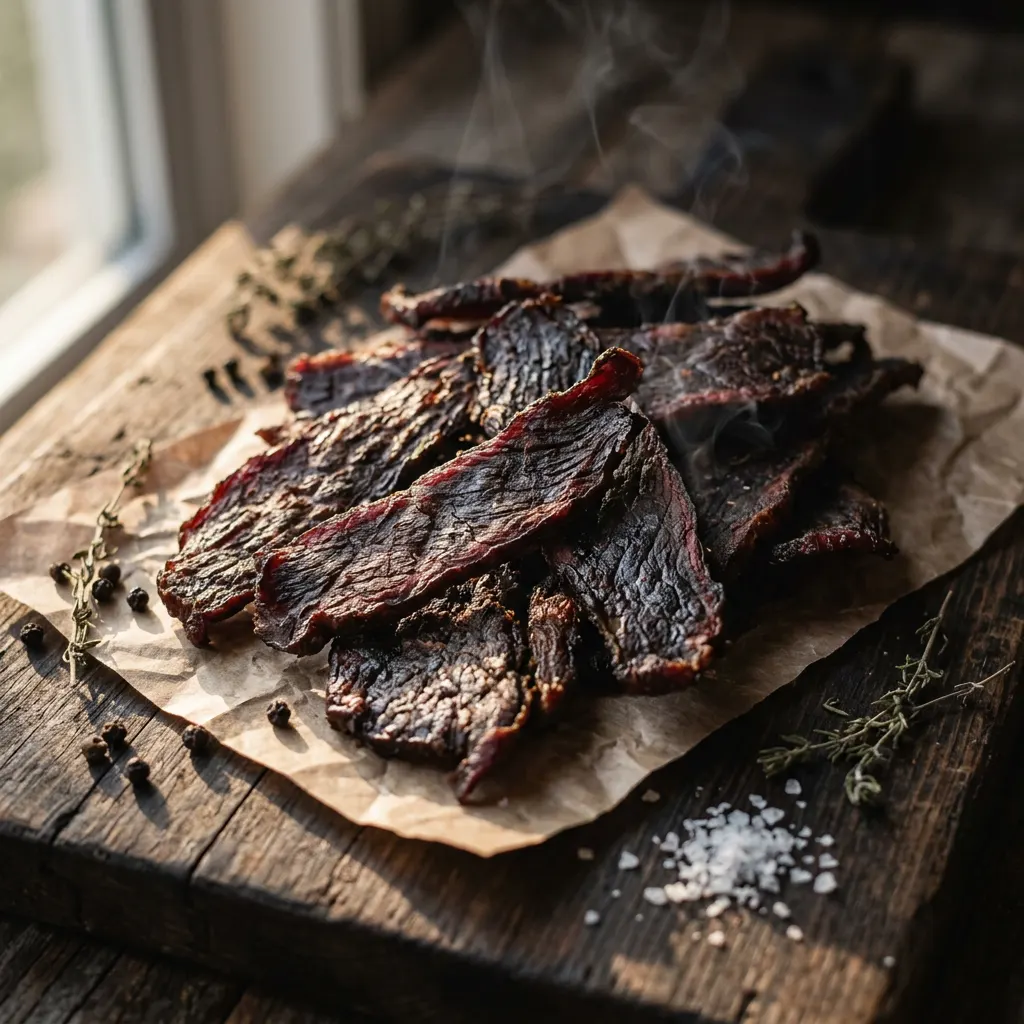
Apple-Smoked Smoked Beef Jerky
Eye-of-round sliced thin, 24hr marinade, 4hr at 180°F.
Cook Mode
One step at a time, big text, timers, and your screen stays awake. 0/22 steps done.
Ingredients
Tap to tick off · 0/25 gathered
Method
- 20 min
Trim any excess fat from the eye of round. Slice the beef against the grain into uniform 1/8 to 1/4 inch thick strips. If the beef is too soft to slice easily, place it in the freezer for 30-60 minutes to firm up.
Why it matters
Consistent thickness ensures even drying, and slicing against the grain makes the jerky more tender and easier to chew.
Common mistake
Slicing with the grain results in tough, stringy jerky that's hard to eat.
- 1h
Partially freeze the eye of round roast for 1-2 hours to make it easier to slice. Slice the beef against the grain into uniform 1/8-inch thick strips.
Why it matters
Uniform thickness ensures even dehydration, preventing some pieces from being too dry while others are still moist.
Common mistake
Slicing with the grain will result in tougher, stringier jerky.
- 30 min
Partially freeze the eye-of-round for about 1-2 hours to make it easier to slice. Using a sharp knife or meat slicer, slice the beef against the grain into 1/8 to 1/4 inch thick strips. Trim any excess fat.
Why it matters
Slicing against the grain breaks up muscle fibers, resulting in more tender jerky. Trimming fat prevents rancidity during storage.
Common mistake
Slicing with the grain, which creates tougher jerky that's harder to chew.
- 30 min
Trim any excess fat from the eye of round roast. For easier slicing, partially freeze the roast for 1-2 hours. Slice the beef against the grain into uniform 1/8 to 1/4 inch thick strips. In a large bowl or resealable bag, combine the soy sauce, Worcestershire sauce, brown sugar, smoked paprika, garlic powder, onion powder, black pepper, and curing salt (if using). Whisk well to dissolve the sugar.
Why it matters
Consistent thickness ensures even drying and a uniform texture in the final jerky. Slicing against the grain makes the jerky more tender and easier to chew.
Common mistake
Slicing with the grain or unevenly, leading to tough or inconsistently cooked jerky.
- 5 min
In a large bowl, whisk together the soy sauce, Worcestershire sauce, brown sugar, black pepper, garlic powder, onion powder, smoked paprika, and red pepper flakes until the sugar is dissolved.
Why it matters
Thoroughly mixing the marinade ensures all flavors are evenly distributed throughout the beef.
Common mistake
Not fully dissolving the sugar can lead to uneven sweetness and flavor in the final product.
- 24h
In a large bowl, whisk together soy sauce, Worcestershire sauce, brown sugar, smoked paprika, garlic powder, onion powder, black pepper, and liquid smoke (if using). If using Cure #1, dissolve it in a tablespoon of warm water before adding to the marinade. Add the sliced beef to the marinade, ensuring all strips are fully coated. Cover the bowl and refrigerate for 24 hours.
Why it matters
The marinade infuses the meat with flavor and helps tenderize it. The long marination time allows the flavors to penetrate deeply. Cure #1 is a critical safety component for curing meats.
Common mistake
Not fully submerging the meat in the marinade, leading to uneven flavor distribution.
- 5 min
In a large bowl, whisk together the soy sauce, Worcestershire sauce, brown sugar, black pepper, garlic powder, onion powder, and smoked paprika. Add liquid smoke if using.
Why it matters
Thoroughly mixing the marinade ensures all flavors are evenly distributed before adding the beef.
Common mistake
Not fully dissolving the brown sugar can lead to inconsistencies in flavor distribution.
- 4h
After marinating, remove the beef strips from the marinade and pat them thoroughly dry with paper towels. Arrange the strips in a single layer on wire racks, making sure they don't touch. Place the racks back in the refrigerator, uncovered, for 2-4 hours, or until the surface of the meat feels tacky.
Why it matters
Forming a pellicle (a sticky, dry surface) helps smoke adhere better to the meat and prevents a 'case hardening' effect, allowing the jerky to dry more evenly.
Common mistake
Skipping the pellicle step, leading to less smoky flavor and unevenly dried jerky.
- 24h
Add the sliced beef to the marinade, ensuring all pieces are fully coated. Cover the bowl and refrigerate for 24 hours.
Why it matters
A full 24-hour marination allows the flavors to deeply penetrate the beef and tenderize it, leading to a richer, more complex jerky.
Common mistake
Shortening the marination time will result in less flavorful jerky.
- 180°F30 min
Preheat your pellet grill or smoker to 180°F (82°C). Load your smoker with mesquite wood pellets or chips. Ensure your smoker has reached and is stable at the target temperature before placing the meat inside.
Why it matters
Maintaining a low, consistent temperature is crucial for dehydrating without cooking the jerky too quickly, preserving its chewiness. Mesquite provides a strong, traditional smoke flavor.
Common mistake
Not preheating properly, causing temperature fluctuations and uneven cooking.
- 2h
Remove the beef strips from the marinade and pat them thoroughly dry with paper towels. Arrange the strips in a single layer on wire racks and allow them to air dry at room temperature for 2-4 hours, or until a tacky膜 (pellicle) forms.
Why it matters
A pellicle is a sticky, glossy surface that helps smoke adhere better to the meat, resulting in a more robust smoky flavor and a better dehydrated texture.
Common mistake
Skipping the pellicle formation can lead to less smoke flavor and a less desirable texture.
- 180°F20 min
While the pellicle is forming, preheat your smoker or pellet grill to a stable 180°F (82°C). Add your chosen wood (Mesquite is recommended for this recipe) to generate clean smoke.
Why it matters
Maintaining a consistent low temperature is crucial for slow dehydration and smoke penetration without cooking the jerky too quickly or unevenly.
Common mistake
Not allowing the smoker to reach a stable temperature before loading the meat, leading to inconsistent cooking.
- 180°F15 min
Preheat your smoker or pellet grill to 180°F (82°C). Add mesquite wood to the smoker for consistent smoke production.
Why it matters
Maintaining a low, stable temperature and consistent smoke is crucial for dehydrating the jerky slowly and infusing it with flavor without cooking it too quickly.
Common mistake
Fluctuating temperatures can lead to uneven cooking and an inconsistent jerky texture.
- 180°F30 min
Preheat your smoker or pellet grill to a stable 180°F (82°C). Add your mesquite wood for smoke. Once the smoker is at temperature, arrange the beef strips directly on the grates or on the cooling racks if using them, ensuring good airflow around each piece.
Why it matters
Achieving a stable low temperature is key for drying the jerky without cooking it too quickly, preserving its texture and flavor.
Common mistake
Fluctuating temperatures can lead to jerky that is either undercooked/under-dried or too brittle.
- 180°F4h
Place the wire racks with the jerky strips directly onto the smoker grates. Smoke for 4 hours, or until the jerky is firm, pliable, and bends without breaking. The internal temperature will slowly rise during this time.
Why it matters
Slow dehydration at a low temperature helps preserve the protein structure, creating the characteristic chewy texture of jerky, while the smoke adds deep flavor.
Common mistake
Overcooking will result in brittle, dry jerky; undercooking will result in jerky that is too soft and can spoil easily.
- 1h
Once the jerky reaches the desired texture, remove it from the smoker. Let it cool completely on a wire rack at room temperature for at least 1 hour. During this time, carryover drying will occur and the texture will firm up slightly.
Why it matters
Cooling allows the jerky to fully set its texture and release any residual moisture, preventing condensation and potential mold growth when stored.
Common mistake
Packaging jerky while still warm, which can trap moisture and lead to spoilage.
- 180°F4h
Maintain a smoker temperature of 180°F. Smoke the beef jerky for approximately 3.5 to 4 hours, or until it reaches your desired dryness and texture. The jerky should be firm, able to bend without breaking, and show no signs of moisture in the center when torn.
Why it matters
The low and slow smoking process dehydrates the meat while infusing it with deep smoky flavor and maintaining a safe internal temperature.
Common mistake
Overcooking leads to brittle, crumbly jerky; undercooking leaves it too moist and prone to spoilage.
- 12h
Once the jerky has reached the desired texture, remove it from the smoker and let it cool completely at room temperature, spread out on a cooling rack. After cooling, place the jerky in an airtight container for 12-24 hours to 'condition'. This allows any residual moisture to equalize throughout the batch, preventing overly dry or overly moist spots.
Why it matters
Conditioning improves the overall texture and consistency of the jerky, making it more enjoyable to eat and helping with preservation.
Common mistake
Skipping conditioning can result in some pieces being too dry while others are still a bit moist, impacting shelf life and quality.
- 1h
Once the jerky reaches the desired texture, remove it from the smoker and let it cool completely at room temperature. Store in an airtight container for up to 2 weeks, or freeze for longer storage.
Why it matters
Proper cooling helps the jerky firm up and prevents condensation in storage, which can lead to mold.
Common mistake
Storing warm jerky will create condensation, potentially causing mold growth.
Store the finished jerky in an airtight container or resealable bag at room temperature for up to 1-2 weeks. For longer storage, refrigerate for up to 1 month or freeze for several months.
Why it matters
Proper storage ensures the longevity and safety of your homemade jerky, protecting it from moisture and contaminants.
Common mistake
Improper storage, such as in a non-airtight container, which dramatically reduces shelf life.
Store the cooled jerky in an airtight container or sealable bags. For best results and longer shelf life, you can vacuum seal it. Properly stored, homemade jerky can last for several weeks to months.
Why it matters
Proper storage is essential to maintain the quality, moisture content, and safety of your homemade jerky.
Common mistake
Storing jerky in a non-airtight container, which exposes it to oxygen and moisture, reducing its shelf life.
Your delicious mesquite smoked beef jerky is ready to serve! Store any leftovers in an airtight container at room temperature for up to 2-3 weeks, or refrigerate for longer storage.
Why it matters
Proper storage ensures the jerky maintains its quality and prevents spoilage, allowing you to enjoy your hard work longer.
Common mistake
Storing jerky improperly (e.g., in a non-airtight container) can lead to it going stale or molding quickly.
Sauce It
Cooks & Reviews
Guild members can rate this recipe, log their cooks and share photos.
Sign in to continueMember reviews
No reviews yet — be the first to rate this cook.
Ask the Pitmaster about this recipe
Substitutions, scaling, technique, troubleshooting — get answers grounded in this cook.
Sign in to try the AI Pitmaster on Apple-Smoked Smoked Beef Jerky. New members get 3 free questions.
Sign in to tryComments(0)
Loading comments…