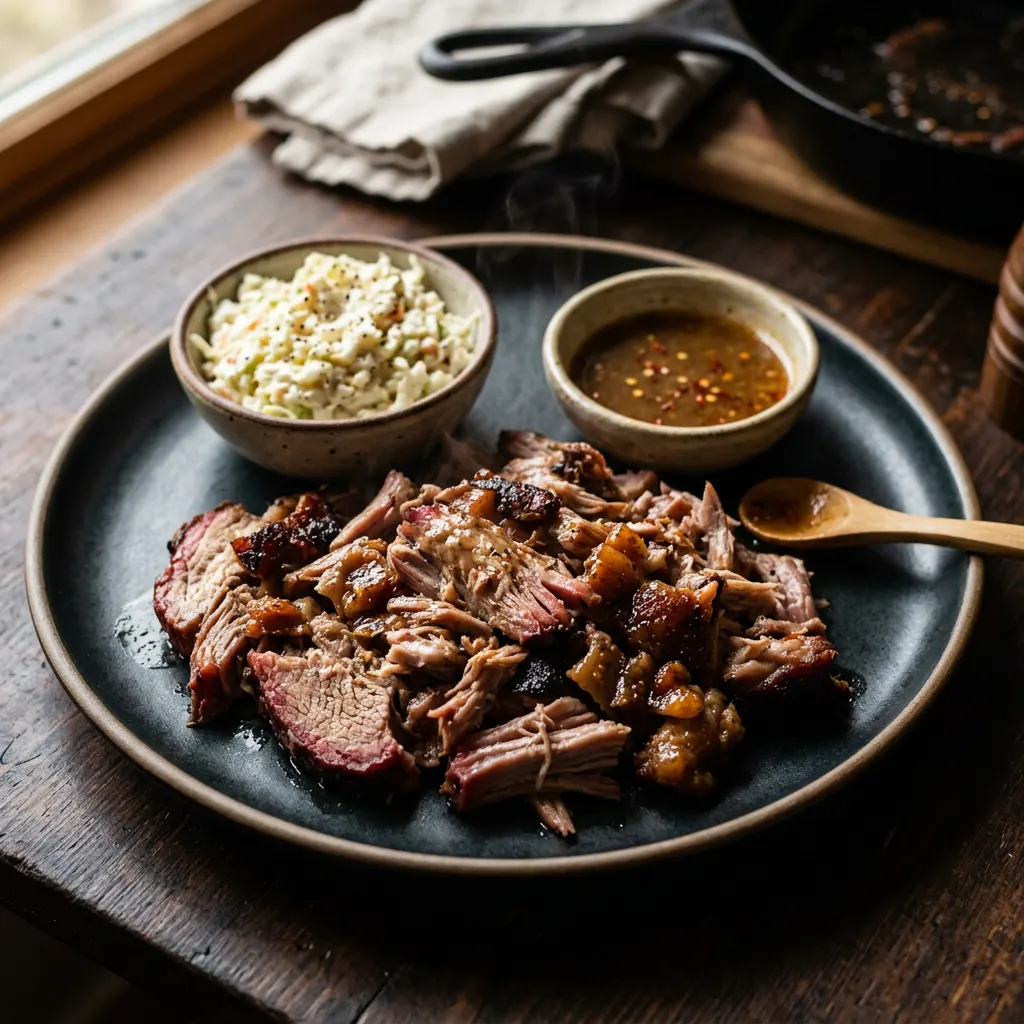
Apple-Smoked Whole Hog Eastern Carolina Style
24-hour pit-cooked whole hog with vinegar pepper mop.
Cook Mode
One step at a time, big text, timers, and your screen stays awake. 0/7 steps done.
Ingredients
Tap to tick off · 0/10 gathered
Method
- 1h
Rinse the hog thoroughly inside and out with cold water. Pat dry completely. Prepare the Eastern Carolina mop: In a large container, combine 2 gallons of apple cider vinegar, 1 gallon of white vinegar, 2 cups brown sugar, 1 cup kosher salt, 1/2 cup red pepper flakes, 1/4 cup black pepper, and 1/4 cup garlic powder. Stir until salt and sugar are dissolved. Inject the hog's hams, shoulders, and loin with 1-2 gallons of the prepared mop, focusing on meaty areas. Apply a light layer of mop over the entire internal surface of the hog.
Why it matters
The vinegar-based mop not only adds deep flavor and moisture but also begins the tenderizing process and helps develop a dark, crispy skin and bark during the long cook.
Common mistake
Not injecting enough or unevenly, leading to dry spots. Ensure the mop is well-mixed to prevent salt/sugar settling.
- 235°F45 min
Prepare your smoker or pellet grill for a long cook. Fill the hopper with a 50/50 blend of Hickory and Apple pellets/wood chunks. Set the smoker temperature to 235°F. Ensure water pans are full if your smoker uses them. Allow the smoker to preheat and stabilize at the target temperature for at least 30-45 minutes.
Why it matters
Stable temperatures are crucial for consistent cooking and bark development over an extended period. The combination of woods provides a balanced, complex smoke flavor.
Common mistake
Rushing the preheat or not managing fuel, leading to temperature swings that can toughen meat or create an acrid smoke.
- 235°F8h
Carefully place the prepared whole hog, skin-side up, onto the smoker grates. Insert a probe into the thickest part of the ham and another into the shoulder, avoiding bone. Close the smoker and begin the cook. For the first 6-8 hours, maintain the smoker temperature at 235°F. Do not open the lid frequently. Start applying the mop every 2 hours after the initial 3 hours of smoke, using a clean mop brush.
Why it matters
This initial phase is where the smoke flavor penetrates deepest into the meat, and the bark begins to form. Consistent, low heat breaks down connective tissues slowly.
Common mistake
Opening the lid too often, which causes temperature drops and prolongs the cook, hindering consistent bark development.
- 235°F10h
After 8 hours, the hog's internal temperature will likely hit 'the stall' (around 150-165°F). Continue maintaining 235°F smoker temperature. Increase mop application to every 1-1.5 hours. Continue cooking until the hams reach an internal temperature of 170-175°F and shoulders reach 165-170°F. This phase can take an additional 6-10 hours depending on the hog size and smoker consistency.
Why it matters
The stall is when moisture evaporating from the surface cools the meat. Powering through it with consistent heat and continued mopping is key to developing a deep bark and tenderizing the meat.
Common mistake
Panicking during the stall and wrapping the hog too early, which can soften the bark and prevent further smoke penetration.
- 250°F5h
Once the ham reaches 170-175°F and shoulder reaches 165-170°F, you can optionally increase the smoker temperature to 250°F to push through to the final desired tenderness. Continue cooking and mopping every 1-1.5 hours until the internal temperature of the hams reaches 195-205°F and the shoulder reaches 200-205°F. Crucially, the meat should feel 'probe tender' – the probe should slide in with little to no resistance.
Why it matters
Reaching these higher temperatures and probe tenderness ensures all connective tissues have broken down, resulting in incredibly succulent and pull-apart meat.
Common mistake
Cooking to a specific temperature without checking for tenderness, which can result in tough meat if cooked too low or dry meat if pushed too high without sufficient collagen breakdown.
- 4h
Once probe tender, carefully remove the hog from the smoker. Place it on a large, clean surface or in a large foil pan. Cover the entire hog loosely with foil, then wrap tightly in several layers of peach paper or butcher paper, followed by blankets or towels. Place the wrapped hog into a clean cooler or warming box. Allow it to rest for at least 3-4 hours, or up to 6 hours.
Why it matters
Resting allows the muscle fibers to relax and reabsorb juices, resulting in a significantly more tender and moist product. This is non-negotiable for competition-level results.
Common mistake
Skipping or shortening the rest, which allows all the delicious juices to escape when carving, leading to dry meat.
- 1h
Carefully unwrap the rested hog. The skin should be crispy, and the meat should literally fall off the bone. Separate the hams, shoulders, and loins. Coarsely chop all the meat, including some of the crispy skin (if desired). As you chop, ladle the remaining mop over the meat, incorporating it thoroughly. Serve immediately.
Why it matters
Chopping allows for a mix of textures and flavors. Integrating the mop at this stage ensures every bite is tangy, moist, and perfectly seasoned, embodying true Eastern Carolina style.
Common mistake
Shredding the meat instead of chopping, which can make it stringy. Not adding enough mop when chopping, resulting in a bland product.
5 more steps locked
You've seen the ingredients and the first two steps. Pit Members get every step, every temp, every glaze — plus the Cook Monitor and Pitmaster AI.
See Membership OptionsAlready a member? Sign in.
Sauce It
Cooks & Reviews
Guild members can rate this recipe, log their cooks and share photos.
Sign in to continueMember reviews
No reviews yet — be the first to rate this cook.
Ask the Pitmaster about this recipe
Substitutions, scaling, technique, troubleshooting — get answers grounded in this cook.
Sign in to try the AI Pitmaster on Apple-Smoked Whole Hog Eastern Carolina Style. New members get 3 free questions.
Sign in to tryComments(0)
Loading comments…