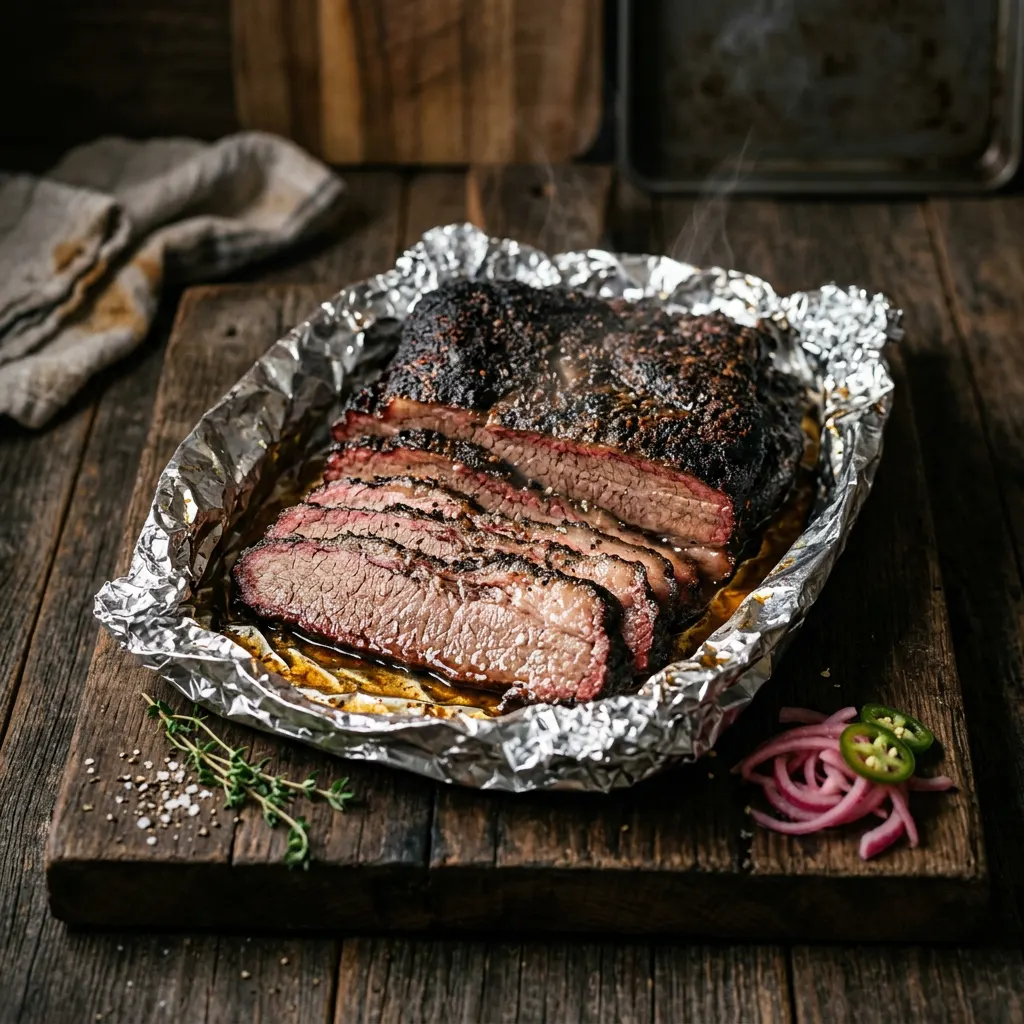
Apple-Smoked Foil-Boat Brisket
Naked bark for 6 hours, then unwrapped foil boat to finish.
Cook Mode
One step at a time, big text, timers, and your screen stays awake. 0/7 steps done.
Ingredients
Tap to tick off · 0/10 gathered
Method
- 30 min
Trim the hard fat off the bottom of the flat to about 1/4 inch thickness. Remove any silver skin and hard fat from the point. Shape the brisket for even cooking. Create a 50/50 blend of kosher salt and coarse black pepper, then add garlic and onion powder to create your rub. Apply the rub liberally to all surfaces of the brisket.
Why it matters
Proper trimming ensures even cooking, allows smoke and rub penetration, and prevents overly fatty or dry sections. The rub forms the foundation of your bark.
Common mistake
Leaving too much hard fat, which won't render and will be unpalatable, or trimming too much fat, leading to a dry brisket.
- 250°F30 min
Set your smoker or pellet grill to 250°F. Ensure you have a clean burn with your chosen wood (Post Oak for this recipe). Add a water pan to the smoker if it has the feature; this helps maintain humidity.
Why it matters
Achieving a stable smoker temperature before putting the meat on is crucial for consistent cooking and a good smoke ring. A water pan helps prevent the surface from drying out too quickly.
Common mistake
Adding the brisket before the smoker reaches a stable temperature, leading to inconsistent smoke flavor and cook times.
- 250°F6h
Place the trimmed and seasoned brisket fat-side up on the smoker grates. Close the lid and resist the urge to peek. Maintain the smoker temperature at 250°F. Begin spritzing every 60-90 minutes with a 50/50 mix of water and apple cider vinegar once the bark begins to set, usually after 3-4 hours.
Why it matters
This phase is critical for developing the deep smoke flavor and forming the legendary 'bark'. Spritzing helps keep the surface moist for better smoke adhesion and prevents it from drying out.
Common mistake
Opening the smoker too frequently, which causes temperature fluctuations and extends cooking time, or not spritzing, leading to a dry, brittle bark.
- 250°F15 min
Once the brisket has been smoking for approximately 6 hours, or when the internal temperature reaches 165-175°F and the bark is well-established, it's time for the foil boat. Take two large sheets of heavy-duty aluminum foil and overlap them. Place the brisket, fat side down, onto the foil. Form a 'boat' around the brisket, leaving the top exposed. Pour 1/2 cup of water (or beef broth) into the boat. Add a few pats of beef tallow on top of the brisket if desired.
Why it matters
The foil boat allows the top of the brisket to continue absorbing smoke and developing bark, while the liquid and foil around the sides and bottom tenderize the meat and prevent drying, giving you juicy results.
Common mistake
Wrapping completely in foil (the 'Texas Crutch') which softens the bark too much, or not adding liquid to the boat, which can still lead to a dry bottom.
- 250°F4h
Return the foil-boated brisket to the smoker, fat side up. Continue cooking at 250°F, monitoring the internal temperature with a probe inserted into the thickest part of the flat. Cook until the brisket reaches an internal temperature of 200-205°F and feels 'probe tender', like warm butter, when probed in multiple spots.
Why it matters
Cooking to probe tenderness, rather than just a target temperature, ensures the collagen has rendered properly, resulting in a buttery, tender texture. The foil boat continues to baste the meat in its own juices.
Common mistake
Pulling the brisket solely based on temperature without checking for probe tenderness, leading to tough, undercooked meat.
- 3h
Once probe tender, remove the foil-boated brisket from the smoker. Tightly wrap the entire foil boat in another layer of foil. Place the wrapped brisket in an insulated cooler (without ice) or a warming oven set to 150-160°F. Allow it to rest for a minimum of 2-4 hours, or even longer if possible.
Why it matters
Resting is crucial for allowing the meat's juices to redistribute throughout the brisket, resulting in a more moist and flavorful final product. It also allows carry-over cooking to tenderize the meat further.
Common mistake
Slicing the brisket immediately after removing it from the smoker, which causes all the precious juices to run out, resulting in dry meat.
- 15 min
After the rest, remove the brisket from the foil. Separate the flat from the point. Slice the flat against the grain into pencil-thick slices. For the point, cube it for burnt ends or slice it against its grain. Serve immediately and enjoy your championship brisket!
Why it matters
Slicing against the grain shortens the muscle fibers, making each bite more tender and enjoyable. The different grain directions of the flat and point necessitate separate slicing techniques.
Common mistake
Slicing with the grain, which results in tough, chewy slices even from a perfectly cooked brisket.
Sauce It
Cooks & Reviews
Guild members can rate this recipe, log their cooks and share photos.
Sign in to continueMember reviews
No reviews yet — be the first to rate this cook.
Ask the Pitmaster about this recipe
Substitutions, scaling, technique, troubleshooting — get answers grounded in this cook.
Sign in to try the AI Pitmaster on Apple-Smoked Foil-Boat Brisket. New members get 3 free questions.
Sign in to tryComments(0)
Loading comments…