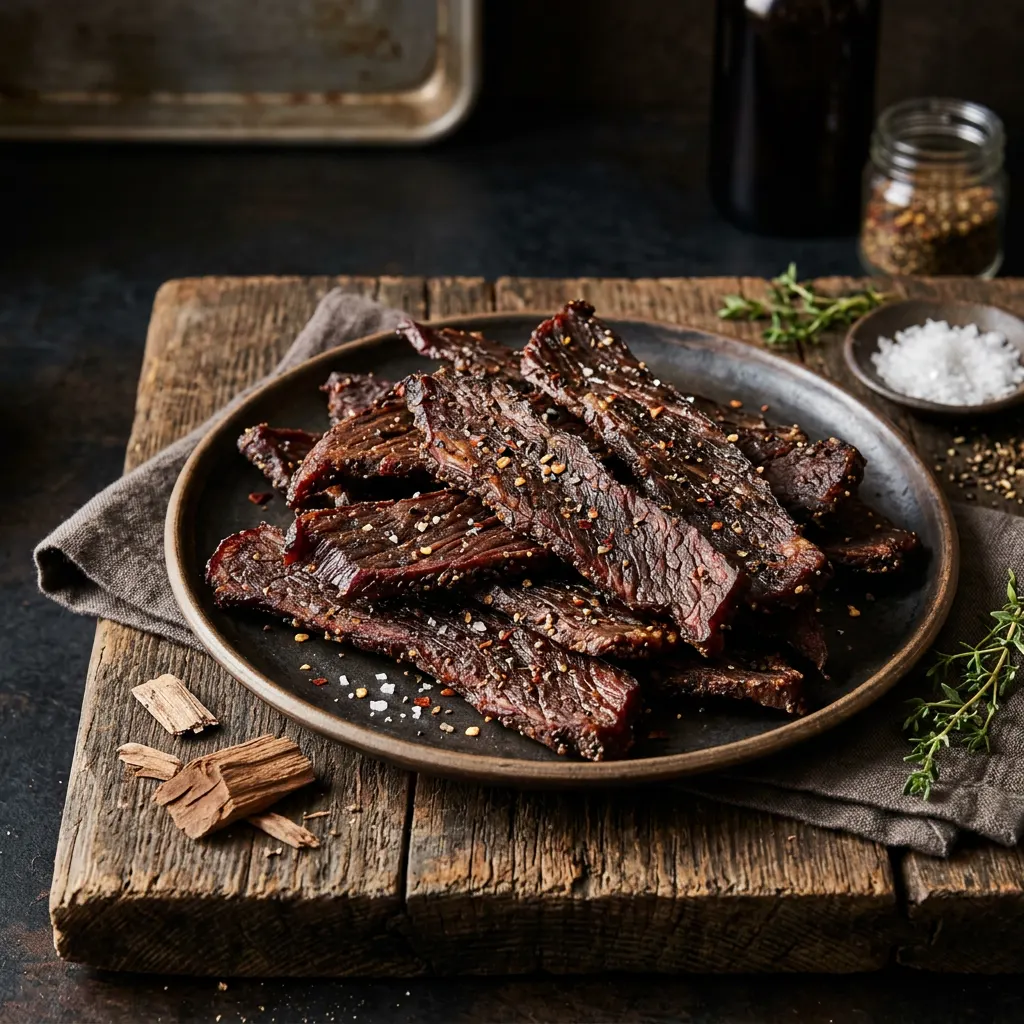
Pecan-Smoked Smoked Beef Jerky with Butcher Paper Wrap
Eye-of-round sliced thin, 24hr marinade, 4hr at 180°F.
Cook Mode
One step at a time, big text, timers, and your screen stays awake. 0/9 steps done.
Ingredients
Tap to tick off · 0/10 gathered
Method
- 1h 30m
Partially freeze the eye-of-round for 1-2 hours; this makes slicing much easier. Using a sharp knife, slice the beef against the grain into uniform strips, about 1/8 to 1/4 inch thick. Trim off any remaining fat or silver skin. Fat can go rancid and silver skin makes jerky tough.
Why it matters
Consistent thickness ensures even drying, and removing fat prevents spoilage and improves texture.
Common mistake
Slicing with the grain results in very tough, stringy jerky. Not trimming fat reduces shelf life.
- 5 min
In a large non-reactive bowl or resealable bag, combine soy sauce, Worcestershire sauce, brown sugar, garlic powder, black pepper, smoked paprika, red pepper flakes, and Prague Powder #1. Whisk until sugar and curing salt are fully dissolved.
Why it matters
Thoroughly dissolving the cure ensures it distributes evenly, providing consistent protection and flavor.
Common mistake
Not fully dissolving the curing salt can lead to uneven curing and potentially unsafe product.
- 24h
Add the sliced beef to the marinade, ensuring all strips are fully coated. Massage the marinade into the beef. Seal the bag or cover the bowl and refrigerate for a minimum of 24 hours, up to 48 hours. Flip or stir occasionally to ensure even penetration.
Why it matters
The long marination time allows the cure, salt, and flavors to penetrate deep into the meat, tenderizing it slightly and providing food safety protection.
Common mistake
Shortening the marination time can result in less flavorful and less safely cured jerky.
- 1h 30m
After marinating, remove the beef strips from the liquid. Pat them thoroughly dry with paper towels. Arrange the strips in a single layer on wire racks, ensuring no pieces are overlapping. Allow them to air dry at room temperature for 1-2 hours until a tacky, shiny pellicle forms on the surface.
Why it matters
A dry surface (pellicle) helps smoke adhere better, creates a more even color, and prevents the jerky from becoming 'case hardened' (dry on the outside, moist inside).
Common mistake
Skipping the drying step leads to uneven smoke penetration and a less desirable texture.
- 180°F30 min
Preheat your smoker or pellet grill to a stable 180°F (82°C). Load your smoker with mesquite wood chunks or pellets for a robust smoky flavor. Ensure the water pan (if applicable) is full to maintain humidity.
Why it matters
Consistent low temperature and good smoke are critical for slow dehydration and infusing flavor without cooking the meat too quickly.
Common mistake
Fluctuating temperatures or too high a heat will cook the meat rather than dehydrate it.
- 180°F4h
Place the wire racks with the beef strips into the preheated smoker. Maintain the smoker temperature at 180°F. The jerky needs to dehydrate slowly. Monitor the texture of the jerky, it should be flexible but not break when bent.
Why it matters
The low and slow smoke allows for gradual moisture reduction, flavor absorption, and achieves the desired chewy texture while safely raising the internal temperature.
Common mistake
Overcooking leads to brittle jerky; undercooking leaves it too moist and unsafe for long-term storage.
After 3-4 hours, begin checking the jerky for doneness. A properly dried piece of jerky should bend without breaking and show white fibers when torn, but not be crumbly. The texture should be chewy and dry, but not brittle.
Why it matters
Properly dried jerky is crucial for both texture and food safety; it must have enough moisture removed to inhibit bacterial growth.
Common mistake
Removing jerky too early will leave it too moist, leading to potential spoilage; leaving it too long will result in an unpleasantly hard, brittle texture.
- 2h
Once the jerky reaches your desired consistency, remove it from the smoker. Allow it to cool completely at room temperature, arranging pieces loosely on a rack for better airflow. Once cool, transfer the jerky to an airtight container or a large resealable bag. Leave the container slightly ajar for the first few hours (or 'burp' the bag every few hours) to allow any residual moisture to escape. This is called 'conditioning' and helps equalize moisture levels.
Why it matters
Conditioning prevents moisture pockets from forming, which can lead to mold, and helps ensure a uniform texture across all pieces.
Common mistake
Sealing hot jerky immediately can trap moisture, promoting mold growth.
Your delicious homemade smoked beef jerky is ready to enjoy! Store it in an airtight container at room temperature for up to 2 weeks, or in the refrigerator for up to 1 month. For longer storage, freeze it for several months.
Why it matters
Proper storage maintains freshness and prevents spoilage, especially since this jerky contains curing salt for enhanced safety.
Common mistake
Improper storage (e.g., in a non-airtight container) will quickly lead to stale or moldy jerky.
Sauce It
Cooks & Reviews
Guild members can rate this recipe, log their cooks and share photos.
Sign in to continueMember reviews
No reviews yet — be the first to rate this cook.
Ask the Pitmaster about this recipe
Substitutions, scaling, technique, troubleshooting — get answers grounded in this cook.
Sign in to try the AI Pitmaster on Pecan-Smoked Smoked Beef Jerky with Butcher Paper Wrap. New members get 3 free questions.
Sign in to tryComments(0)
Loading comments…