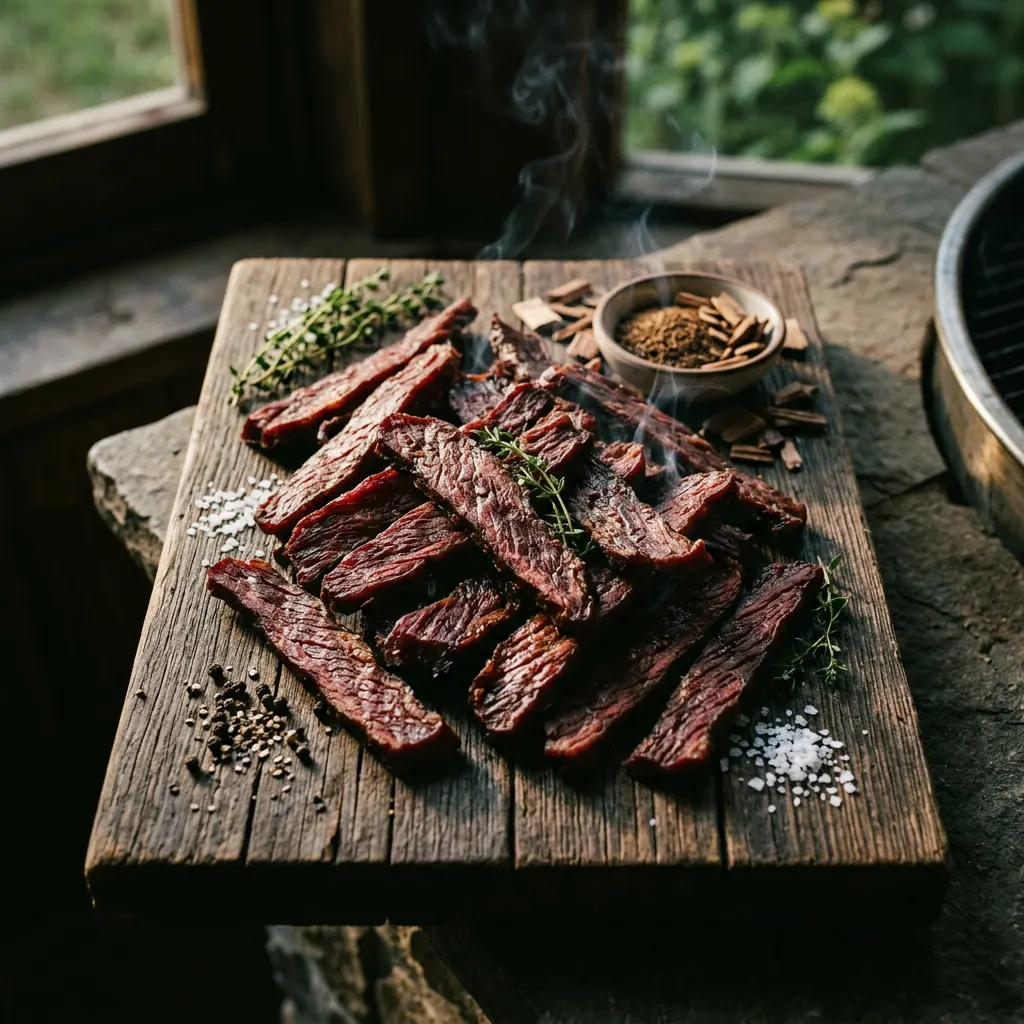
Honey-Glazed Smoked Beef Jerky
Eye-of-round sliced thin, 24hr marinade, 4hr at 180°F.
Cook Mode
One step at a time, big text, timers, and your screen stays awake. 0/33 steps done.
Ingredients
Tap to tick off · 0/29 gathered
Method
- 1h
Partially freeze the eye of round roast for 30-60 minutes to make it easier to slice. Using a sharp knife, slice the beef against the grain into uniform 1/8 to 1/4 inch thick strips. Trim any remaining visible fat or silver skin from the slices.
Why it matters
Consistent slice thickness ensures even drying and texture. Trimming fat prevents rancidity and improves chewiness.
Common mistake
Slicing with the grain results in tough, stringy jerky. Thick slices won't dry properly.
- 30 min
Partially freeze the eye-of-round for about 1-2 hours to make it easier to slice. Using a sharp knife or meat slicer, slice the beef against the grain into 1/8 to 1/4 inch thick strips. Trim any excess fat.
Why it matters
Slicing against the grain breaks up muscle fibers, resulting in more tender jerky. Trimming fat prevents rancidity during storage.
Common mistake
Slicing with the grain, which creates tougher jerky that's harder to chew.
- 5 min
In a large bowl, whisk together the soy sauce, Worcestershire sauce, brown sugar, garlic powder, onion powder, black pepper, smoked paprika, liquid smoke (if using), and red pepper flakes (if using).
Why it matters
Thoroughly mixing the marinade ensures all flavors are evenly distributed before adding the beef.
Common mistake
Not fully dissolving the sugar or powders, leading to uneven flavor concentration on the meat.
- 1h
Partially freeze the eye of round roast for 1-2 hours to make it easier to slice. Slice the beef against the grain into uniform 1/8-inch thick strips.
Why it matters
Uniform thickness ensures even dehydration, preventing some pieces from being too dry while others are still moist.
Common mistake
Slicing with the grain will result in tougher, stringier jerky.
- 24h
Add the sliced beef to the marinade, ensuring all pieces are fully submerged and coated. Cover the bowl and refrigerate for a minimum of 12 hours, preferably 24 hours.
Why it matters
Extended marination allows the flavors to penetrate deep into the meat, tenderizing it and infusing it with seasoning.
Common mistake
Shortening the marination time results in bland, less flavorful jerky that lacks depth.
- 30 min
Trim any excess fat from the eye of round roast. For easier slicing, partially freeze the roast for 1-2 hours. Slice the beef against the grain into uniform 1/8 to 1/4 inch thick strips. In a large bowl or resealable bag, combine the soy sauce, Worcestershire sauce, brown sugar, smoked paprika, garlic powder, onion powder, black pepper, and curing salt (if using). Whisk well to dissolve the sugar.
Why it matters
Consistent thickness ensures even drying and a uniform texture in the final jerky. Slicing against the grain makes the jerky more tender and easier to chew.
Common mistake
Slicing with the grain or unevenly, leading to tough or inconsistently cooked jerky.
- 4h
After marinating, remove the beef strips from the marinade, discarding any excess liquid. Pat each strip thoroughly dry with paper towels. Arrange the strips in a single layer on wire racks and allow them to air dry at room temperature for 2-4 hours, or until a tacky, non-wet surface (pellicle) forms.
Why it matters
A dry surface (pellicle) is crucial for smoke adherence, resulting in better flavor and color, and allowing for efficient dehydration.
Common mistake
Skipping the drying step or not drying enough; wet meat steams rather than smokes and won't develop a good crust or smoke ring.
- 180°F30 min
Preheat your pellet grill or smoker to a consistent 180°F (82°C). Ensure your smoker has enough Mesquite wood pellets or chunks to maintain smoke for at least 4 hours.
Why it matters
Maintaining a low, stable temperature and consistent smoke is key for slow dehydration and infusing deep smoky flavor without cooking the jerky too fast.
Common mistake
Fluctuating temperatures lead to uneven cooking and can dry out the jerky too quickly, making it brittle.
- 5 min
In a medium bowl, whisk together the soy sauce, Worcestershire sauce, brown sugar, garlic powder, onion powder, black pepper, smoked paprika, and red pepper flakes (if using) until the sugar is dissolved.
Why it matters
A well-balanced marinade adds flavor, helps tenderize the meat, and contributes to the preservation process.
Common mistake
Not fully dissolving the sugar can lead to uneven flavor distribution on the meat.
- 180°F4h
Arrange the dried beef strips on the smoker grates, ensuring there is space between each piece for airflow. Smoke the jerky at 180°F, flipping the strips every hour or so, for approximately 3.5 to 4 hours, or until the jerky is dry and pliable but still bends without breaking.
Why it matters
Low and slow smoking dehydrates the meat, kills potential pathogens, and infuses it with the characteristic smoky flavor. Flipping ensures even drying.
Common mistake
Overcooking leads to brittle, crispy jerky. Under-drying leaves too much moisture, potentially leading to spoilage.
- 5 min
In a large bowl, whisk together the soy sauce, Worcestershire sauce, brown sugar, black pepper, garlic powder, onion powder, and smoked paprika. Add liquid smoke if using.
Why it matters
Thoroughly mixing the marinade ensures all flavors are evenly distributed before adding the beef.
Common mistake
Not fully dissolving the brown sugar can lead to inconsistencies in flavor distribution.
- 30 min
To check for doneness, cool a piece of jerky to room temperature. It should bend and crack but not break cleanly in half. It should be tough and chewy. Once done, remove the jerky from the smoker and place it on a wire rack to cool completely.
Why it matters
Cooling a test piece allows you to accurately assess the final texture, as jerky will stiffen as it cools. Cooling completely prevents condensation and maintains texture.
Common mistake
Judging doneness while the jerky is hot, as it feels softer and more pliable when warm.
- 5 min
In a large non-reactive bowl, whisk together the soy sauce, Worcestershire sauce, brown sugar, garlic powder, onion powder, black pepper, smoked paprika, and curing salt. Ensure the curing salt is fully dissolved.
Why it matters
A well-mixed marinade ensures even flavor distribution. Curing salt is critical for inhibiting bacterial growth (especially botulism) and preserving the meat during the long, low-temperature drying process.
Common mistake
Not fully dissolving the cure can lead to uneven curing or overly salty spots. Forgetting curing salt altogether is a significant food safety risk for low-temp smoking.
Once fully cooled, store the smoked beef jerky in an airtight container or a resealable bag at room temperature for up to two weeks, or refrigerate for longer storage.
Why it matters
Proper storage is essential to maintain freshness and prevent spoilage. Airtight containers protect against moisture and air exposure.
Common mistake
Storing warm jerky, which can lead to condensation and mold growth, or in a non-airtight container, which dries it out prematurely.
- 24h
In a large bowl, whisk together soy sauce, Worcestershire sauce, brown sugar, smoked paprika, garlic powder, onion powder, black pepper, and liquid smoke (if using). If using Cure #1, dissolve it in a tablespoon of warm water before adding to the marinade. Add the sliced beef to the marinade, ensuring all strips are fully coated. Cover the bowl and refrigerate for 24 hours.
Why it matters
The marinade infuses the meat with flavor and helps tenderize it. The long marination time allows the flavors to penetrate deeply. Cure #1 is a critical safety component for curing meats.
Common mistake
Not fully submerging the meat in the marinade, leading to uneven flavor distribution.
- 24h
Refrigerate the beef in the marinade for a minimum of 24 hours, or up to 48 hours. Occasionally agitate the bag or stir the bowl to ensure even distribution of the marinade.
Why it matters
This extended marination time allows flavors to penetrate thoroughly and begins the curing process, helping to preserve the meat.
Common mistake
Shortening the marination time results in less flavorful jerky. Over-marinating (beyond 48 hours) can make the jerky too salty or develop an undesirable texture.
- 4h
After marinating, remove the beef strips from the marinade and pat them thoroughly dry with paper towels. Arrange the strips in a single layer on wire racks, making sure they don't touch. Place the racks back in the refrigerator, uncovered, for 2-4 hours, or until the surface of the meat feels tacky.
Why it matters
Forming a pellicle (a sticky, dry surface) helps smoke adhere better to the meat and prevents a 'case hardening' effect, allowing the jerky to dry more evenly.
Common mistake
Skipping the pellicle step, leading to less smoky flavor and unevenly dried jerky.
- 180°F20 min
While the pellicle is forming, preheat your smoker or pellet grill to a stable 180°F (82°C). Add your chosen wood (Mesquite is recommended for this recipe) to generate clean smoke.
Why it matters
Maintaining a consistent low temperature is crucial for slow dehydration and smoke penetration without cooking the jerky too quickly or unevenly.
Common mistake
Not allowing the smoker to reach a stable temperature before loading the meat, leading to inconsistent cooking.
- 3h
Remove the beef from the marinade and pat each strip thoroughly dry with paper towels. Arrange the strips in a single layer on wire racks, ensuring no pieces are overlapping. Allow the strips to air dry at room temperature for 2-4 hours, or until a shiny, tacky 'pellicle' forms on the surface.
Why it matters
A dry surface (pellicle) helps smoke adhere better and promotes more even and efficient dehydration, preventing a leathery exterior with a moist interior.
Common mistake
Skipping the drying step leads to uneven smoke penetration and a longer drying time in the smoker.
- 2h
Remove the beef from the marinade. Pat each strip thoroughly dry with paper towels. Arrange the strips on wire racks, ensuring there is no overlap. The racks should fit into your smoker. This drying process is critical for forming a pellicle.
Why it matters
A dry surface (pellicle) helps smoke adhere better to the meat and promotes even drying, leading to that characteristic jerky chew and flavor.
Common mistake
Skipping the drying step leads to a 'steamy' smoke that doesn't penetrate well and a less desirable texture.
- 180°F30 min
Preheat your pellet grill or smoker to 180°F (82°C). Load your smoker with mesquite wood pellets or chips. Ensure your smoker has reached and is stable at the target temperature before placing the meat inside.
Why it matters
Maintaining a low, consistent temperature is crucial for dehydrating without cooking the jerky too quickly, preserving its chewiness. Mesquite provides a strong, traditional smoke flavor.
Common mistake
Not preheating properly, causing temperature fluctuations and uneven cooking.
- 180°F20 min
Preheat your pellet grill or smoker to a stable 180°F (82°C). Ensure your water pan (if applicable) is filled and add your mesquite wood for smoke generation. Arrange the dried beef strips on the smoker grates in a single layer, ensuring good airflow around each piece.
Why it matters
A consistent, low temperature is vital for dehydrating the jerky without cooking it too quickly. Mesquite wood provides a strong, traditional smoky flavor that complements beef jerky perfectly.
Common mistake
Fluctuating temperatures can lead to unevenly dried jerky or 'cooking' the jerky instead of dehydrating it.
- 180°F20 min
Preheat your smoker or pellet grill to 180°F (82°C). Load your smoker with mesquite wood pellets or chunks. Consistency in temperature is key for even dehydration.
Why it matters
A low, consistent temperature gently dehydrates the meat without cooking it too fast, preserving its texture and preventing it from becoming brittle.
Common mistake
Too high a temperature will cook the meat instead of dehydrating it, resulting in a crispy, overcooked texture rather than chewy jerky.
- 180°F4h
Smoke the beef strips at 180°F. The target internal temperature is not relevant here as we are dehydrating. Continue smoking for 3 to 5 hours, or until the jerky is dry but still pliable. It should crack when bent but not break, and there should be no moisture visible when torn. Rotate racks halfway through if your smoker has hot spots.
Why it matters
The slow, low heat combined with smoke gradually removes moisture, creating the characteristic chewy texture and infusing it with deep smoky flavor while remaining food-safe. The 'bend test' is the best indicator of doneness for jerky.
Common mistake
Over-drying results in brittle, hard-to-chew jerky. Under-drying leaves too much moisture, which can lead to spoilage.
- 1h
Once the jerky reaches the desired texture, remove it from the smoker. Let it cool completely on a wire rack at room temperature for at least 1 hour. During this time, carryover drying will occur and the texture will firm up slightly.
Why it matters
Cooling allows the jerky to fully set its texture and release any residual moisture, preventing condensation and potential mold growth when stored.
Common mistake
Packaging jerky while still warm, which can trap moisture and lead to spoilage.
Store the cooled jerky in an airtight container or sealable bags. For best results and longer shelf life, you can vacuum seal it. Properly stored, homemade jerky can last for several weeks to months.
Why it matters
Proper storage is essential to maintain the quality, moisture content, and safety of your homemade jerky.
Common mistake
Storing jerky in a non-airtight container, which exposes it to oxygen and moisture, reducing its shelf life.
- 1h
Once the jerky reaches the desired texture, remove it from the smoker. Place the jerky on a wire rack to cool completely at room temperature for at least 1 hour.
Why it matters
Cooling allows the internal temperature to equalize and the jerky to fully set its texture. Some residual moisture may still dissipate during this phase.
Common mistake
Packaging warm jerky can trap moisture and promote mold growth.
- 1h
Once the jerky reaches the desired consistency, remove it from the smoker. Let it cool completely at room temperature on the wire racks before storing. This allows any residual moisture to equalize and prevents condensation in storage.
Why it matters
Cooling fully prevents moisture buildup when stored, which could lead to mold. It also allows the texture to set properly.
Common mistake
Storing jerky while still warm traps moisture, significantly reducing its shelf life.
- 1h
Once the jerky reaches the desired texture, remove it from the smoker. Let it cool completely at room temperature for at least 1 hour before storing. Store in an airtight container or resealable bag in a cool, dry place. For longer storage, refrigerate or freeze.
Why it matters
Cooling allows the jerky to fully set and for any residual moisture to equalize, preventing condensation inside the storage container, which could lead to spoilage.
Common mistake
Storing warm jerky can create moisture, promoting mold growth and reducing shelf life.
- 1h
Once the jerky reaches the desired texture, remove it from the smoker and let it cool completely at room temperature. Store in an airtight container for up to 2 weeks, or freeze for longer storage.
Why it matters
Proper cooling helps the jerky firm up and prevents condensation in storage, which can lead to mold.
Common mistake
Storing warm jerky will create condensation, potentially causing mold growth.
- 160°F
Begin checking the jerky after 3 hours. A properly dehydrated piece of jerky will bend without breaking but will show white fibers when bent significantly. It should not be brittle or crumbly. The internal temperature of the jerky should reach at least 160°F (71°C) to ensure food safety.
Why it matters
Reaching the correct internal temperature kills potential pathogens, and the bend test indicates ideal moisture content for texture and shelf stability.
Common mistake
Removing the jerky too early leaves too much moisture, potentially leading to spoilage, while over-drying makes it too tough or brittle.
Store the cooled jerky in an airtight container or a vacuum-sealed bag at room temperature for up to 2 weeks, or refrigerate for up to 1 month. For longer storage, freeze for several months.
Why it matters
Proper storage prevents moisture reabsorption and maintains the quality and safety of the jerky. Air and moisture are the enemies of preserved meats.
Common mistake
Improper storage (e.g., in a non-airtight container) allows moisture and air in, leading to quick spoilage.
Store the cooled jerky in an airtight container or a vacuum-sealed bag. It can be kept at room temperature for 1-2 weeks or refrigerated for up to 1 month. For longer storage, freeze it.
Why it matters
Airtight storage prevents moisture reabsorption and exposure to oxygen, both of which can degrade quality and lead to spoilage.
Common mistake
Storing jerky in a breathable container or a humid environment drastically reduces its shelf life and can encourage mold.
Sauce It
Free Guide
5 Techniques Competition Smokers Use That Home Cooks Don't
Join the Guild email list and we'll send you the free guide — the exact moves that separate backyard cooks from competition pitmasters.
Cooks & Reviews
Guild members can rate this recipe, log their cooks and share photos.
Sign in to continueMember reviews
No reviews yet — be the first to rate this cook.
Ask the Pitmaster about this recipe
Substitutions, scaling, technique, troubleshooting — get answers grounded in this cook.
Sign in to try the AI Pitmaster on Honey-Glazed Smoked Beef Jerky. New members get 3 free questions.
Sign in to tryComments(0)
Loading comments…