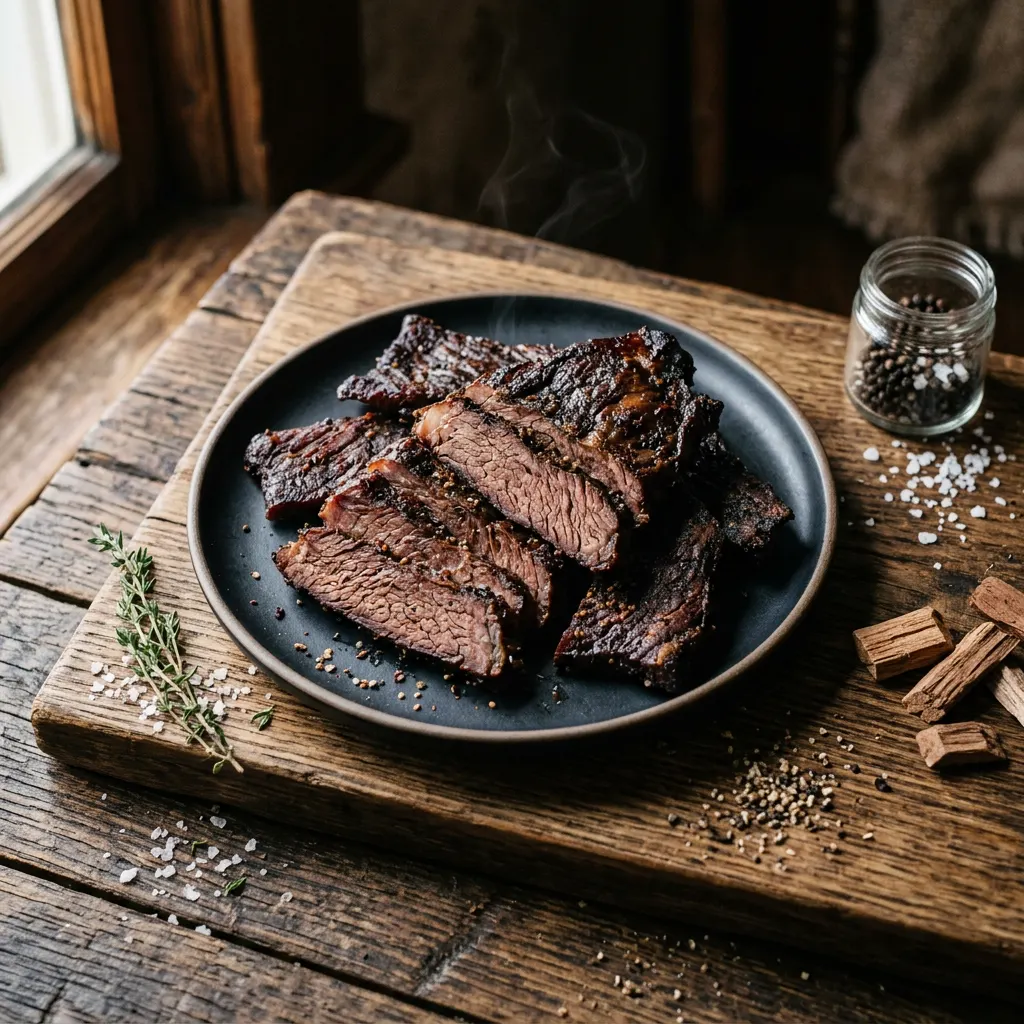
Variation of Hickory-Smoked Smoked Beef Jerky
Eye-of-round sliced thin, 24hr marinade, 4hr at 180°F.
Cook Mode
One step at a time, big text, timers, and your screen stays awake. 0/32 steps done.
Ingredients
Tap to tick off · 0/32 gathered
Method
- 30 min
Partially freeze the eye of round roast for 1-2 hours, or until firm but not solid. This makes slicing against the grain much easier. Using a sharp knife or meat slicer, slice the beef against the grain into 1/8 to 1/4 inch thick strips. Trim any visible fat, as fat can turn rancid and shorten the jerky's shelf life.
Why it matters
Slicing against the grain ensures a more tender chew, while removing fat is crucial for preservation and quality.
Common mistake
Slicing with the grain results in stringy, tough jerky. Leaving too much fat can lead to off-flavors over time.
- 30 min
Partially freeze the eye of round roast for 1-2 hours. This makes it easier to slice very thin, against the grain, about 1/8 to 1/4 inch thick. Trim off any remaining silver skin or large pieces of fat as they can become rancid during the dehydration process.
Why it matters
Thin, uniform slices ensure even drying and a tender, chewy texture. Freezing firm makes precise slicing much simpler and safer.
Common mistake
Slicing with the grain or too thick, leading to tough, hard-to-chew jerky.
- 30 min
Partially freeze the eye of round roast for 30-60 minutes to make slicing easier. Using a sharp knife or meat slicer, slice the beef against the grain into uniform 1/8-inch thick strips. In a large bowl, whisk together soy sauce, Worcestershire sauce, brown sugar, smoked paprika, garlic powder, onion powder, black pepper, and curing salt (if using).
Why it matters
Uniform thickness ensures consistent dehydration and chewiness. Slicing against the grain makes for more tender jerky. Partially freezing stiffens the meat for cleaner cuts.
Common mistake
Slicing with the grain results in stringy, tough jerky. Uneven slices will lead to some pieces being over-dried and others still moist.
- 24h
Slice the beef eye-of-round thinly, 1/8 to 1/4 inch thick, against the grain. In a large bowl or resealable bag, combine all marinade ingredients (soy sauce, Worcestershire, brown sugar, garlic powder, onion powder, smoked paprika, black pepper, optional red pepper flakes, and Prague Powder #1). Add the sliced beef, ensuring all pieces are thoroughly coated. Seal and refrigerate.
Why it matters
Slicing against the grain makes the jerky more tender and easier to chew. The marinade infuses flavor and the curing salt (Prague Powder #1) inhibits bacterial growth during the long, low-temperature smoke, making it safe to eat.
Common mistake
Slicing with the grain will result in tough, stringy jerky that is difficult to chew.
- 30 min
Begin by trimming any visible fat from the eye of round. Fat can go rancid quickly, spoiling your jerky. For easier slicing, partially freeze the beef for 30-60 minutes until firm but not solid. Slice the beef against the grain into uniform strips, about 1/8 to 1/4 inch thick. Against the grain slicing results in a more tender, less stringy jerky.
Why it matters
Uniform thickness ensures even drying, and slicing against the grain yields a more palatable chew.
Common mistake
Not removing all fat leads to rancid jerky. Slicing with the grain makes it tough to chew.
- 1h 30m
Remove the beef from the marinade and pat each strip thoroughly dry with paper towels. Arrange the strips on wire racks, ensuring no pieces are overlapping. Allow the strips to air dry at room temperature for 1-2 hours, or until a tacky, glossy surface (pellicle) forms. Alternatively, use a fan to speed up the process.
Why it matters
Pellicle formation is crucial; it creates a sticky surface that allows smoke to adhere better, enhancing flavor and creating a more even cook.
Common mistake
Skipping this step leads to less smoky flavor and a longer dehydration time, as surface moisture must evaporate before drying begins.
- 4h
After 24 hours, remove the beef from the marinade. Pat each slice thoroughly dry with paper towels. Arrange the slices on wire racks without overlapping. Place the racks back into the refrigerator, uncovered.
Why it matters
Drying the surface of the meat in the refrigerator helps form a tacky 'pellicle'. This pellicle is crucial as it allows the smoke to adhere better to the meat, creating a deeper smoky flavor and more even drying.
Common mistake
Skipping the pellicle step results in less smoky flavor and a potentially longer drying time.
- 15 min
In a large bowl, whisk together the soy sauce, Worcestershire sauce, brown sugar, black pepper, garlic powder, onion powder, smoked paprika, and red pepper flakes (if using). Add the sliced beef to the marinade, ensuring all pieces are fully submerged and coated. Cover the bowl tightly or transfer to a large Ziploc bag.
Why it matters
The marinade not only imparts flavor but also acts as a curing agent (primarily the salt in soy sauce), helping to preserve the meat and prevent spoilage during the long cook. Brown sugar balances the salt and helps with moisture retention.
Common mistake
Not fully coating all meat, leading to uneven flavor or curing.
- 3h
Once the jerky reaches your desired texture, remove it from the smoker. Let it cool completely at room temperature, spread out on a wire rack for about 1-2 hours. After cooling, place the jerky in an airtight container for 1-2 days at room temperature. This 'conditioning' allows any remaining moisture to equalize throughout the batch.
Why it matters
Proper cooling and conditioning prevents moisture pockets, ensuring a consistent texture and extending shelf life.
Common mistake
Packaging warm jerky can create condensation, leading to mold. Skipping conditioning results in inconsistent texture and potential spoilage.
- 5 min
In a large non-reactive bowl or resealable bag, combine the soy sauce, Worcestershire sauce, brown sugar, garlic powder, onion powder, black pepper, red pepper flakes, and the optional cure #1. Stir or shake until the sugar and cure (if used) are fully dissolved.
Why it matters
Thoroughly dissolving the cure and sugar ensures even distribution of flavor and preservatives.
Common mistake
Undissolved sugar can create burnt spots on the jerky, and undissolved cure can lead to uneven preservation.
- 5 min
In a large bowl, whisk together the soy sauce, Worcestershire sauce, brown sugar, black pepper, garlic powder, onion powder, smoked paprika, pink curing salt No. 1, and optional red pepper flakes until the sugar and salt are dissolved.
Why it matters
Thoroughly mixing the marinade ensures all flavors and the curing salt are evenly distributed.
Common mistake
Not dissolving the sugar and salt completely can lead to uneven flavoring and curing.
- 1h 30m
Remove the beef strips from the marinade, discarding any excess liquid. Pat each strip thoroughly dry with paper towels. Arrange the strips in a single layer on wire racks and allow them to air dry at room temperature for 1-2 hours, or until a shiny, slightly tacky surface (pellicle) forms.
Why it matters
The pellicle acts as a protective barrier, helps smoke adhere better, and allows for even dehydration by preventing rapid drying of the surface.
Common mistake
Skipping the pellicle step can lead to a less smoky flavor, uneven drying, and a less desirable texture in the final product.
- 24h
Place the covered bowl or bag in the refrigerator for a minimum of 12 hours, preferably 24 hours. For best results, occasionally agitate the bag or stir the bowl to redistribute the marinade.
Why it matters
This extended marination time allows the flavors to deeply penetrate the meat and for the curing process to adequately prepare the beef for drying. The longer it cures, the more flavorful and preserved the jerky will be.
Common mistake
Shortening the marination time, resulting in less flavorful and potentially less safe jerky.
- 24h
Add the beef strips to the marinade, ensuring all pieces are fully submerged. Cover the bowl or transfer to a large Ziploc bag, remove as much air as possible, and refrigerate for 12-24 hours.
Why it matters
This step allows the flavors to penetrate the meat and the curing salt to work its magic, which is crucial for both flavor and food safety during the low-temperature smoke.
Common mistake
Not marinating long enough will result in bland jerky and inadequate curing.
- 4h
After marinating, remove the beef strips from the marinade and pat them thoroughly dry with paper towels. Arrange the strips on wire racks without overlapping. Place the racks in a well-ventilated area or in front of a fan for 2-4 hours, or until a shiny, tacky film (pellicle) forms on the surface.
Why it matters
The pellicle is a dry, slightly sticky surface that helps smoke adhere better to the meat, resulting in a more intense smoky flavor and even cooking. It also helps prevent moisture from being trapped, which can lead to a less desirable texture.
Common mistake
Skipping this step will result in jerky with less smoky flavor and a potentially chewier, less ideal texture.
- 4h
Remove the beef from the marinade and pat each slice thoroughly dry with paper towels. Arrange the slices in a single layer on wire racks, making sure they do not overlap. Place the racks uncovered in the refrigerator for 2-4 hours, or in front of a fan at room temperature for 1-2 hours, until a slightly tacky, shiny film (pellicle) forms on the surface.
Why it matters
A pellicle is a dry, sticky film on the meat's surface that helps smoke adhere better and promotes more even drying. It's crucial for good smoke penetration and proper dehydration.
Common mistake
Skipping this step, leading to jerky that takes longer to dry and has less smoke flavor.
- 180°F15 min
Preheat your pellet grill or smoker to 180°F, using Mesquite wood pellets/chips for smoke. While the smoker is preheating, arrange the beef strips on the smoker grates, ensuring there is ample space between each piece for good airflow.
Why it matters
Proper spacing allows for consistent smoke penetration and even dehydration across all jerky pieces. Maintaining a low, stable temperature is crucial for drying, not cooking, the meat.
Common mistake
Overcrowding the smoker leads to uneven cooking and can steam the jerky instead of drying and smoking it properly.
- 180°F20 min
Preheat your pellet grill or smoker to a stable 180°F (82°C). Add mesquite wood pellets or chunks to the smoker box or hopper, as per your equipment's instructions. Ensure you have enough fuel for at least 4 hours of smoking.
Why it matters
Maintaining a consistent low temperature is key for drying the jerky without cooking it too fast. Mesquite wood provides a strong, traditional smoke flavor that pairs well with beef.
Common mistake
Not allowing the smoker to stabilize at the target temperature before adding meat, leading to fluctuating temperatures and uneven cooking.
- 180°F30 min
Preheat your smoker or pellet grill to a stable 180°F (82°C). Load with mesquite wood for that classic smoky flavor.
Why it matters
Maintaining a low, consistent temperature is key to dehydrating the meat slowly without cooking it too quickly, preserving its jerky texture. Mesquite offers a strong, traditional smoke profile for beef jerky.
Common mistake
Too high a temperature will cook the meat instead of dehydrating it, resulting in a tougher, cooked beef texture rather than jerky.
- 180°F
Begin checking the jerky after 2 hours, and then every 30 minutes. Jerky is done when it's dry and firm, but still pliable. When you bend a piece, it should crack but not break cleanly. There should be white fibers showing when bent and torn.
Why it matters
Properly dried jerky is essential for texture, flavor, and food safety. Under-dried jerky can spoil, while over-dried jerky becomes brittle and unpleasant to eat.
Common mistake
Removing jerky too early can lead to mold and spoilage; drying too long produces brittle, hard jerky.
- 180°F4h
Place the jerky in the preheated smoker. Smoke for approximately 3-4 hours, or until the jerky is dry and pliable but not brittle. The jerky should bend without breaking. Check periodically starting at 3 hours. The internal temperature of the jerky should reach at least 160°F for food safety, though this recipe focuses on dehydration.
Why it matters
The low temperature slowly dehydrates the meat while infusing it with smokey flavor, killing off pathogens without overcooking. The pliability test is key to achieving the desired chewy texture.
Common mistake
Smoking at too high a temperature will cook the jerky, making it tough and brittle. Opening the smoker too frequently will cause temperature fluctuations and prolong the cook time.
- 180°F30 min
While the pellicle is forming, preheat your smoker or pellet grill to a stable temperature of 180°F (82°C). Add your mesquite wood pellets or chunks as directed by your smoker's manufacturer to establish a clean, consistent smoke.
Why it matters
Maintaining a low, stable temperature is key to dehydrating the meat slowly without cooking it, which is essential for jerky. Mesquite wood provides a strong, classic smoke flavor that pairs well with beef.
Common mistake
Fluctuating temperatures, which can cook the jerky instead of dehydrating it, or using too much wood for too long, resulting in bitter-tasting jerky.
- 180°F4h
Once the smoker is at temperature, place the racks of beef strips directly on the grates, ensuring there is space between each piece for optimal airflow. Smoke for 3-5 hours, or until the jerky is dry and bendable but not brittle. The jerky should crack when bent but not break completely.
Why it matters
Slow smoking at a low temperature renders fat, imparts deep smoke flavor, and properly dehydrates the meat to the desired jerky texture. Good airflow is vital for even drying.
Common mistake
Overcooking will result in overly dry, difficult-to-chew jerky. Undercooking leaves too much moisture, reducing shelf life and posing a food safety risk.
- 180°F4h
Arrange the pellicle-formed beef slices on the smoker racks, again ensuring no overlapping. Insert a probe into the thickest piece of jerky to monitor internal temperature, aiming for at least 160°F (71°C) to ensure safety. Smoke for approximately 3-4 hours, or until the jerky is dry but still pliable. It should bend without breaking. If it snaps cleanly, it's overdone; if it's too soft, it needs more time.
Why it matters
The low and slow smoking process dehydrates the meat while infusing it with flavor and ensuring food safety by reaching an internal temperature where pathogens are killed. Pliability indicates proper moisture content.
Common mistake
Overcooking to the point of brittleness or undercooking, which can lead to mold or spoilage.
- 1h
Once desired dryness is achieved, remove the jerky from the smoker. Place it on a clean wire rack at room temperature to cool completely.
Why it matters
Cooling the jerky to room temperature allows any residual moisture to equalize throughout the pieces, preventing condensation that could lead to mold and ensuring a consistent texture.
Common mistake
Storing warm jerky can lead to condensation and spoilage.
- 1h
Once the jerky reaches the desired texture, remove it from the smoker and let it cool completely on a wire rack at room temperature. This allows any residual moisture to evaporate and the texture to fully set.
Why it matters
Cooling properly prevents condensation, which can lead to mold, and allows the jerky to reach its final texture and flavor profile.
Common mistake
Storing warm jerky will create moisture inside the container, potentially causing spoilage.
- 24h
Once the jerky reaches the desired texture, remove it from the smoker. Allow it to cool completely at room temperature. For optimal texture and moisture equalization, place the cooled jerky in an airtight container or a Ziploc bag for 12-24 hours. Occasionally open the container to 'burp' it, releasing any excess moisture.
Why it matters
Conditioning allows any remaining internal moisture to redistribute evenly throughout the jerky, preventing dry, brittle spots and ensuring a consistent texture. Burping prevents condensation that could lead to mold.
Common mistake
Skipping the conditioning step, leading to unevenly textured jerky with potential for quick spoilage.
Store cooled jerky in an airtight container or zip-top bag at room temperature for up to 1-2 weeks, or refrigerate for longer storage.
Why it matters
Proper storage maintains the jerky's freshness and prevents moisture uptake, which can lead to spoilage.
Common mistake
Storing jerky in non-airtight containers or in humid environments will reduce its shelf life considerably.
Your homemade smoked beef jerky is now ready to enjoy. It makes a fantastic snack, perfect for hikes, road trips, or just anytime you crave a savory, smoky bite.
Why it matters
Sharing your hard work with friends and family is always the best part of BBQ!
Common mistake
Not making enough. Jerky disappears quickly once people taste it!
- 12h
Once the jerky has reached the desired texture, remove it from the smoker and allow it to cool completely at room temperature. For optimal conditioning, place the cooled jerky in an airtight container or a large resealable bag. Leave it at room temperature for 12-24 hours, shaking the bag occasionally. This equalizes the moisture throughout all pieces, preventing some from being too dry and others too moist. Store in an airtight container at room temperature for up to 2-3 weeks, or freeze for longer storage.
Why it matters
Conditioning allows any remaining moisture to distribute evenly, preventing mold on wetter pieces and ensuring a consistent chew throughout the batch. Proper storage maximizes shelf life.
Common mistake
Storing warm jerky can create condensation and promote mold. Not conditioning can lead to inconsistent texture and reduced shelf life.
Your delicious backyard smoked beef jerky is ready to enjoy! Store it in an airtight container at room temperature for up to 1-2 weeks, or in the refrigerator for up to 1 month. For longer storage, freeze it for several months.
Why it matters
Proper storage maintains the quality, flavor, and safety of your homemade jerky, allowing you to enjoy it over time.
Common mistake
Improper storage, leading to rapid spoilage or loss of flavor and texture.
Store the finished jerky in an airtight container at room temperature for up to 2 weeks, or in the refrigerator for up to a month. For longer storage, freeze it.
Why it matters
Proper storage maintains the jerky's quality and extends its shelf life, allowing you to enjoy your homemade snack for longer.
Common mistake
Improper storage, such as in an unsealed container or humid environment, will lead to quick spoilage.
Sauce It
Cooks & Reviews
Guild members can rate this recipe, log their cooks and share photos.
Sign in to continueMember reviews
No reviews yet — be the first to rate this cook.
Ask the Pitmaster about this recipe
Substitutions, scaling, technique, troubleshooting — get answers grounded in this cook.
Sign in to try the AI Pitmaster on Variation of Hickory-Smoked Smoked Beef Jerky. New members get 3 free questions.
Sign in to tryComments(0)
Loading comments…