Vietnamese Lemongrass
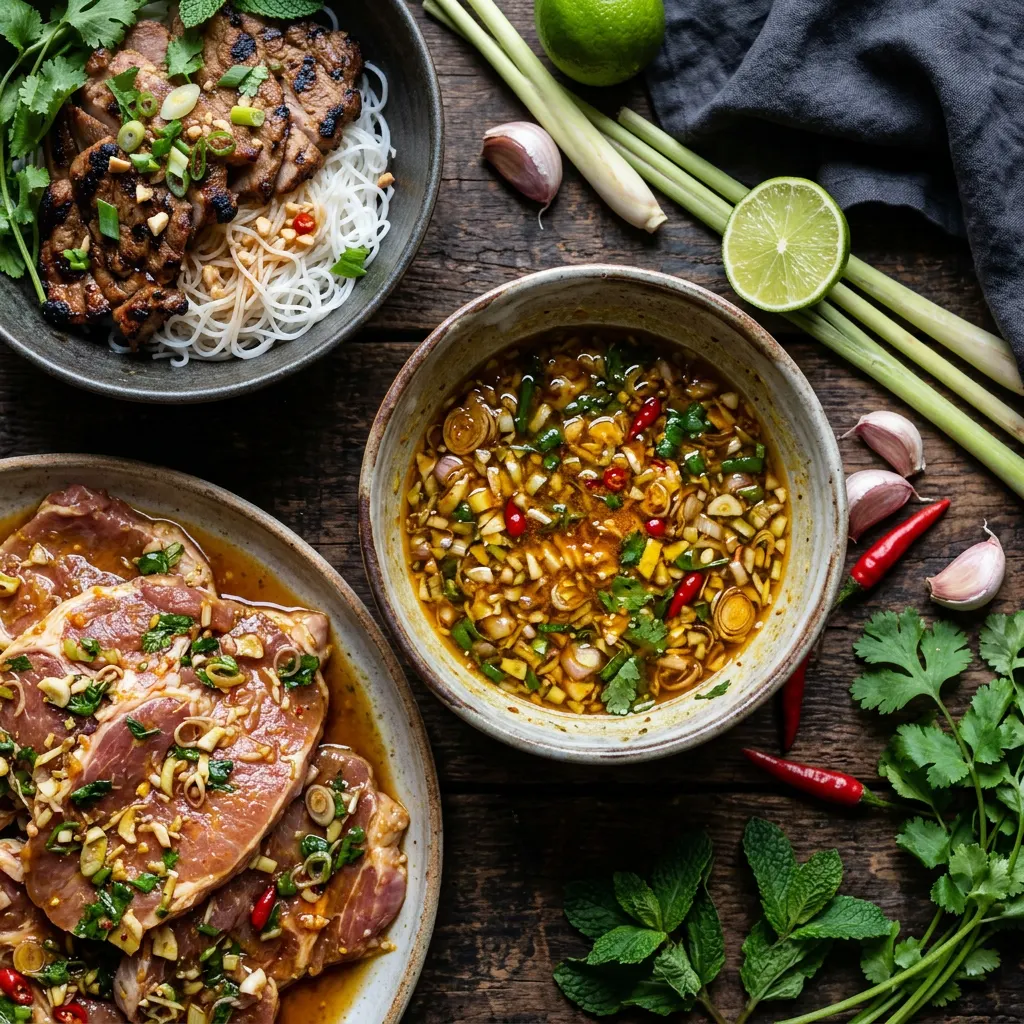
The marinade behind grilled pork over rice noodles. Sweet, funky, aromatic, and it chars into something addictive. Best on pork shoulder, pork chops, and chicken.
Cook Mode
One step at a time, big text, timers, and your screen stays awake. 0/15 steps done.
Ingredients
Tap to tick off · 0/26 gathered
Method
- 15 min
Finely mince the bottom third of the lemongrass stalks, garlic, and shallots. You want these to be very fine to release their flavor and to prevent large pieces from burning during cooking.
Why it matters
Finely mincing aromatics maximizes surface area for flavor extraction and ensures even distribution throughout the marinade.
Common mistake
Not mincing finely enough, leading to chunky bits that can burn or not infuse enough flavor.
Combine everything in a bowl — the sugar can take a minute to dissolve into the fish sauce.
Marinate 3 to 8 hours. Pat dry, then cook hot enough for the sugar to caramelize into those dark, sweet char marks.
- 5 min
Combine the chopped lemongrass, garlic, shallot, fish sauce, sugar, soy sauce, lime juice, sesame oil, and black pepper in a blender. Blend until completely smooth. You may need to stop and scrape down the sides a few times.
Why it matters
Blending creates a smooth marinade that adheres well to the meat and infuses flavor deeply. A smooth texture also prevents burnt bits of unblended aromatics on the grill.
Common mistake
Not blending long enough, resulting in chunky bits that can burn quickly on the grill.
- 5 min
In a medium bowl, combine the minced lemongrass, garlic, shallots, fish sauce, granulated sugar, soy sauce, sriracha, black pepper, and vegetable oil. Whisk everything together until the sugar is fully dissolved. Taste and adjust for your desired balance of sweet, salty, and spicy.
Why it matters
Dissolving the sugar completely ensures the marinade penetrates the meat evenly, preventing overly sweet or salty spots.
Common mistake
Not fully dissolving the sugar, which can lead to a less cohesive flavor and potential caramelization issues.
- 6h
Place your chosen cut of pork (shoulder slices, chops, or chicken) in a non-reactive container or resealable bag. Pour the blended marinade over the meat, ensuring all pieces are well coated. Refrigerate.
Why it matters
Marinating allows the flavors to penetrate the meat, tenderize it slightly, and develop that signature Vietnamese taste.
Common mistake
Not marinating long enough, leading to less flavorful meat. Conversely, over-marinating can sometimes make meat mealy due to acids affecting protein structure.
- 5 min
Add your sliced pork shoulder (or other protein) to the marinade. Ensure all surfaces are thoroughly coated. Cover the bowl or place the pork and marinade into a resealable bag.
Why it matters
Ensuring full coverage is crucial for maximum flavor penetration and consistent results. The marinade's ingredients, especially the acidic components, help tenderize the meat.
Common mistake
Not adequately coating the meat, leaving some parts unflavored or less tender.
- 4h
Refrigerate the marinated pork for at least 4 hours, or preferably overnight (up to 24 hours). If using larger cuts like a whole pork shoulder, marinate for 12-24 hours.
Why it matters
Extended marination allows the complex flavors to deeply penetrate the meat. The salt in the fish and soy sauces also acts as a cure, improving texture and moisture retention.
Common mistake
Marinating for too short a time, resulting in less flavorful meat; or marinating too long for thin cuts, which can make the meat mushy due to the acids.
- 300°F20 min
Preheat your smoker/pellet grill to 300°F (149°C). For this recipe, we're looking for a higher, direct-heat grilling approach rather than low and slow smoking, to achieve good char and caramelization.
Why it matters
A consistent grill temperature is crucial for even cooking and achieving the desired char without burning.
Common mistake
Not allowing the smoker to fully come to temperature before placing the meat, which can lead to uneven cooking and less desirable browning.
- 145°F30 min
Remove meat from the marinade, allowing any excess to drip off. Place the marinated meat directly on the grates. Cook, flipping every 8-10 minutes, until deeply caramelized and cooked through. Target internal temperature will depend on the cut: 145°F for pork chops/loin, 165°F for chicken, or a higher target for tender pork shoulder slices (often 185-195°F for pull-apart tender, though here we're aiming for char).
Why it matters
Frequent flipping promotes even cooking and prevents one side from burning while the other remains undercooked. The higher temperature helps achieve the characteristic char and caramelization of Vietnamese grilled meats.
Common mistake
Leaving the meat undisturbed for too long, leading to burnt spots on one side and less flavorful browning on the other.
- 375°F20 min
Preheat your smoker or pellet grill to achieve a stable temperature. For sliced pork, you'll be grilling hot and fast. For a whole shoulder, set it low and slow. Ensure your wood is ready for smoking.
Why it matters
A stable cooking temperature is crucial for consistent results. Preheating allows the heat to evenly distribute and the grates to properly sear, if grilling.
Common mistake
Starting to cook before the smoker is at a stable temperature, leading to uneven cooking and temperature fluctuations.
- 375°F1h
For sliced pork: Grill directly over medium-high heat (375-400°F) for 2-3 minutes per side, until nicely charred and cooked through. For a whole pork shoulder: Place directly on the grates. Smoke at 250°F until an internal temperature of 200-205°F is reached. This will take several hours.
Why it matters
The high heat for sliced pork creates beautiful caramelization and char, typical of Vietnamese grilled meats. For a whole shoulder, low and slow renders fats and connective tissue, resulting in tender, pull-apart meat.
Common mistake
Overcooking thin slices, making them dry and tough; or not cooking a whole shoulder long enough, resulting in tough, unrendered meat.
- 10 min
Once cooked, transfer the pork (sliced or whole) to a cutting board and tent loosely with foil. Let it rest.
Why it matters
Resting allows the juices within the meat to redistribute, resulting in a more tender and moist final product. Skipping this step means the juices will run out when sliced.
Common mistake
Cutting into the meat immediately after cooking, causing all the flavorful juices to escape.
- 5 min
Slice the rested meat against the grain into thin pieces. Serve traditionally over vermicelli noodles with fresh herbs, pickled daikon and carrot, and a side of Nuoc Cham (dipping sauce).
Why it matters
Slicing against the grain shortens the muscle fibers, making the meat more tender and easier to chew. The traditional accompaniments complete the dish's flavor profile.
Common mistake
Slicing with the grain, which can make even tender meat seem tough and stringy.
- 5 min
Slice the rested pork against the grain into thin pieces. Serve over rice noodles with fresh herbs, pickled vegetables, and a side of nuoc cham for dipping. For a whole shoulder, shred and serve similar to pulled pork.
Why it matters
Slicing against the grain shortens the muscle fibers, making each bite more tender and enjoyable.
Common mistake
Slicing with the grain, which creates tougher, chewier pieces of meat.
Cooks & Reviews
Guild members can rate this recipe, log their cooks and share photos.
Sign in to continueMember reviews
No reviews yet — be the first to rate this cook.
Ask the Pitmaster about this recipe
Substitutions, scaling, technique, troubleshooting — get answers grounded in this cook.
Sign in to try the AI Pitmaster on Vietnamese Lemongrass. New members get 3 free questions.
Sign in to tryComments(0)
Loading comments…