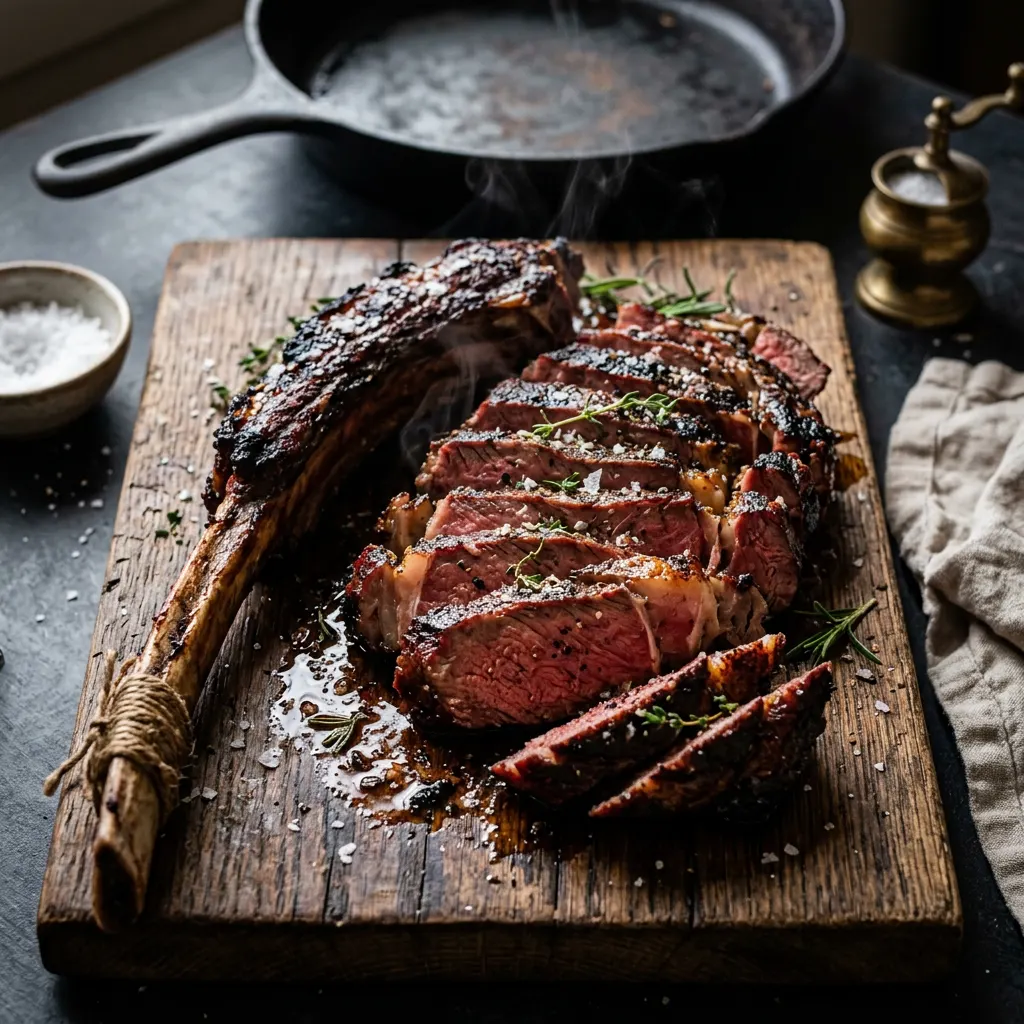
Low-and-Slow Reverse-Sear Tomahawk Ribeye
30oz monster steak smoked then seared, sliced tableside.
Cook Mode
One step at a time, big text, timers, and your screen stays awake. 0/29 steps done.
Ingredients
Tap to tick off · 0/20 gathered
Method
- 10 min
Remove the Tomahawk ribeye from its packaging and pat it thoroughly dry with paper towels. Trim any excess silver skin or small bits of fat from the bone, but leave the cap fat intact. Season generously and evenly on all sides with kosher salt, coarse black pepper, and garlic powder. Apply slightly more seasoning to the fat cap.
Why it matters
A dry surface promotes better bark formation and a more effective pellicle. Generous seasoning provides the foundational flavor.
Common mistake
Not drying the steak enough, leading to steaming instead of smoking and searing.
- 225°F15 min
Preheat your pellet grill or smoker to a stable 225°F (107°C) using oak wood. While the smoker preheats, let the seasoned steak rest on a wire rack at room temperature. Insert a reliable probe thermometer into the thickest part of the steak, avoiding the bone.
Why it matters
Preheating ensures a consistent smoke environment. Bringing the steak closer to room temperature helps it cook more evenly and shortens initial cook time. Oak wood imparts a classic, strong beefy smoke flavor.
Common mistake
Placing a cold steak directly into the smoker, which can lead to uneven cooking and a longer cook time.
- 10 min
Pat the Tomahawk ribeye completely dry with paper towels. Trim any silver skin or excessive fat, but leave a good cap of fat for flavor. In a small bowl, mix the coarse ground black pepper, kosher salt, and garlic powder. Apply the rub liberally and evenly all over the steak, including the bone.
Why it matters
A dry surface ensures a better bark and allows for even smoke adhesion. Trimming improves texture, and a generous, even rub application creates that fantastic seasoned crust.
Common mistake
Not drying the steak thoroughly, leading to steaming instead of smoking and poor bark formation.
- 1h
Pat the tomahawk ribeye completely dry with paper towels. Trim off any excess silver skin or small loose pieces, but leave most of the fat cap. Apply kosher salt, coarse black pepper, and garlic powder evenly on all sides of the steak. Let it sit at room temperature.
Why it matters
Drying the surface ensures a better bark formation. Seasoning ahead allows the salt to penetrate and tenderize the meat, enhancing flavor.
Common mistake
Not patting the steak dry, which inhibits smoke penetration and crust development.
- 225°F1h 15m
Place the seasoned Tomahawk ribeye directly on the smoker grates. Smoke at 225°F until the internal temperature reaches 115°F (46°C). This can take approximately 60-75 minutes depending on steak thickness and smoker consistency.
Why it matters
Smoking at a low temperature gently renders fat, infuses deep smoky flavor, and allows for precise temperature control to achieve an edge-to-edge medium-rare without a gray band.
Common mistake
Smoking to too high of an internal temperature before the sear, resulting in an overcooked steak after the final sear.
- 10 min
Once the steak hits 115°F internal, remove it from the smoker and set it aside. Increase your smoker temperature (if it has a searing feature) or preheat a heavy cast-iron skillet over high heat until it's screaming hot – almost smoking. For maximum crust, use a separate gas grill or stovetop burner for the sear.
Why it matters
A high-temperature sear is crucial for developing a beautiful, crusty Maillard reaction on the exterior of the steak. Removing the steak temporarily prevents overcooking while the searing surface heats up.
Common mistake
Not getting the searing surface hot enough, leading to a dull, steamed crust rather than a crispy, flavorful bark.
- 10 min
Remove the Tomahawk Ribeye from its packaging. Using paper towels, thoroughly pat the steak dry on all sides, including the bone. Drizzle with olive oil and rub evenly. In a small bowl, combine coarse kosher salt, freshly ground black pepper, and granulated garlic. Generously apply this rub mixture to all surfaces of the steak.
Why it matters
A dry surface is crucial for smoke adherence and developing a beautiful crust during the sear. The olive oil acts as a binder, helping the rub stick.
Common mistake
Not drying the steak enough, which inhibits bark formation and smoke penetration.
- 225°F20 min
Load your smoker with oak wood pellets or chunks. Preheat your smoker to a stable 225°F. Ensure you have a reliable probe thermometer ready for the steak's internal temperature.
Why it matters
A stable, low temperature is crucial for the 'reverse' part of the reverse-sear, allowing the steak to cook evenly to your desired doneness without overcooking the exterior.
Common mistake
Not waiting for the smoker to stabilize at the target temperature, leading to inconsistent cooking.
- 5 min
Add avocado oil to the hot skillet (or directly on the steak if using grill grates). Place the Tomahawk in the skillet and sear for 60-90 seconds per side, rotating for even browning. During the last minute, add cold butter, rosemary, and thyme to the pan and baste the steak repeatedly with the melted, herb-infused butter. Sear the fat cap and bone edge as well.
Why it matters
The intense heat creates the crust. Basting with cold butter and herbs adds incredible richness, depth of flavor, and aroma, ensuring a buttery finish.
Common mistake
Over-searing, which can quickly take your steak past medium-rare, or not searing all sides, including the fat cap, for maximum flavor.
- 10 min
Remove the seared Tomahawk from the heat. Place it on a cutting board, tent loosely with foil, and let it rest. If desired, you can pour any remaining herb butter from the pan over the resting steak.
Why it matters
Resting allows the juices, which have been forced to the center during cooking, to redistribute throughout the steak, resulting in a more tender and flavorful bite. Skipping this step leads to dry meat.
Common mistake
Cutting into the steak immediately after searing, causing all the flavorful juices to run out.
- 225°F15 min
Preheat your pellet grill or smoker to a stable 225°F (107°C). Use oak wood for a classic beefy smoke flavor. Ensure your water pan (if applicable) is full.
Why it matters
Maintaining a consistent low temperature is crucial for the 'reverse sear' method, allowing the steak to slowly absorb smoke and cook evenly.
Common mistake
Not letting the smoker come to a stable temperature before adding the meat, leading to inconsistent cooking.
- 5 min
After resting, slice the Tomahawk ribeye off the bone and then against the grain into thick, shareable slices. Serve immediately with a sprinkle of flaky sea salt, if desired. Enjoy!
Why it matters
Slicing against the grain shortens the muscle fibers, making the steak much more tender and enjoyable to eat. Slicing tableside is a great presentation for this monster steak.
Common mistake
Slicing with the grain, which makes the meat chewy and tough, despite proper cooking.
- 225°F20 min
Preheat your pellet grill or smoker to a stable 225°F (107°C). If using a charcoal smoker, prepare for indirect heat, adding oak wood chunks for smoke. Ensure the smoker holds temperature consistently.
Why it matters
Maintaining a low and consistent temperature is crucial for the 'reverse-sear' method, allowing the steak to slowly absorb smoke flavor and cook evenly without overshooting the target internal temperature.
Common mistake
Not letting the smoker come to a stable temperature before placing the meat, which can lead to uneven cooking and 'dirty' smoke flavors.
- 115°F1h
Place the seasoned Tomahawk ribeye directly on the grill grates, insert a reliable leave-in probe into the thickest part of the meat, avoiding the bone. Smoke until the internal temperature reaches 115°F (46°C).
Why it matters
Smoking to this precise temperature creates an incredible smoky flavor and a beautiful pink color from edge-to-edge. It's the foundation for achieving that perfect medium-rare without a gray band.
Common mistake
Not using a reliable meat thermometer or inserting it incorrectly, which can lead to overcooking during the smoking phase.
- 115°F1h 15m
Place the seasoned Tomahawk Ribeye directly on the grates of your preheated smoker. Smoke until the internal temperature reaches 115°F (46°C). This typically takes about 60-75 minutes, but rely on the probe thermometer.
Why it matters
This low and slow smoke allows the fat to render slowly, develops a smoky flavor, and cooks the steak evenly from edge-to-edge, preventing a gray band before the high-temp sear.
Common mistake
Smoking past 115°F internal, which can lead to an overcooked steak after the searing process.
- 225°F1h
Place the seasoned tomahawk ribeye directly on the grates of your preheated smoker. Insert a reliable probe thermometer into the thickest part of the meat, avoiding the bone. Smoke until the internal temperature reaches 115°F (46°C).
Why it matters
Smoking to 115°F ensures edge-to-edge medium-rare doneness after searing, preventing the dreaded 'gray band' often seen with traditional searing.
Common mistake
Overcooking during the smoking phase, which will result in an overdone steak after the high-temp sear.
- 115°F1h
Place the seasoned Tomahawk ribeye directly on the smoker grates. Insert a probe thermometer into the thickest part of the steak, avoiding the bone. Close the lid and smoke until the internal temperature reaches 115°F.
Why it matters
Smoking at a low temperature infuses the meat with a beautiful smoky flavor and allows for a more even cook from edge to edge, minimizing the gray band that often plagues conventionally seared steaks.
Common mistake
Over-smoking the steak, which can lead to a 'creosote' flavor, or pulling it too late, reducing the searing window.
- 500°F10 min
Once the steak hits 115°F, remove it from the smoker and set it aside on a cutting board or wire rack. Immediately increase your smoker/grill temperature to its maximum, ideally 450-500°F (232-260°C). Alternatively, heat a heavy cast-iron skillet on high heat on a stovetop or side burner until smoking hot, adding the high smoke point oil.
Why it matters
A screaming hot surface is essential for a proper sear. This creates the Maillard reaction, developing a deep brown, flavorful, and crusty exterior in a short amount of time.
Common mistake
Not getting the searing surface hot enough, resulting in a less-than-perfect crust and potentially overcooking the interior while trying to achieve a sear.
- 15 min
Once the steak hits 115°F, remove it from the smoker and place it on a wire rack over a baking sheet. Loosely tent with foil. Increase your smoker or preheat a cast iron pan to screaming hot (500-600°F / 260-315°C).
Why it matters
This brief rest allows the steak's surface to cool slightly, preventing it from overcooking when it hits the scorching hot sear. It also allows time to get your searing surface ready.
Common mistake
Not resting the steak before searing, leading to uneven cooking and a less crisp crust.
- 10 min
Once the steak hits 115°F, remove it from the smoker and place it on a cutting board or wire rack. Loosely tent with foil. While the steak rests, increase your smoker's temperature as high as it can go (500-600°F) or preheat a heavy-duty cast iron skillet over high heat on a stovetop or side burner.
Why it matters
A brief rest allows the surface to cool slightly and the steak to relax before the high-heat sear, which helps achieve a better crust. Heating your sear surface to maximum is essential for a quick, impactful sear.
Common mistake
Not allowing the steak to rest, or not getting the searing surface hot enough before the next step.
- 10 min
Once the steak reaches 115°F, remove it from the smoker. Tent it loosely with foil. While the steak rests, preheat a heavy-bottomed cast iron skillet or a searing station to screaming hot. Add avocado oil to the skillet.
Why it matters
Removing the steak from the smoker allows the cast iron to heat up properly. A super-hot pan is essential for developing a deep, crusty sear quickly, without overcooking the interior.
Common mistake
Not getting the pan hot enough, resulting in a less-than-perfect crust.
- 600°F4 min
Add 2 tablespoons of high smoke point oil to your screaming hot cast iron pan (or direct grates). Carefully place the steak in the pan. Sear for 1.5 to 2 minutes per side until a deep, crusty bark forms. During the last minute of searing, add cold butter, smashed garlic, rosemary, and thyme to the pan and continuously baste the steak.
Why it matters
A very hot pan creates the Maillard reaction, developing a delicious, savory crust. Basting with butter and aromatics infuses complex flavors and creates a beautiful, rich exterior.
Common mistake
Not getting the pan hot enough, which results in a steamed rather than seared crust, or over-searing which will burn the crust and overcook the interior.
- 6 min
Place the steak on the hot grates or in the hot skillet. Sear for 2-3 minutes per side. During the last minute of searing, add the butter, smashed garlic, rosemary, and thyme to the pan (if using a skillet) and baste generously, spooning the aromatic butter over the steak.
Why it matters
Rapid, high-heat searing locks in juices and develops an incredible, savory crust. Basting with aromatic butter infuses the steak with rich, herbaceous flavors that complement the beef.
Common mistake
Over-searing the steak, which can lead to a burnt crust or pushing the internal temperature beyond the desired medium-rare.
- 125°F8 min
Once the skillet is smoking, place the Tomahawk in the hot oil. Sear for 2 minutes per side. After flipping, add cold butter, smashed garlic, rosemary, and thyme to the pan. Baste continuously by tilting the pan and spooning the melted butter and aromatics over the steak.
Why it matters
The high heat creates the Maillard reaction, developing a flavorful, crispy crust. Basting with butter and aromatics adds incredible depth of flavor and a beautiful sheen to the steak.
Common mistake
Over-searing, which can quickly push the internal temperature beyond medium-rare, or not basting aggressively enough.
- 10 min
Immediately remove the seared tomahawk ribeye from the pan and place it back on the wire rack. Loosely tent with foil and allow it to rest.
Why it matters
This final rest allows the internal juices to redistribute evenly throughout the steak, ensuring maximum juiciness and tenderness when sliced.
Common mistake
Slicing the steak immediately after searing, which causes all the flavorful juices to run out, resulting in a dry steak.
- 15 min
Remove the steak from the skillet when the internal temperature reaches 125-130°F for a perfect medium-rare (adjust for desired doneness). Place it on a cutting board, tent loosely with foil, and let it rest for 10-15 minutes.
Why it matters
Resting allows the juices to redistribute evenly throughout the meat, preventing them from spilling out when you slice, ensuring a tender and juicy steak.
Common mistake
Slicing the steak too soon, resulting in a dry, less flavorful cut.
- 20 min
Remove the Tomahawk ribeye from the heat immediately after searing. Transfer it to a clean cutting board and tent loosely with foil. Let it rest for at least 15-20 minutes.
Why it matters
Resting allows the muscle fibers to relax and reabsorb the juices that have migrated to the center during cooking. This results in a juicier, more tender steak.
Common mistake
Cutting into the steak too early, causing all the flavorful juices to run out, resulting in a dry steak.
After resting, slice the Tomahawk ribeye off the bone, then slice against the grain into thick pieces. Arrange on a platter and serve immediately. Garnish with a sprinkle of flaky sea salt if desired.
Why it matters
Slicing against the grain shortens the muscle fibers, making each bite more tender. Serving tableside adds to the presentation and experience of this magnificent steak.
Common mistake
Slicing with the grain, which makes the meat chewier and less enjoyable.
After resting, carve the steak by slicing along the bone to remove the main portion of meat. Then, slice against the grain into thick, shareable pieces. Serve immediately.
Why it matters
Slicing against the grain shortens the muscle fibers, making the steak much more tender and enjoyable to eat. Slicing tableside adds to the presentation!
Common mistake
Slicing with the grain, which makes the steak chewy and less pleasant to eat.
Sauce It
Free Guide
5 Techniques Competition Smokers Use That Home Cooks Don't
Join the Guild email list and we'll send you the free guide — the exact moves that separate backyard cooks from competition pitmasters.
Cooks & Reviews
Guild members can rate this recipe, log their cooks and share photos.
Sign in to continueMember reviews
No reviews yet — be the first to rate this cook.
Ask the Pitmaster about this recipe
Substitutions, scaling, technique, troubleshooting — get answers grounded in this cook.
Sign in to try the AI Pitmaster on Low-and-Slow Reverse-Sear Tomahawk Ribeye. New members get 3 free questions.
Sign in to tryComments(0)
Loading comments…