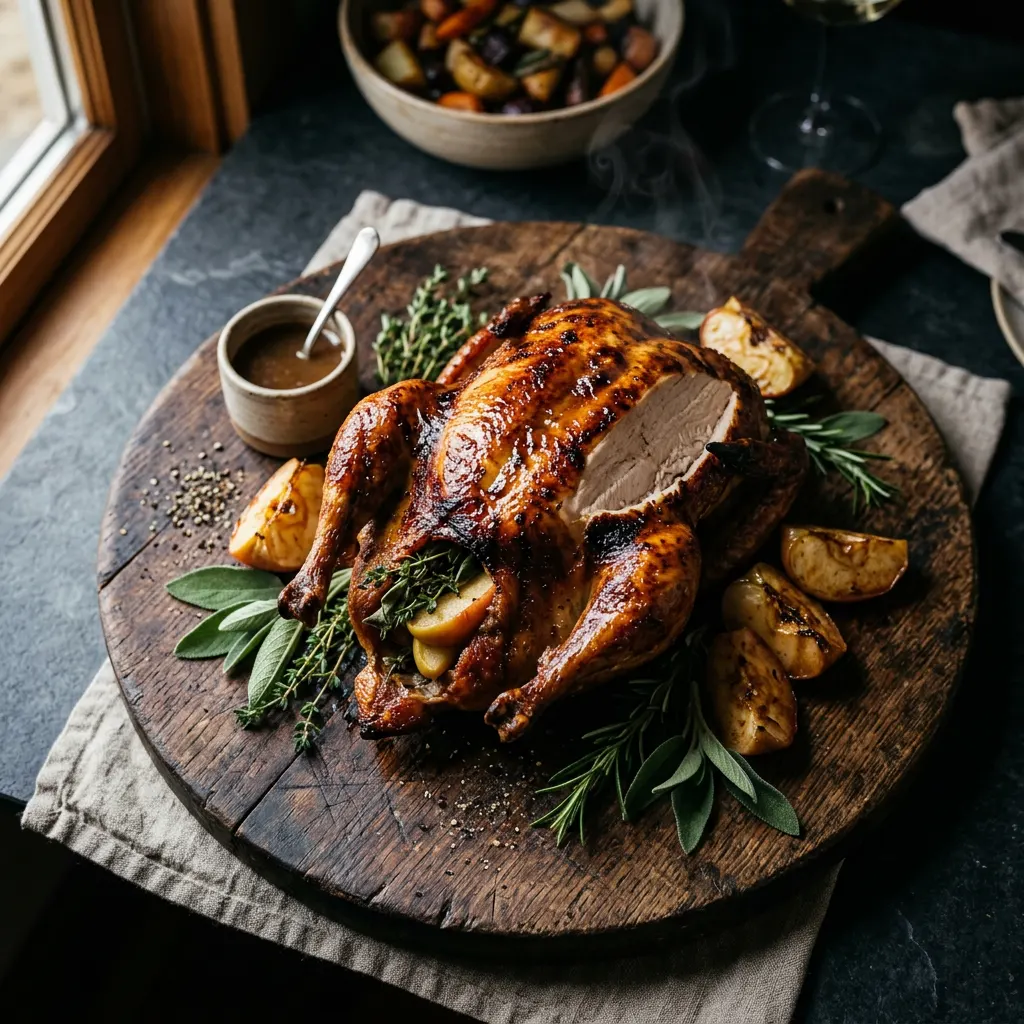
Smoked Whole Pheasant, Apple-Brined
A whole pheasant brined in apple juice and sage, smoked over apple wood until the light meat stays juicy — Sunday dinner from the field.
Ingredients
- 2.5 lb whole pheasant
- 2 lbsWhole Pheasant— cleaned, giblets removed
- 1 birdWhole pheasant— approx. 2-3 lbs, thawed if frozen
- 4 cups apple juice
- 64 ozApple Juice— unsweetened
- 4 cupsApple juice— unsweetened
- 0.5 gallonApple Juice— no sugar added
- 0.5 cupKosher Salt
- 0.5 cupKosher salt
- 1/2 cup kosher salt
- 0.3 cupKosher Salt
- 1/4 cup brown sugar
- 0.3 cupBrown Sugar— packed
- 0.3 cupBrown sugar— packed
- 10 leavesFresh Sage Leaves
- 6 fresh sage leaves
- 8 leavesFresh Sage Leaves— roughly chopped
- 6 leavesFresh sage leaves— about 1 tablespoon chopped
- 2 bay leaves
- 1 tablespoonBlack peppercorns— whole
- 1 tablespoonBlack Peppercorns
- 4 clovesGarlic Cloves— crushed
- 4 clovesGarlic Cloves— smashed
- 3 tbsp softened butter
- 1 tbspBlack Peppercorns
- 4 clovesGarlic cloves— crushed
- Apple Wood Pellets— for pellet grill
- 1 tsp black pepper
- 1 stripOrange peel— from 1/2 orange, pith removed
- 2 tablespoonsUnsalted Butter— melted
- 4 cupsIce water
- 1 tbsp olive oil
Method
1.Prepare the Brine
1hIn a large pot, combine apple juice, kosher salt, brown sugar, fresh sage leaves, black peppercorns, and smashed garlic cloves. Heat gently over medium heat, stirring until the salt and sugar are fully dissolved. Remove from heat and allow to cool completely to room temperature, then chill in the refrigerator until ice cold. This cooling step is critical to prevent bacterial growth.
Why it matters
Cooling the brine completely ensures the pheasant doesn't start cooking or promote bacteria growth when submerged, which is crucial for food safety and optimal brining.
Common mistake
Adding warm brine to the pheasant can cook parts of the meat and create a food safety hazard.
2.Brine
Combine brine ingredients, bring to a boil, cool. Submerge pheasant 12 hours refrigerated.
3.Prepare the Brine
1hIn a large pot, combine apple juice, kosher salt, brown sugar, fresh sage leaves, crushed garlic cloves, and black peppercorns. Heat over medium heat, stirring until the salt and sugar are dissolved. Remove from heat and allow the brine to cool completely to room temperature, then chill thoroughly in the refrigerator.
Why it matters
Cooling the brine completely prevents shocking the pheasant and ensures even brining. This also prevents bacterial growth.
Common mistake
Adding warm brine to the pheasant can cook parts of the meat and affect texture.
4.Prepare the Brine
30 minIn a large pot, combine apple juice, kosher salt, brown sugar, sage leaves, black peppercorns, crushed garlic, and orange peel. Bring the mixture to a simmer over medium heat, stirring until salt and sugar are dissolved. Remove from heat and let cool completely. Once cool, stir in the ice water.
Why it matters
Cooling the brine completely is critical to prevent cooking the pheasant and to ensure proper absorption of flavors.
Common mistake
Adding the pheasant to warm brine, which can partially cook the meat and result in a rubbery texture.
5.Brine the Pheasant
12hSubmerge the cleaned whole pheasant in the cold apple brine. Ensure the pheasant is fully covered by the liquid. Place the brining pheasant in the refrigerator for a minimum of 12 hours, and up to 24 hours.
Why it matters
The brine tenderizes the meat and infuses it with flavor and moisture, which is especially important for lean pheasant to prevent it from drying out during smoking.
Common mistake
Not brining long enough will result in less flavor and moisture retention, while brining too long can make the meat overly salty and change its texture.
6.Brine the Pheasant
12hSubmerge the whole pheasant in the cooled brine. Ensure the bird is completely covered. Place the pot or container in the refrigerator and allow it to brine for 12 hours.
Why it matters
The apple-sage brine infuses the pheasant with moisture and flavor, helping to keep the lean meat juicy during smoking.
Common mistake
Brining for too short a time, which yields less flavor and moisture, or brining for too long, which can make the meat too salty.
7.Dry and butter
Rinse and pat dry. Slip softened butter under the breast skin. Rub outside with oil, pepper.
8.Brine the Pheasant
12hSubmerge the whole pheasant in the chilled apple brine. Ensure the pheasant is fully covered; use a plate or weight if necessary to keep it submerged. Brine in the refrigerator for 12 hours.
Why it matters
The brine tenderizes the meat and infuses it with flavor, while also helping the lean pheasant retain moisture during the smoking process. This is crucial for juicy white meat.
Common mistake
Over-brining can make the meat too salty; under-brining won't provide the same moisture retention or flavor.
9.Smoke
Smoke at 275°F over apple wood until breast reads 160°F and thigh 175°F, ~2 hours.
10.Air Dry (Pellicle Formation)
4hAfter 12 hours, remove the pheasant from the brine. Discard the brine. Rinse the pheasant thoroughly under cold running water, pat it very dry with paper towels, and place it on a wire rack set over a baking sheet. Refrigerate uncovered for 2-4 hours to allow a pellicle to form.
Why it matters
A dry surface (pellicle) helps smoke adhere better to the meat and contributes to a crispier skin.
Common mistake
Skipping this step or not drying the bird thoroughly, which can result in rubbery skin and less smoky flavor.
11.Pellicle Formation
3hAfter brining, remove the pheasant from the brine and pat it thoroughly dry with paper towels. Place the pheasant on a wire rack set over a baking sheet and refrigerate uncovered for 2-4 hours. This allows a 'pellicle' to form on the skin.
Why it matters
A pellicle is a sticky, thin film on the surface of the meat that helps smoke adhere and allows the skin to crisp up nicely during cooking.
Common mistake
Skipping the pellicle step will result in less smoke penetration and rubbery skin, as the moisture on the surface will steam instead of allowing the skin to crisp.
12.Rinse and Air Dry
3hRemove the pheasant from the brine, rinse it thoroughly under cold water, and pat it dry with paper towels. Place the pheasant on a wire rack set over a baking sheet and refrigerate uncovered for 2-4 hours.
Why it matters
Rinsing removes excess salt. Air drying in the refrigerator forms a pellicle on the skin, which helps smoke adhere better and results in crispier skin.
Common mistake
Skipping the air dry step results in rubbery skin and less smoky flavor.
13.Preheat Smoker
275°F30 minWhile the pheasant is forming its pellicle, preheat your smoker or pellet grill to a stable 275°F (135°C). Add apple wood chunks or pellets as per your smoker's instructions.
Why it matters
Achieving a stable smoker temperature before adding the meat ensures even cooking and consistent smoke infusion from the start.
Common mistake
Adding meat before the smoker reaches target temperature, leading to undercooking or inconsistent results.
14.Preheat Smoker
275°F15 minFill your pellet grill hopper with apple wood pellets. Preheat your smoker to 275°F (135°C).
Why it matters
Preheating creates a stable cooking environment, ensuring consistent temperature from the moment the pheasant enters the smoker.
Common mistake
Placing meat in a cold smoker can lead to longer cook times and uneven cooking.
15.Rest
Rest tented 15 minutes before carving.
16.Preheat Smoker
275°F30 minWhile the pellicle is forming, preheat your smoker or pellet grill to a stable 275°F. Add apple wood chips or pellets according to your smoker's instructions for a continuous, clean smoke.
Why it matters
Maintaining a consistent smoker temperature is key for even cooking and optimal smoke flavor absorption. Apple wood complements the pheasant and apple brine beautifully.
Common mistake
Fluctuating temperatures can lead to unevenly cooked meat and can also cause 'dirty smoke' which imparts a harsh, bitter flavor.
17.Smoke the Pheasant
275°F2hPlace the pheasant directly on the smoker grates. Insert a wireless temperature probe into the thickest part of the breast, avoiding the bone. Smoke until the breast meat reaches an internal temperature of 155-160°F. During the last 30 minutes of cooking, brush the pheasant skin with melted unsalted butter to promote browning.
Why it matters
Cooking to 155-160°F in the breast section allows for carryover cooking to reach a safe and juicy final temperature, while the lower smoker temperature allows dark meat to slowly tenderize without drying out the white meat.
Common mistake
Overcooking pheasant, especially the breast, leads to dry, tough meat. Don't rely solely on time; always use a reliable meat thermometer.
18.Smoke the Pheasant
275°F2hPlace the pheasant directly on the smoker grates. Insert a wireless meat thermometer into the thickest part of the breast, avoiding the bone. Smoke until the internal temperature of the breast reaches 155°F (68°C). This usually takes about 1.5 - 2 hours.
Why it matters
Smoking to 155°F allows for carryover cooking during the rest, bringing the breast to perfect juiciness without drying it out, while also allowing the dark meat to tenderize further.
Common mistake
Overcooking the breast past 160°F, which can lead to dry, tough meat due to the low-fat content of pheasant.
19.Smoke the Pheasant
275°F2h 30mPlace the pheasant directly on the grates of the preheated smoker. Insert a probe thermometer into the thickest part of the breast, avoiding the bone. Smoke until the internal temperature reaches 160°F (71°C) in the breast and 175°F (79°C) in the thigh, about 2 to 2.5 hours total. If the breast cooks faster, you can tent it with foil.
Why it matters
Smoking at 275°F provides a good balance, allowing the white meat to cook without drying out while the dark meat reaches its tenderizing temperature. Monitoring internal temperature prevents overcooking.
Common mistake
Cooking by time alone can result in dry pheasant; always rely on internal temperature.
20.Achieve Dark Meat Doneness (Optional Browning)
30 minOnce the breast reaches 155°F, check the internal temperature of the thigh. If it's not yet around 170-175°F (77-79°C), you can continue smoking for another 15-30 minutes, or if the breast is already looking good, you can remove the pheasant and finish in a hot oven (400°F) for 10-15 minutes to increase the thigh temperature and crisp the skin further, if desired.
Why it matters
Ensuring the dark meat reaches a higher temperature provides a tender, not chewy, texture while preventing the leaner breast meat from drying out.
Common mistake
Pulling the bird when the breast hits temperature but the dark meat is still tough.
21.Rest the Pheasant
20 minOnce the pheasant reaches the target internal temperatures, remove it from the smoker and tent it loosely with aluminum foil. Let it rest for 15-20 minutes.
Why it matters
Resting allows the muscle fibers to relax and reabsorb juices, resulting in a more tender and moist final product.
Common mistake
Cutting into the pheasant immediately after cooking will cause all the flavorful juices to run out.
22.Rest the Pheasant
20 minOnce the breast reaches 155-160°F, remove the pheasant from the smoker and tent it loosely with aluminum foil. Let it rest for 15-20 minutes. This allows the internal temperature to rise further (carryover cooking) to 160-165°F and the juices to redistribute throughout the meat, ensuring maximum tenderness and moisture. The dark meat will also continue to tenderize toward its ideal 175°F.
Why it matters
Resting is crucial for juicy meat. Cutting into the pheasant immediately after cooking causes the juices to run out, resulting in a dry bird.
Common mistake
Skipping the rest period leads to dry meat as the muscle fibers contract and release all their moisture when cut.
23.Carve and Serve
5 minCarve the pheasant into desired portions and serve immediately. Enjoy your perfectly smoked pheasant!
Why it matters
Serving promptly ensures optimal taste and texture while the meat is still warm and juicy.
Common mistake
Allowing the meat to cool too much after resting can diminish the eating experience.
24.Carve and Serve
After resting, carve the pheasant into desired portions. Serve immediately with your favorite sides.
Why it matters
Presenting well-carved meat enhances the dining experience. Serving promptly ensures the pheasant is enjoyed at its peak flavor and temperature.
Common mistake
Rushing the carving can result in jagged, unattractive pieces and leave a lot of meat on the bone.
25.Rest the Pheasant
20 minOnce the pheasant reaches its target internal temperatures (breast 155°F-160°F, thigh 170°F-175°F), carefully remove it from the smoker. Tent it loosely with foil and allow it to rest for 15-20 minutes.
Why it matters
Resting allows the muscle fibers to relax and redistribute the juices throughout the meat, ensuring a more tender and flavorful bird.
Common mistake
Carving immediately, which causes juices to run out and results in a drier pheasant.
26.Carve and Serve
After resting, carve the pheasant into portions. Serve immediately with your favorite sides.
Why it matters
Proper carving ensures each serving gets a mix of delicious breast and dark meat, maximizing enjoyment.
Common mistake
Trying to carve a hot bird right off the smoker, which will make it harder to handle and result in less appealing slices.
Ask the Pitmaster about this recipe
Substitutions, scaling, technique, troubleshooting — get answers grounded in this cook.
Sign in to try the AI Pitmaster on Smoked Whole Pheasant, Apple-Brined. New members get 3 free questions.
Sign in to tryComments(0)
Loading comments…