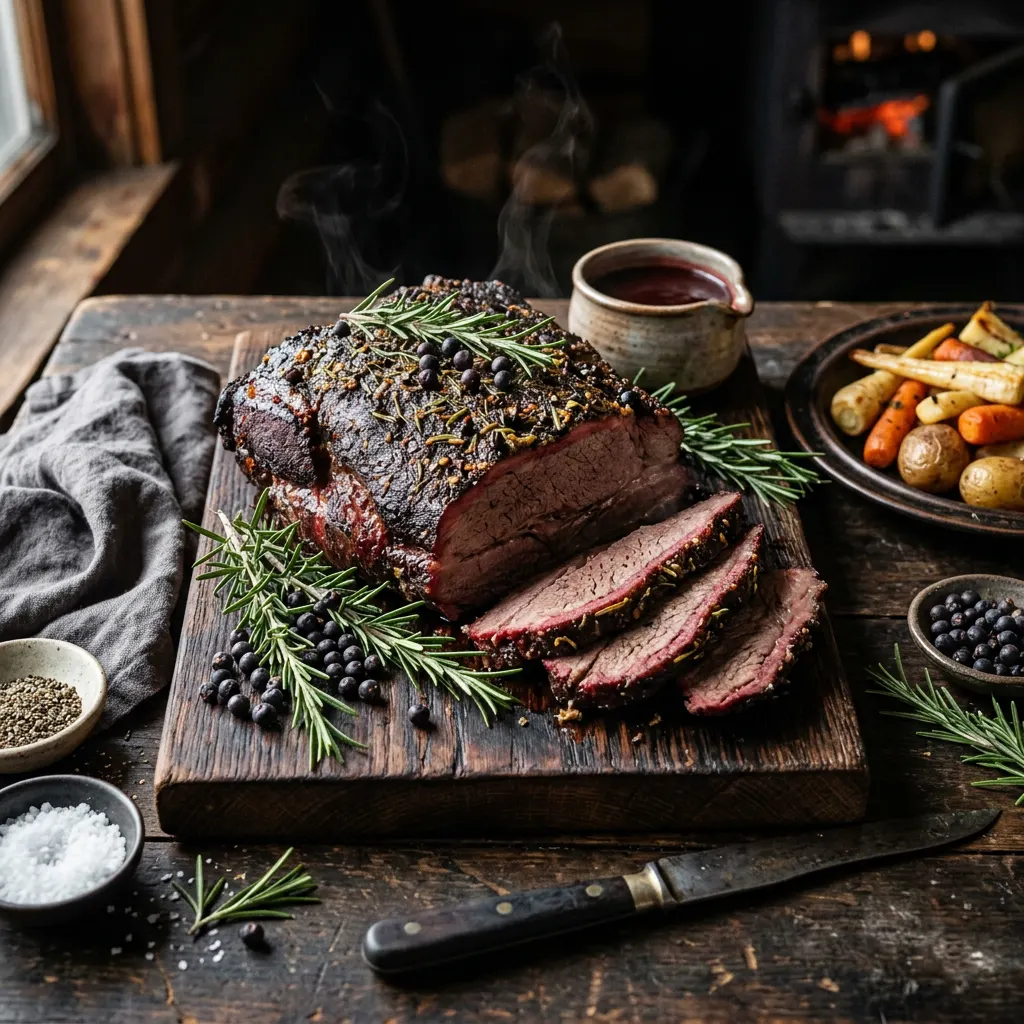
Smoked Bear Roast with Juniper & Rosemary
Bear shoulder benefits from bold aromatics — juniper, rosemary, and a mustard bind cut the richness and pair with the deep smoke ring.
Cook Mode
One step at a time, big text, timers, and your screen stays awake. 0/21 steps done.
Ingredients
Tap to tick off · 0/23 gathered
Method
Trim silverskin and excess fat. Rub with Dijon, then press juniper-rosemary-salt-pepper-garlic mix over the whole roast. Refrigerate 4 hours.
- 15 min
Pat the bear roast dry with paper towels. Trim any excessive fat or silver skin, leaving about 1/4 inch of fat cap. In a small bowl, combine coarse ground black pepper, kosher salt, crushed juniper berries, chopped fresh rosemary, garlic powder, and dry mustard powder to create your rub. Spread a thin layer of yellow mustard over the entire surface of the bear roast; this acts as a binder. Generously apply the dry rub to all sides of the roast, pressing it firmly into the meat.
Why it matters
Trimming ensures better bark formation and prevents excessive greasiness, while the mustard binder helps the rub adhere and contributes a subtle tang to the final flavor.
Common mistake
Not patting the meat dry before applying the rub, which can lead to a splotchy, uneven bark.
- 20 min
Pat the bear roast dry with paper towels. Trim any excess silver skin or hard fat, leaving about 1/4 inch of fat cap if present. In a small bowl, combine kosher salt, black pepper, crushed juniper berries, chopped rosemary, garlic powder, and smoked paprika. Apply a thin, even coat of Dijon mustard all over the roast, then generously apply the dry rub, pressing it into the meat.
Why it matters
Trimming removes undesirable textures and allows for better rub penetration. The mustard acts as a binder for the rub and adds a sharp counterpoint to the rich meat.
Common mistake
Leaving too much silver skin; it will not render and remains tough after cooking.
- 15 min
Pat the bear roast dry with paper towels. Trim any excessive fat, leaving about 1/4 inch intact for flavor and moisture, but ensure it's not too thick.
Why it matters
Drying the surface helps the rub adhere better, and trimming ensures the rub penetrates the meat effectively while preventing grease fires.
Common mistake
Leaving too much fat can prevent smoke penetration and make the final product greasy.
Bring to room temp. Smoke at 235°F over oak and cherry to internal 145°F, ~4 hours.
- 1h
Once seasoned, place the bear roast on a wire rack set over a baking sheet. Allow it to sit uncovered at room temperature for 30-60 minutes.
Why it matters
This allows the rub to penetrate the meat slightly and helps develop a pellicle on the surface, which is crucial for smoke adhesion and bark formation.
Common mistake
Placing the meat directly into the smoker without allowing the rub to set, resulting in a weaker bark and less intense smoke flavor.
- 20 min
In a small bowl, combine crushed juniper berries, chopped rosemary, kosher salt, black pepper, garlic powder, and onion powder. Spread a thin, even layer of Dijon mustard over the entire surface of the bear roast. Generously apply the dry rub mixture, pressing it firmly into the mustard binding on all sides.
Why it matters
The mustard acts as a binder, helping the rub stick to the meat, while also contributing a subtle tangy flavor that complements the bold aromatics.
Common mistake
Not pressing the rub firmly enough can lead to it falling off during cooking.
- 12h
Place the seasoned bear roast uncovered on a wire rack set over a baking sheet. Refrigerate for at least 4 hours, or preferably overnight (12-24 hours).
Why it matters
This allows the salt to penetrate deeply into the meat and helps form a pellicle, a slightly tacky surface perfect for smoke adhesion and bark development.
Common mistake
Skipping this step results in a less flavorful bark and less effective smoke ring.
Wrap in foil with olive oil. Continue until internal 165°F for food safety and 195°F for pull-apart, about 3-4 more hours.
- 12h
Place the seasoned bear roast uncovered on a wire rack set over a baking sheet. Refrigerate for at least 4 hours, or preferably overnight (12-18 hours).
Why it matters
Allowing the roast to air-dry in the refrigerator forms a pellicle, a tacky surface that helps smoke adhere better to the meat, resulting in a richer smoke flavor and a better bark.
Common mistake
Skipping this step can lead to a less intense smoke flavor and a less desirable bark.
- 235°F30 min
Preheat your smoker or pellet grill to a stable 235°F. Add oak and cherry wood chunks or pellets for a robust smoke flavor.
Why it matters
Maintaining a consistent low temperature is key for slow cooking tough cuts, allowing collagen to break down without drying out the meat. Oak provides a strong base, while cherry adds a fruity sweetness.
Common mistake
Not allowing the smoker to come to a stable temperature before placing the meat, leading to inconsistent cooking and poor smoke penetration.
- 235°F30 min
Set your smoker to 235°F. Add oak and cherry wood chunks or pellets to the smoker for a clean, consistent smoke. Prepare your spritz mixture by combining apple cider vinegar and water in a spray bottle.
Why it matters
Preheating ensures a stable temperature environment. The wood choice (oak for strong smoke, cherry for color and fruity notes) complements the bear and aromatics.
Common mistake
Placing meat in a cold smoker causes a dirty smoke flavor and slows down the cooking process.
Rest 30 minutes wrapped. Slice against the grain.
- 235°F4h
Place the seasoned bear roast directly on the smoker grates. Insert a probe thermometer into the thickest part of the meat, avoiding the bone. Close the lid and smoke, maintaining a constant smoker temperature of 235°F.
Why it matters
Slow smoking allows the connective tissues to tenderize gradually, and the low temperature helps prevent the muscle fibers from seizing up, resulting in a more tender product.
Common mistake
Opening the smoker lid too frequently, which causes temperature fluctuations and extends cook time significantly.
- 235°F30 min
Fill your pellet grill with oak and cherry wood pellets. Preheat the smoker to 235°F. Once the temperature is stable, add a water pan to the smoker if you have one.
Why it matters
Maintaining a stable temperature is crucial for even cooking, and the water pan helps to maintain humidity, preventing the meat from drying out.
Common mistake
Not allowing the smoker to come to a stable temperature before adding the meat can lead to inconsistent cooking.
- 235°F7h
Place the bear roast directly on the grates in the preheated smoker. Insert a reliable probe thermometer into the thickest part of the meat, avoiding the bone. Smoke until the internal temperature reaches 160°F. Begin spritzing with chicken broth every hour after the first 2 hours of smoking.
Why it matters
Smoking at a low temperature renders fat and breaks down tough muscle fibers slowly, resulting in tender meat. Spritzing keeps the surface moist, preventing it from drying out and promoting bark formation.
Common mistake
Opening the smoker too frequently to check the meat will cause temperature fluctuations and extend the cooking time.
- 235°F3h
Once the internal temperature reaches 150°F, remove the roast from the smoker. Wrap it tightly in butcher paper (or aluminum foil for a softer bark). Return to the smoker and continue cooking until the internal temperature reaches a minimum of 160°F for safety, ideally pushing for 195-205°F for tenderness, or until it probes tender like warm butter. Continue spritzing the butcher paper occasionally to maintain moisture.
Why it matters
Wrapping helps the meat push through the 'stall' and retains moisture, resulting in a more tender product. Cooking to 160°F+ is crucial for bear meat safety. Pushing to 195-205°F allows collagen to fully render.
Common mistake
Not cooking to a safe internal temperature, or pulling the meat too early resulting in a tough roast.
- 235°F3h
After 4 hours, or when the internal temperature reaches about 150°F, begin spritzing the roast every hour with a mixture of half apple cider vinegar and half water. Continue smoking until the internal temperature reaches a minimum of 160°F. For maximum tenderness, aim for a probe-tender temperature between 195-205°F, similar to pork shoulder, as indicated by very little resistance when probed.
Why it matters
Spritzing keeps the surface moist, which helps prevent the bark from getting too hard and allows more smoke flavor to adhere. Reaching a high internal temperature ensures the breakdown of tough collagen, crucial for a tender result in working-muscle cuts like bear shoulder, and guarantees food safety.
Common mistake
Pulling the bear off the smoker at 160°F assuming it's tender. While safe, it won't be as tender as it could be unless cooked to probe tender.
- 235°F1h
Once the internal temperature reaches 160°F, remove the roast from the smoker. Tightly wrap the roast in butcher paper or heavy-duty foil. Return the wrapped roast to the smoker and continue cooking until the internal temperature reaches 200-205°F and the meat is probe tender (the probe should slide in with little to no resistance).
Why it matters
Wrapping the meat helps it push through the 'stall' (where evaporation cools the meat, pausing temperature rise) and cooks it to tenderness while retaining moisture.
Common mistake
Not wrapping the meat can lead to a long stall and a drier end product.
- 1h 30m
Once the roast reaches its target internal temperature and is probe tender, carefully remove it from the smoker. Leave it wrapped and place it in an empty cooler or wrap it in towels for insulation. Let it rest for at least 1-2 hours.
Why it matters
Resting allows the muscle fibers to relax and reabsorb juices, resulting in a more tender and flavorful roast. Skipping this step means all the juices will run out when you slice.
Common mistake
Slicing the meat too soon after cooking will result in dry, tough meat as the juices escape.
- 10 min
Unwrap the rested bear roast. Slice against the grain into desired thickness. Serve immediately with your favorite sides.
Why it matters
Slicing against the grain shortens the muscle fibers, making the meat more tender and easier to chew.
Common mistake
Slicing with the grain will result in tough, chewy meat.
Cooks & Reviews
Guild members can rate this recipe, log their cooks and share photos.
Sign in to continueMember reviews
No reviews yet — be the first to rate this cook.
Ask the Pitmaster about this recipe
Substitutions, scaling, technique, troubleshooting — get answers grounded in this cook.
Sign in to try the AI Pitmaster on Smoked Bear Roast with Juniper & Rosemary. New members get 3 free questions.
Sign in to tryComments(0)
Loading comments…