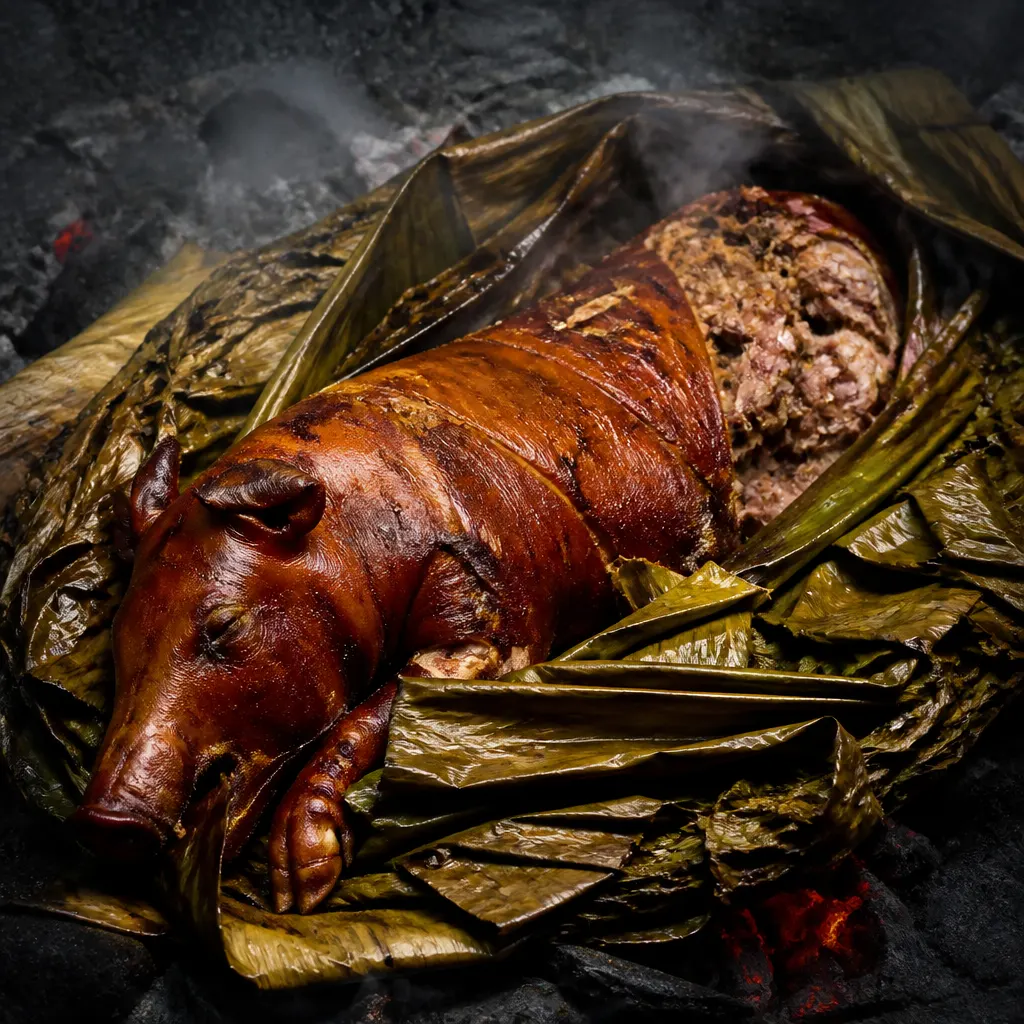
Whole Imu-Style Kalua Pig
The luau centerpiece, and the closest a backyard smoker gets to a true imu. A whole pig or a large half-hog, salted, wrapped in layers of ti and banana leaf to trap moisture the way an underground pit does, and smoked for the better part of a day. A full production that demands a big rig, a plan, and patience.
Cook Mode
One step at a time, big text, timers, and your screen stays awake. 0/9 steps done.
Ingredients
Tap to tick off · 0/5 gathered
- — MAIN —
Method
- 30 min
Using a sharp paring knife or meat fork, pierce the skin of the 20–40 lb whole suckling pig or half-hog all over to create entry points for seasoning. Rub 0.5 cup of Hawaiian sea salt aggressively into the cavity, the punctured skin, and the thickest muscle groups of the hams and shoulders. This dry-brining process uses the salt to draw moisture out and then re-absorb it as a concentrated brine, seasoning the pig to the bone while the salt helps denature the protein structure for a more tender result.
Why it matters
The brine equilibrates moisture and seasons through the flesh; skipping it gives you dry, bland pork.
Common mistake
Failing to pierce the skin, which prevents the salt from penetrating the fat cap to reach the meat.
- 38°F24h
Place the salted pig in a large tray or wrap it securely in plastic and refrigerate for 12–24 hours. Maintaining a temperature below 40°F is essential for food safety during this extended cure. Over this duration, the salt works through the meat via osmosis, improving water-holding capacity so the pig remains juicy during the long smoke. This step also allows the skin to dry slightly, which is the first step in achieving a better bark and fat render later.
Why it matters
Time allows the salt to penetrate deeply, ensuring a uniform flavor profile across large muscle groups.
Common mistake
Curing at room temperature, which risks bacterial growth in the food safety danger zone.
- 250°F1h
Prepare your large-scale smoker for indirect cooking, targeting a rock-steady temperature of 250°F. Use a mixture of Kiawe and Guava wood chunks to provide a traditional, pungent Hawaiian smoke profile. Ensure your fire is burning clean with 'blue smoke'—a nearly invisible, translucent exhaust—before adding the meat. This ensures the smoke remains sweet and aromatic rather than depositing bitter, black creosote that will be trapped under the leaf wrap in later steps.
Why it matters
A clean-burning fire prevents the accumulation of soot and bitter flavors that ruin large cuts.
Common mistake
Adding the meat while the smoke is thick and white, leading to a creosote-covered exterior.
- 150°F5h
Place the pig on the grate, silver-skin side up or cavity side down depending on your rig's specific airflow. Insert an ambient probe near the loin and a meat probe in the shoulder. Smoke the pig unwrapped for approximately 4–5 hours. During this phase, the meat is in the 40-140°F danger zone, so consistent heat is vital to move through this window safely. The goal is to build a deep, mahogany-bronze hue and allow the meat to absorb the Kiawe smoke before it is sealed for steaming.
Why it matters
This phase provides the only opportunity for the meat to take on smoke flavor and develop color.
Common mistake
Wrapping the pig too early before the smoke flavor has sufficiently permeated the surface.
- 250°F45 min
Lay out a double layer of heavy-duty foil, followed by a dense bed using 1 bundle of banana leaves and 1 bundle of ti leaves in an overlapping pattern. Move the pig onto the leaves and wrap it tightly, ensuring the leaves are in direct contact with the skin. The ti and banana leaves provide a floral, earthy aroma that mimics a traditional underground pit (imu). Seal the entire package with additional foil to create an airtight environment that will trap steam and break down heavy connective tissue.
Why it matters
The airtight leaf wrap creates a high-moisture environment that braises the collagen into gelatin.
Common mistake
Leaving gaps in the foil, which allows moisture to escape and causes the meat to stall indefinitely or dry out.
- 190°F8h
Return the wrapped pig to the 250°F smoker with a large drip pan underneath. Monitor the internal temperature through 'the stall'—the plateau caused by evaporative cooling usually occurring around 160-170°F. Since the pig is wrapped, this phase is effectively a braise. Maintain your firebox temperature to drive the internal temp through the stall and toward the finishing range. This phase generally takes 6 to 10 hours depending on the pig’s mass and bone density.
Why it matters
Consistent heat during this phase is what transforms tough muscle into tender, shreddable Kalua pork.
Common mistake
Opening the smoker too often to check the pig, which causes significant temperature drops.
- 203°F1h
Begin probing the meat through the foil once the internal temperature reaches 198°F. Focus on the center of the shoulder and the thickest part of the ham. The pig is officially done when an instant-read thermometer slides into the meat with zero resistance, like piercing room-temperature butter. This usually occurs around an internal temp of 203°F. If any resistance is felt, reseal the foil and continue cooking in 30-minute increments until the probe 'melts' into the meat.
Why it matters
Internal temperature is a guide, but physical tenderness (the 'probe test') is the only true indicator of doneness.
Common mistake
Pulling the pig based solely on time rather than waiting for the physical breakdown of connective tissue.
- 1h 30m
Remove the wrapped pig from the smoker and let it rest, fully encased in its leaf and foil layers, for at least 60–90 minutes. This is non-negotiable for large meats; the rest allows the muscle fibers to relax and reabsorb the rendered fats and juices rather than spilling them onto the cutting board. Carryover cooking will occur, potentially raising the temperature by several degrees, which helps finish the rendering process in a gentle, descending heat environment.
Why it matters
A proper rest ensures the juices stay within the meat fibers, preventing a dry and stringy texture.
Common mistake
Shredding the pig immediately after it comes off the smoker, causing all the 'liquid gold' moisture to evaporate.
- 165°F30 min
Carefully open the foil and leaves, being sure to save all accumulated juices in the bottom of the wrap. Discard the charred leaves. Benefit from the 'liquid gold' by pouring it into a bowl and skimming off excess grease. Shred the pork into long strands using two forks or insulated gloves. Toss the shredded meat with the reserved juices and a final sprinkle of Hawaiian sea salt to taste. Serve warm to showcase the silky texture and smoky, floral aroma of the imu process.
Why it matters
Reincorporating the cooking juices is the secret to the signature succulent texture of authentic Kalua pig.
Common mistake
Discarding the flavorful juices found inside the foil wrap.
7 more steps locked
You've seen the ingredients and the first two steps. Pit Members get every step, every temp, every glaze — plus the Cook Monitor and Pitmaster AI.
See Membership OptionsAlready a member? Sign in.
Sauce It
Cooks & Reviews
Guild members can rate this recipe, log their cooks and share photos.
Sign in to continueMember reviews
No reviews yet — be the first to rate this cook.
Ask the Pitmaster about this recipe
Substitutions, scaling, technique, troubleshooting — get answers grounded in this cook.
Sign in to try the AI Pitmaster on Whole Imu-Style Kalua Pig. New members get 3 free questions.
Sign in to tryComments(0)
Loading comments…