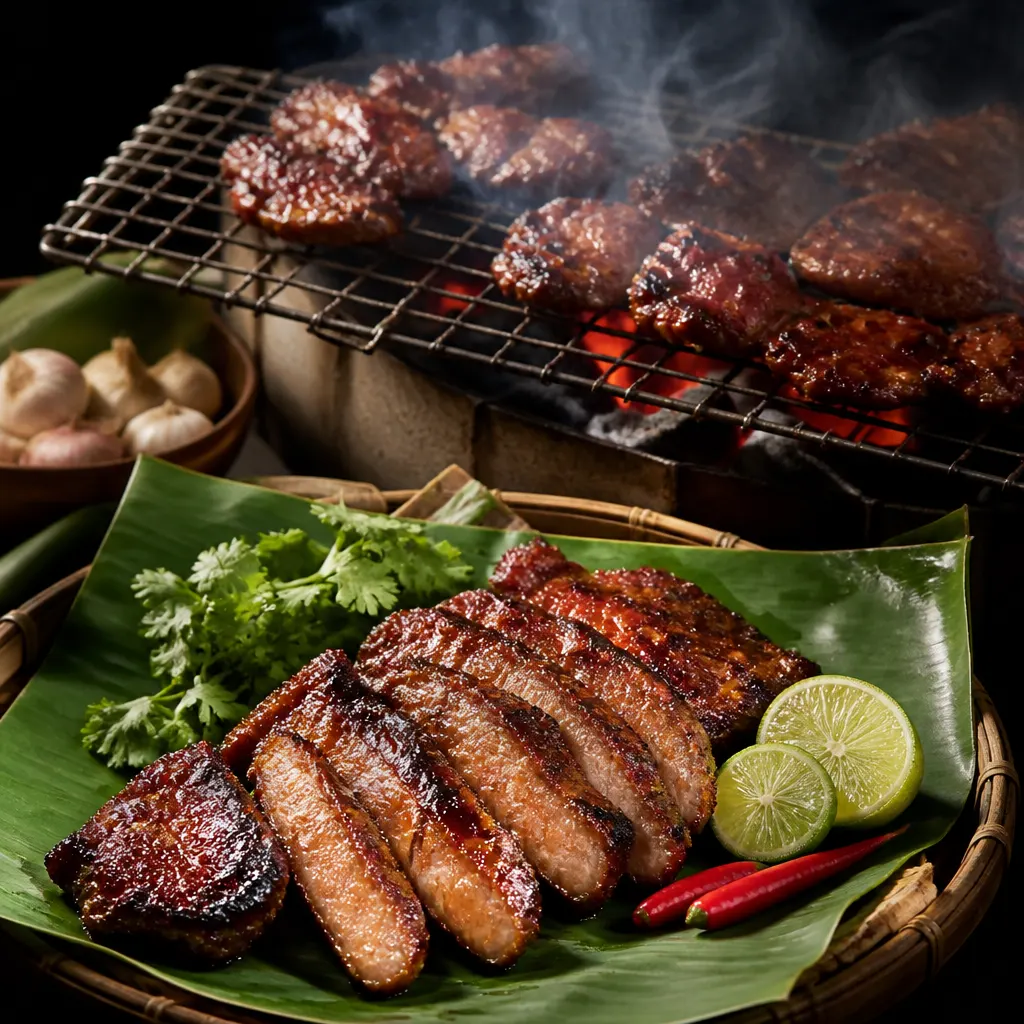
Vietnamese Lemongrass Smoked Pork
The flavor of any good Vietnamese street-cart: lemongrass, fish sauce, garlic, sugar, and black pepper. Smoking pork shoulder steaks in the same marinade gives you deeper, more layered flavor than the quick grill version.
Cook Mode
One step at a time, big text, timers, and your screen stays awake. 0/7 steps done.
Ingredients
Tap to tick off · 0/10 gathered
Method
- 15 min
Begin by removing the tough, fibrous outer layers of 3 lemongrass stalks until you reach the tender, pale core. Mince this core finely and place it into a food processor with 5 garlic cloves, 3 peeled shallots, 3 tbsp brown sugar, and 1 tsp black pepper. Pulse until the mixture forms a coarse, wet paste. This mechanical breakdown of the aromatics is essential because the cell walls of lemongrass are extremely tough; processing them ensures the essential oils are released and can penetrate the meat fibers during the cure phase.
Why it matters
Extracted aromatic oils provide the signature baseline flavor that cannot be achieved with whole or roughly chopped ingredients.
Common mistake
Leaving the woody outer layers of the lemongrass in the paste, which creates an unpleasant, straw-like texture in the final bite.
- 5 min
In a medium bowl, whisk together 3 tbsp fish sauce, 2 tbsp soy sauce, 1 tbsp lime juice, and 2 tbsp neutral oil until the sugar from the aromatic paste has fully dissolved. The fish sauce provides the necessary salt for brining, while the oil acts as a carrier for fat-soluble flavors and helps the smoke stick to the meat. This mixture creates an osmotic environment that draws seasoning deep into the 2.25 lbs of pork shoulder steaks.
Why it matters
The salt in the fish sauce denatures the meat proteins, allowing them to retain more moisture during the smoking process.
Common mistake
Using a flavored oil like toasted sesame which can scorch and overpower the delicate lemongrass notes.
- 40°F8h
Place the 3/4-inch pork shoulder steaks into a gallon-sized freezer bag and pour in the marinade, ensuring every surface of the 2.25 lbs of meat is contacted. Massage the bag to distribute the lemongrass and garlic bits evenly. Refrigerate for at least 4 hours, but no more than 12 hours. Because the marinade contains lime juice, an overnight soak (too long) will over-denature the proteins, turning the exterior of the pork mushy rather than tender.
Why it matters
Controlled curing time ensures deep flavor penetration without sacrificing the structural integrity of the pork slices.
Common mistake
Marinating for 24+ hours which results in a 'cooked' ham-like or mushy texture due to the acid in the lime juice.
- 275°F30 min
Preheat your smoker to a steady 275°F using apple wood for a mild, sweet smoke profile. While the smoker stabilizes, remove the pork from the marinade and pat the surface lightly—do not rinse. This leaves the aromatics on the surface to form a 'crust' while allowing the exterior to dry slightly. This surface dryness is the beginning of pellicle formation, which is vital for the smoke to adhere to the meat rather than washing off with excess moisture.
Why it matters
A clean-burning fire at 275°F provides the right balance of heat to render pork fat while setting the sugars in the marinade.
Common mistake
Putting soaking wet meat into a cold smoker, which leads to 'dirty' gray smoke adhesion and a bitter flavor.
- 145°F2h 15m
Arrange the steaks on the grates with at least 1 inch of clearance between each piece to allow for total smoke convection and even bark development. Close the lid and smoke until the internal temperature reaches 145°F. During this window, the sugars and fish sauce proteins will undergo the Maillard reaction, turning the steaks a deep mahogany color. Monitor the meat closely to ensure it passes through the 40-140°F danger zone efficiently.
Why it matters
Cooking to 145°F ensures food safety while maintaining the succulent, fatty texture of the pork shoulder steaks.
Common mistake
Opening the lid frequently to check the meat, which drops the temperature and extends the time in the bacterial danger zone.
- 150°F15 min
Remove the pork from the smoker once it hits the target internal temperature and transfer to a warm platter. Tent loosely with foil. Let the meat rest for 10 to 15 minutes. This allows the internal muscle fibers to relax and reabsorb the rendered fats and juices; if you cut immediately, the moisture will purge onto the board, leaving you with dry pork. This rest also allows for a small amount of carryover cooking to settle the bark.
Why it matters
Resting allows the pressure inside the meat to equalize, ensuring every bite is juicy and flavorful.
Common mistake
Wrapping the foil too tightly, which steams the bark and turns the beautiful smoked exterior soft.
- 5 min
Identify the grain of the meat and slice the steaks into thin, 1/4-inch strips across the grain. This shortens the muscle fibers, making the pork feel significantly more tender in the mouth. Serve the smoked pork alongside jasmine rice and traditional Vietnamese accompaniments like pickled carrots and daikon. The smoky notes of the apple wood will provide a modern BBQ twist on the traditional street-cart flavor profile.
Why it matters
Slicing across the grain is the final step in ensuring the texture meets competitive tenderness standards.
Common mistake
Slicing with the grain, which makes even a perfectly smoked pork shoulder feel chewy and tough.
Sauce It
Cooks & Reviews
Guild members can rate this recipe, log their cooks and share photos.
Sign in to continueMember reviews
No reviews yet — be the first to rate this cook.
Ask the Pitmaster about this recipe
Substitutions, scaling, technique, troubleshooting — get answers grounded in this cook.
Sign in to try the AI Pitmaster on Vietnamese Lemongrass Smoked Pork. New members get 3 free questions.
Sign in to tryComments(0)
Loading comments…