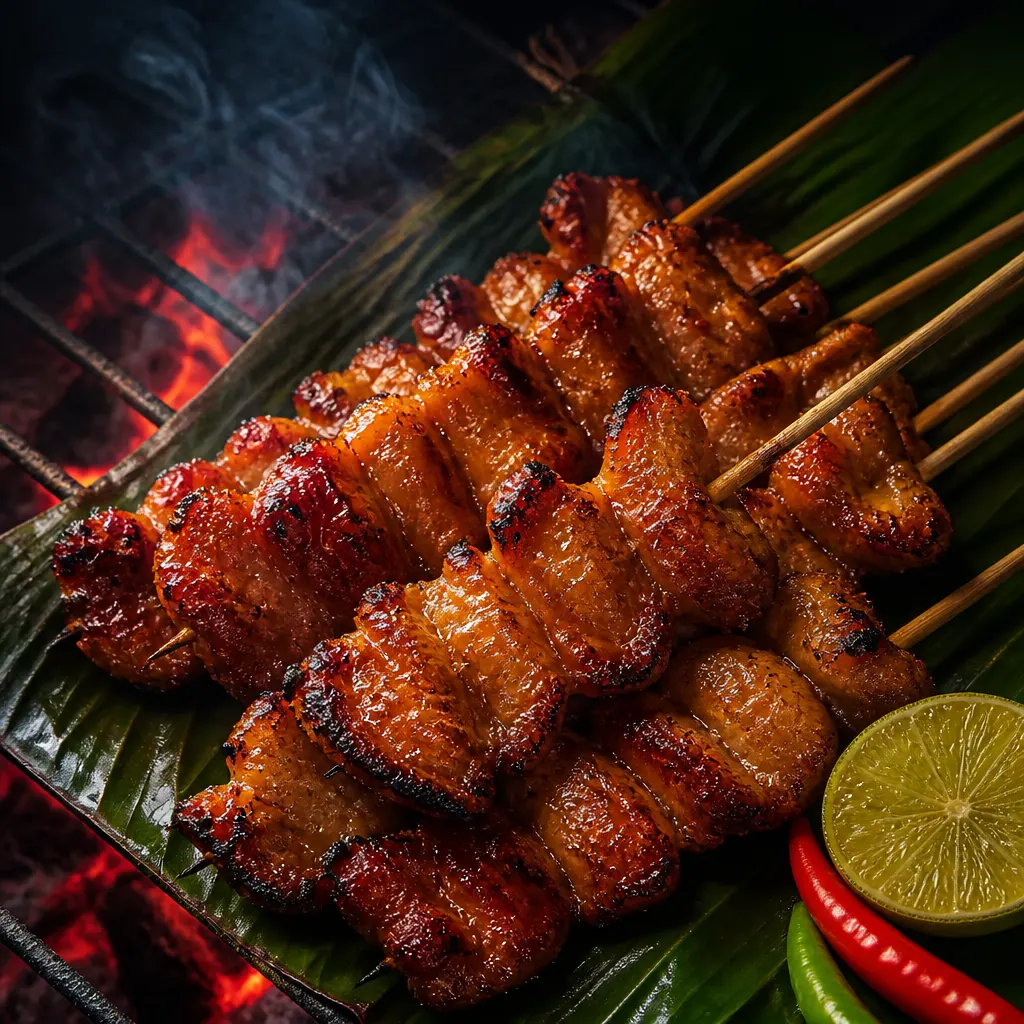
Thai Smoked Pork Skewers (Moo Ping)
Moo ping is the morning street-food skewer of Bangkok: sweet-savory marinated pork on a stick. The coconut-milk baste in the final minutes gives it the signature glossy crust.
Cook Mode
One step at a time, big text, timers, and your screen stays awake. 0/8 steps done.
Ingredients
Tap to tick off · 0/11 gathered
Method
- 15 min
Begin by creating the 'Sam Kler' (Thai Trinity), the flavor foundation of Moo Ping. Using a mortar and pestle, pound the 1 whole head of crushed garlic, the 1 bunch of cilantro roots and stems, and 1 tbsp of ground white pepper into a coarse, fibrous paste. Traditional Thai cooking relies on this mechanical smashing to rupture cell walls and release aromatic oils that a food processor simply slices through. This intense aromatic base provides the pungent, peppery heat that balances the sweet palm sugar later in the process.
Why it matters
The Sam Kler provides the essential aromatic backbone that prevents the pork from being cloyingly sweet.
Common mistake
Using a food processor instead of a mortar and pestle, which leads to less oil extraction and a duller flavor profile.
- 10 min
In a large mixing bowl, whisk together the aromatic paste with 0.333 cup coconut milk, 3 tbsp oyster sauce, 2 tbsp soy sauce, 2 tbsp fish sauce, and 3 tbsp palm sugar. Whisk vigorously until the dense palm sugar is completely dissolved and the coconut milk fat has emulsified with the savory sauces. The salts in the fish and soy sauces will act as a brine, while the coconut milk provides the fat needed to protect the pork shoulder during the low-and-slow smoking process.
Why it matters
The palm sugar must be fully dissolved to ensure even caramelization and prevent gritty spots on the finished bark.
Common mistake
Leaving sugar clumps in the marinade, which leads to uneven charring and bitter spots.
- 40°F8h
Submerge the 2 lbs of pork shoulder (cut into 1/2-inch strips) into the marinade. Use your hands to massage the liquid into the grain of the meat for at least 2 minutes, ensuring every strip is coated. Cover and refrigerate for 8 to 24 hours. This serves as a deep cure; the proteins will break down slightly and absorb the salt and aromatics, ensuring the flavor penetrates to the center of the meat rather than just sitting on the surface.
Why it matters
Shoulder is a working muscle that requires time for the salt to penetrate and tenderize the fibers.
Common mistake
Shortening the marinade time, which results in meat that is seasoned only on the exterior.
- 20 min
Soak your wooden skewers in water for at least 30 minutes to prevent them from igniting. Remove the pork from the marinade and thread the strips onto the skewers in an S-pattern, keeping the meat compact and bunching it together to prevent thin spots from overcooking. Ensure the meat covers the middle of the skewer completely; exposed wood in the center of the meat-pile can snap during the cook as it dries out.
Why it matters
Compact threading ensures the pork remains juicy and prevents the wood from burning through the center.
Common mistake
Leaving gaps between the meat pieces, which causes the pork to dry out and the skewer to burn.
- 275°F30 min
Preheat your smoker to a steady 275°F using Apple wood chunks for a gentle, fruity smoke that won't overpower the delicate coconut and cilantro notes. Ensure your grates are clean and lightly oiled. You are looking for 'thin blue smoke'—if the smoke is thick and white, it will leave a bitter creosote layer on the sugar-rich marinade. Check that your fuel bed is stable to avoid temperature spikes inside the 40-140°F danger zone.
Why it matters
A clean fire is vital for sugar-heavy marinades to avoid a bitter, acrid aftertaste.
Common mistake
Putting the meat on before the smoke has cleared, resulting in a gray, soot-tasting crust.
- 135°F25 min
Arrange the skewers on the hot grates, leaving at least 1 inch of space between each for airflow. Close the lid and smoke for 25 minutes. During this time, the smoke will adhere to the sugars and the pork fat will begin to render. Monitor the internal temperature until it hits 135°F. The goal here is setting the color; the meat should begin to transition from a pale pink to a deep, mahogany-red hue as the apple wood reacts with the palm sugar.
Why it matters
This phase builds the smoke profile and begins the rendering of the pork shoulder's intramuscular fat.
Common mistake
Opening the lid too often, which drops the temperature and stalls the rendering process.
- 145°F10 min
Open the lid and generously brush each skewer with the extra coconut milk using a pastry brush. The fatty coconut milk will mix with the rendering pork fat and palm sugar to create a glossy, lacquer-like finish. Close the lid and continue cooking for 5 to 10 minutes. This step adds a final layer of richness and moisture, helping the pork reach its safe final internal temperature of 145°F while creating a beautiful sheen.
Why it matters
The fat in the coconut milk basting prevents the exterior from becoming leathery and dry.
Common mistake
Skipping the baste, which results in a matte, dry appearance rather than the traditional gloss.
- 150°F5 min
Remove the skewers from the smoker and place them on a warm platter. Tent loosely with foil and let them rest for 5 minutes. This allows for carryover cooking to push the final temperature slightly higher while allowing the muscle fibers to relax and reabsorb juices. Serve alongside warm sticky rice. The rest is crucial; cutting into the meat immediately will cause the liquefied sugars and fats to run off, leaving the skewer dry.
Why it matters
Resting ensures the juices stay within the meat fibers, providing the hallmark succulent texture.
Common mistake
Serving immediately from the heat, which causes all the internal moisture to purge upon the first bite.
Sauce It
Cooks & Reviews
Guild members can rate this recipe, log their cooks and share photos.
Sign in to continueMember reviews
No reviews yet — be the first to rate this cook.
Ask the Pitmaster about this recipe
Substitutions, scaling, technique, troubleshooting — get answers grounded in this cook.
Sign in to try the AI Pitmaster on Thai Smoked Pork Skewers (Moo Ping). New members get 3 free questions.
Sign in to tryComments(0)
Loading comments…