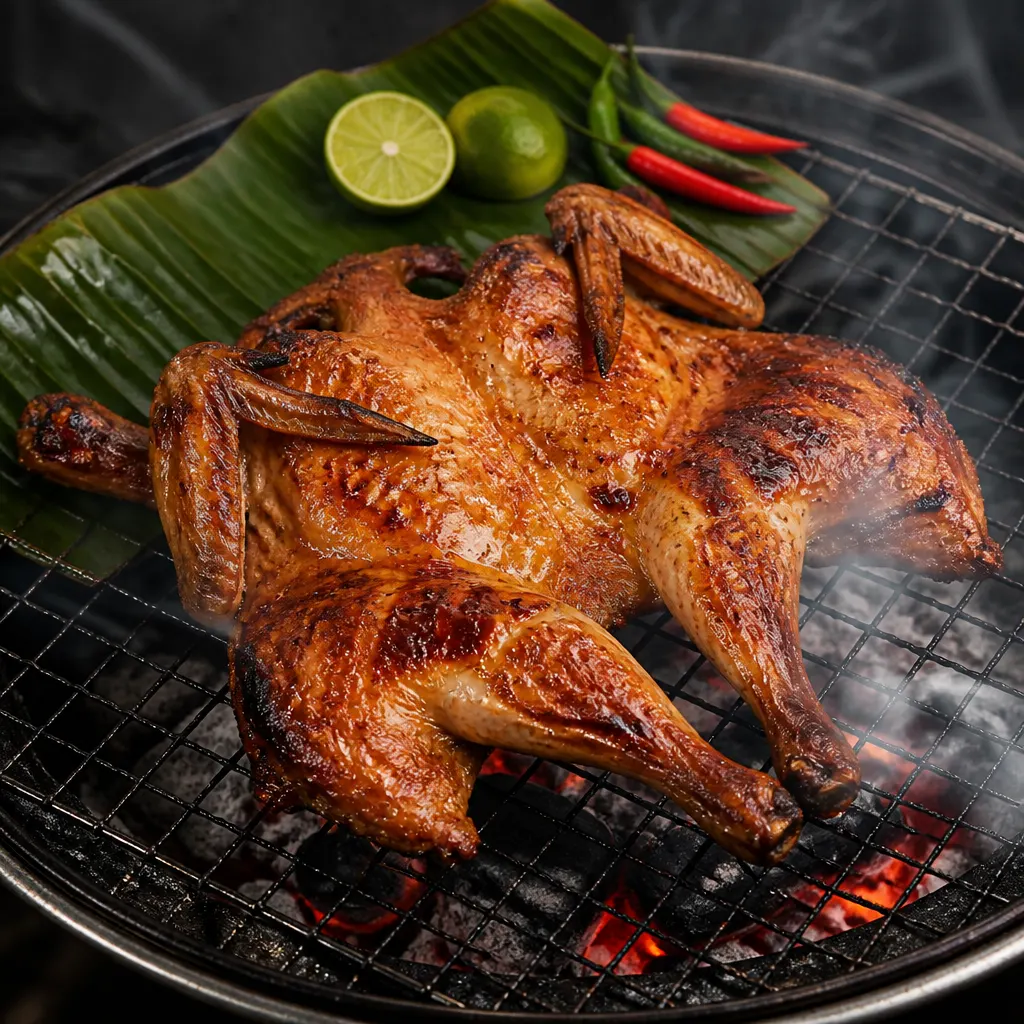
Thai Smoked Chicken (Gai Yang)
Gai yang is the smoky grilled chicken of northeastern Thailand, traditionally butterflied flat and cooked over coals. Bright, clean, and irresistible.
Cook Mode
One step at a time, big text, timers, and your screen stays awake. 0/10 steps done.
Ingredients
Tap to tick off · 0/16 gathered
Method
- 15 min
Begin by peeling one whole head of garlic and finely chopping the stems and roots of one bunch of cilantro. Using a mortar and pestle, pound the garlic, cilantro, and 1 tbsp of ground white peppercorns into a thick, uniform paste; this physical crushing releases essential oils that a food processor would merely slice. If a mortar isn't available, mince finely and mash with the flat of a knife until the mixture is pasty and fragrant. This paste forms the 'holy trinity' of Thai aromatics, providing the backbone of the Gai Yang profile.
Why it matters
Mechanical crushing of aromatics releases cell-bound oils for a deeper, more traditional flavor profile.
Common mistake
Using a food processor which can make the paste too watery and metallic-tasting.
- 10 min
In a non-reactive mixing bowl, whisk together 0.25 cup fish sauce, 2 tbsp soy sauce, 2 tbsp palm sugar, 2 tbsp lime juice, and 2 tbsp neutral oil. Add your prepared garlic-cilantro-pepper paste and whisk until the palm sugar is completely dissolved. The sugar is vital for later caramelization, while the acid in the lime juice begins to tenderize the muscle fibers. Ensure all solids are suspended evenly in the liquid to prevent patchy seasoning on the bird.
Why it matters
The oil acts as a carrier for fat-soluble flavors to penetrate the chicken skin and meat.
Common mistake
Leaving sugar crystals undissolved, which results in uneven burning during the final sear.
- 6h
Using sharp poultry shears, remove the backbone of the 4 lb whole chicken and press firmly on the breastbone until the bird lies completely flat. Apply the marinade generously, manually working it under the skin of the breasts and thighs to ensure direct contact with the meat. Place the chicken and all excess marinade into a vacuum bag or large heavy-duty sealable bag, removing as much air as possible to force the marinade against the skin. Refrigerate for 6 to 24 hours to allow the salt and aromatics to diffuse through the protein.
Why it matters
Spatchcocking increases surface area for smoke and ensures even cooking across different muscle groups.
Common mistake
Neglecting to rub marinade under the skin, leaving the breast meat bland.
- 1h
Remove the chicken from the marinade and pat the surface lightly with paper towels to remove excess moisture, but do not wash off the aromatics. Place the chicken skin-side up on a wire rack over a sheet pan and return it to the refrigerator, uncovered, for 60 minutes. This airflow creates a 'pellicle'—a tacky surface layer that allows smoke to adhere properly and prevents the 'rub-off' of flavor during the cooking process. A dry skin is also the only way to achieve a crisp finish later.
Why it matters
A dry, tacky surface is required for smoke particles to bond effectively to the meat.
Common mistake
Putting wet chicken directly into the smoker, which results in 'steamed' skin and poor smoke color.
- 275°F30 min
Stabilize your smoker at a consistent 275°F using apple wood chunks for a mild, fruity smoke profile that won't mask the delicate cilantro and lime notes. Ensure you have a 'clean' blue smoke coming from the stack; thick white smoke indicates poor combustion and will leave a bitter creosote taste on the poultry. Since poultry skin is most porous at the start of the cook, ensuring high-quality smoke early is critical for a KCBS-level appearance and taste.
Why it matters
Setting the temp at 275°F (rather than 225°F) helps render chicken fat more efficiently to avoid rubbery skin.
Common mistake
Using heavy woods like hickory or mesquite which overpower the Thai aromatics.
- 160°F2h
Place the bird skin-side up on the grates. Close the lid and monitor the internal temperature, avoiding the temptation to peak, which causes heat fluctuations. The goal is to move the chicken through the 40°F to 140°F 'Danger Zone' quickly for food safety while allowing enough time for smoke penetration. Smoke until the thickest part of the breast reaches an internal temperature of 160°F—the temperature will continue to rise during the subsequent sear and rest phases.
Why it matters
Controlled smoke absorption during the rise to 160°F builds the deep mahogany color judges look for.
Common mistake
Cooking strictly by time rather than using a calibrated internal thermometer.
- 165°F5 min
Immediately transfer the chicken to a high-heat grill or crank the smoker to its highest setting (450°F+). Place the chicken skin-side down for 3 to 5 minutes to crisp the skin and caramelize the sugars from the marinade. This step provides the Maillard reaction needed for the authentic Gai Yang 'char.' Monitor constantly; the sugar in the marinade can move from caramelized to burnt in seconds. Remove when the skin is GBD (Golden Brown and Delicious) and the internal temperature of the breast hit 165°F.
Why it matters
High heat is necessary to transform rubbery smoked skin into a bite-through texture.
Common mistake
Walking away during the sear, leading to carbonized, bitter skin.
- 5 min
While the meat undergoes its final rise, whisk 3 tbsp fish sauce, 2 tbsp lime juice, and 1 tbsp palm sugar in a bowl until clear. Fold in 1 tsp Thai chili flakes and 2 thinly sliced shallots. Crucially, add 1 tbsp of toasted rice powder (khao khua) at the very end; this toasted rice adds a nutty aroma and thickens the sauce through starch release. Top with fresh cilantro. This sauce provides the mandatory acid and heat to cut through the fatty, smoky chicken.
Why it matters
The toasted rice powder provides a textural element that defines authentic Isan-style dipping sauces.
Common mistake
Adding the rice powder too early, which makes the sauce unpleasantly sludge-like.
- 15 min
Transfer the chicken to a room-temperature cutting board and let it rest for 15 minutes. During this time, carryover cooking will finish bringing the thighs to approximately 175°F while the muscle fibers relax and reabsorb juices. If you carve too early, the moisture will evacuate onto the board, leaving the meat dry. Do not tent tightly with foil, as this will trap steam and soften the crispy skin you worked to achieve during the sear.
Why it matters
Resting allows internal pressure to equalize, ensuring every bite is moist.
Common mistake
Tightly foiling the bird, which ruins the skin's crispness via steaming.
- 5 min
Using a heavy cleaver or chef's knife, chop the chicken through the bone into bite-sized pieces in traditional street-food style. This presentation is standard for Gai Yang and makes the dish easier to eat with sticky rice. Serve the pieces piled high on a platter with the Jaew sauce on the side. Ensure each piece has a portion of the crispy, smoky skin attached for the perfect balance of flavor and texture.
Why it matters
Traditional chopping through the bone releases marrow flavor and adheres to the authentic Isan aesthetic.
Common mistake
Using a dull knife, which shreds the skin rather than slicing cleanly.
Sauce It
Cooks & Reviews
Guild members can rate this recipe, log their cooks and share photos.
Sign in to continueMember reviews
No reviews yet — be the first to rate this cook.
Ask the Pitmaster about this recipe
Substitutions, scaling, technique, troubleshooting — get answers grounded in this cook.
Sign in to try the AI Pitmaster on Thai Smoked Chicken (Gai Yang). New members get 3 free questions.
Sign in to tryComments(0)
Loading comments…