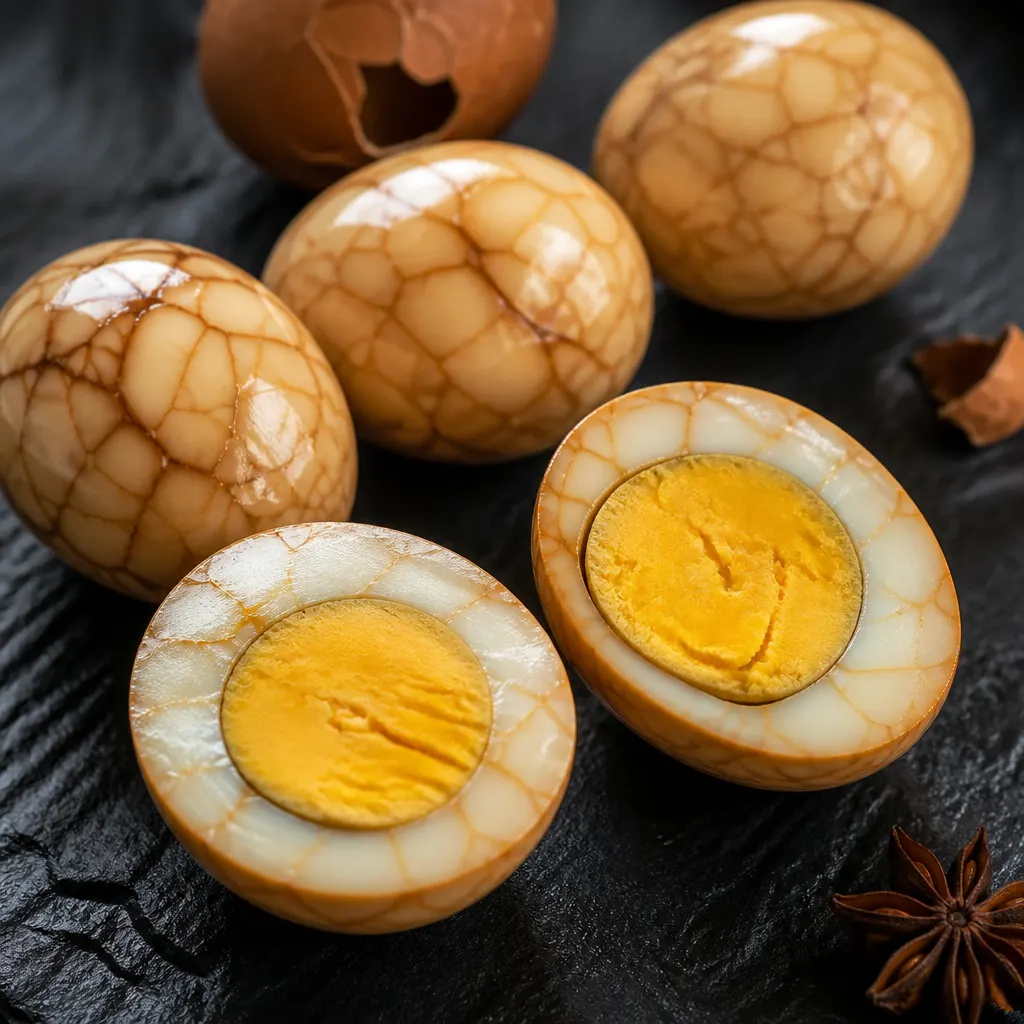
Tea-Smoked Marbled Eggs
Tea eggs are a beloved Chinese snack, hard-cooked eggs cracked and steeped in a spiced soy-and-tea brine until the whites turn into a beautiful marbled pattern. Adding a real tea-smoke stage deepens the flavor and gives them a gentle smokiness the steeped version lacks. They're a perfect introduction to zhangcha (tea-smoking), the technique that defines Chinese smoke, on the lowest-stakes ingredient possible. Cheap, beautiful, and addictive.
Cook Mode
One step at a time, big text, timers, and your screen stays awake. 0/8 steps done.
Ingredients
Tap to tick off · 0/12 gathered
Method
- 10 min
Take 8 hard-cooked and cooled eggs and gently tap them with the back of a spoon to create a fine web of cracks. You must ensure the shell remains intact and does not fall away from the membrane; these specific fractures act as pathways for the dark soy brine to penetrate the albumin. Uniform cracking yields a consistent mahogany spiderweb pattern, while deep gouges will result in large, unappealing blotches of color.
Why it matters
Physical fractures in the shell dictate the final aesthetic by controlling exactly where the concentrated pigment can reach the egg white.
Common mistake
Pressing too hard and peeling the shell early, which ruins the marbled effect.
- 212°F15 min
In a medium saucepan, combine 0.333 cup soy sauce, 2 tbsp dark soy sauce, 2 black tea bags, 2 star anise, 1 cinnamon stick, 1 tbsp sugar, 1 tsp five-spice powder, and 3 cups of water. Bring the mixture to a boil, then reduce to a simmer for 10 minutes. This step is a 'hot infusion' where the heat extracts the tannins from the tea and the essential oils from the spices, creating a highly concentrated liquid capable of flavoring the egg through the shell.
Why it matters
Simmering the spices and tea first ensures the flavoring compounds are fully dissolved and active before the eggs are introduced.
Common mistake
Using only light soy sauce, which lacks the viscosity and pigment needed for deep coloration.
- 40°F12h
Submerge the cracked eggs into the hot brine and remove from heat. Once the liquid reaches room temperature, transfer the eggs and brine to the refrigerator for a minimum of 4 hours, though 12 to 24 hours is preferred. This is a cold-soak equilibrium process; as the egg cools, it actually draws the seasoned liquid inward through the cracks via capillary action. Because eggs are susceptible to bacterial growth, ensure the brine stays below 40°F during the long soak.
Why it matters
Time is the primary variable for flavor depth; a short soak only seasons the surface and leaves the yolk bland.
Common mistake
Leaving the eggs in brine at room temperature for hours, which risks foodborne illness.
- 20 min
Remove the eggs from the brine and gently peel away the shells. Use a paper towel to pat each egg completely dry, then place them on a rack in a cool, ventilated area for 20 minutes. You are looking for a tacky, slightly matte surface known as a pellicle. In Zhangcha smoking, a wet surface acts as a barrier that prevents smoke molecules from bonding, often resulting in a bitter, acrid condensation rather than a clean smoke flavor.
Why it matters
A dry, tacky surface is required for smoke particles to adhere and polymerize correctly.
Common mistake
Attempting to smoke a wet egg, which leads to splotchy color and a metallic taste.
- 10 min
Line a heavy-duty wok or roasting pan with heavy-duty aluminum foil. Combine 0.25 cup raw rice, 0.25 cup brown sugar, and 0.25 cup loose black tea leaves in the center. The rice acts as a heat sink to prevent the sugar from burning too quickly, while the sugar provides sweetness and color, and the tea leaves provide the characteristic incense-like aroma. Place a wire rack over the mixture, ensuring it sits at least 2 inches above the dry ingredients.
Why it matters
The specific ratio of rice to sugar manages the temperature of the smoke to prevent the tea from turning bitter.
Common mistake
Forgetting the foil, which leads to sugar caramelizing and permanently bonding to your cookware.
- 180°F35 min
Arrange the eggs on the rack so they do not touch. Seal the container tightly and heat at 180°F (or medium heat on a stovetop) until fine wisps of smoke appear. Smoke for 30-35 minutes. Monitor the color—the eggs should transition from mahogany to a deep, lustrous bronze. This technique uses combustion of dry aromatics rather than wood logs, delivering a more delicate phenolic profile that complements the spices in the egg.
Why it matters
Controlled heat transforms the dry tea and sugar into an aromatic vapor that cures the exterior of the egg.
Common mistake
Opening the lid frequently to check, which releases the concentrated smoke and lowers the temperature.
- 10 min
Remove the eggs from the smoker and let them rest on a clean rack for 10 minutes. During this period, the smoke flavors on the surface begin to stabilize and mellow. If eaten immediately, the smoke can follow a 'sharp' profile; a short rest allows the oils from the tea and the caramel from the sugar to set into the egg protein, resulting in a smoother, more integrated flavor.
Why it matters
The rest allows the surface temperature to equalize, preventing the 'rub-off' of the freshly deposited smoke layer.
Common mistake
Chilling the eggs immediately in an airtight container, which can cause the smoke flavor to turn sour from trapped moisture.
- 5 min
Slice the eggs in half lengthwise using a sharp, thin-bladed knife or a clean piece of fishing line to prevent the yolk from sticking. The cross-section should reveal the contrast between the marbled white, the golden-bronze smoked exterior, and the creamy yolk. Serve cold or at room temperature as a standalone snack or as a garnish for congee or ramen. Store any leftovers refrigerated at 40°F or below.
Why it matters
Proper slicing technique preserves the visual marbling that is the hallmark of this dish.
Common mistake
Using a dull knife that drags through the yolk and obscures the marbled pattern of the whites.
Cooks & Reviews
Guild members can rate this recipe, log their cooks and share photos.
Sign in to continueMember reviews
No reviews yet — be the first to rate this cook.
Ask the Pitmaster about this recipe
Substitutions, scaling, technique, troubleshooting — get answers grounded in this cook.
Sign in to try the AI Pitmaster on Tea-Smoked Marbled Eggs. New members get 3 free questions.
Sign in to tryComments(0)
Loading comments…