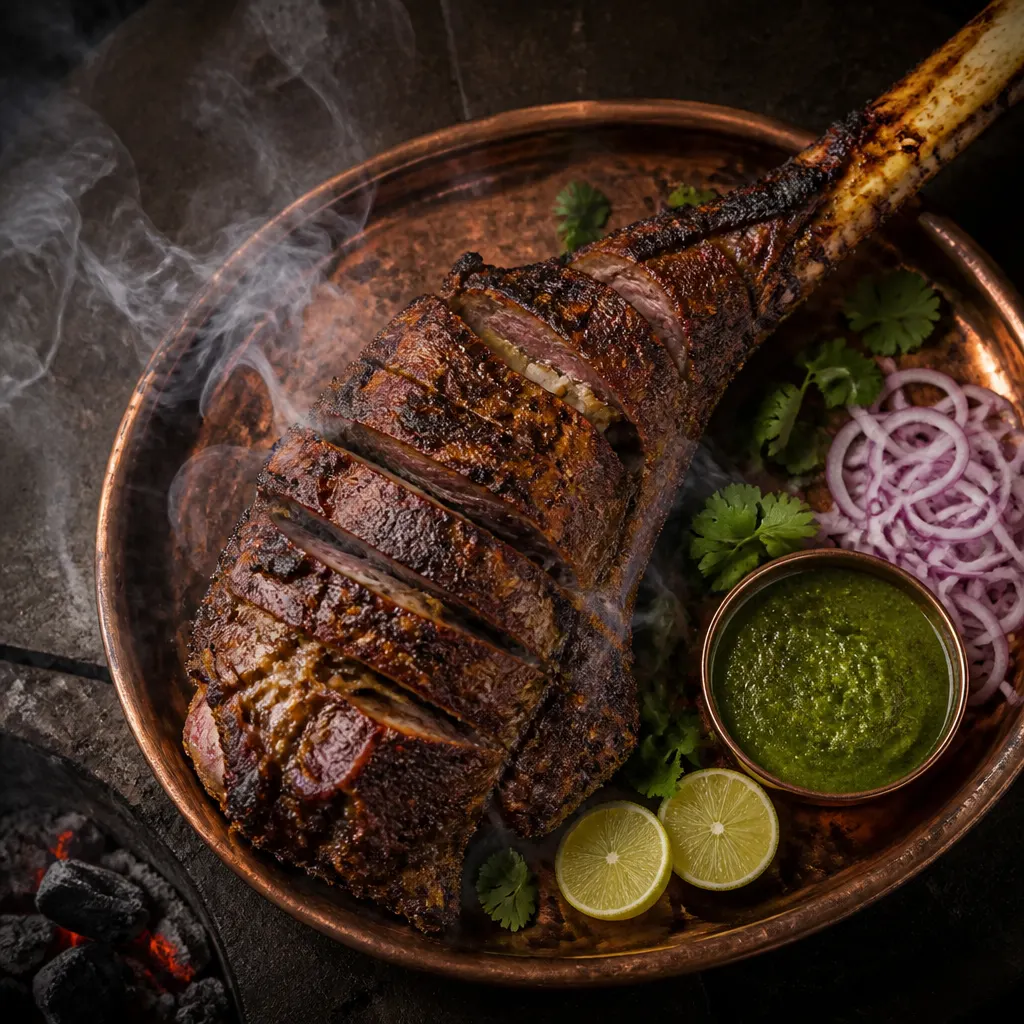
Tandoor-Style Smoked Whole Leg of Lamb (Raan)
The Mughal courts' grand whole lamb leg, slashed deep and marinated in yogurt, raw papaya, and warm spices for two days. A multi-day production and a true centerpiece.
Cook Mode
One step at a time, big text, timers, and your screen stays awake. 0/7 steps done.
Ingredients
Tap to tick off · 0/15 gathered
Method
- 4h
Begin by making deep, vertical slashes into the 7 lbs bone-in leg of lamb every 2 inches until the knife hits the bone. In a bowl, combine the 0.5 grated green papaya, 2 tbsp ginger-garlic paste, 2 tbsp lemon juice, and 1 tbsp salt. Rub this slurry aggressively into the slashes; the papain enzyme in the green papaya breaks down collagen, while the lemon and salt begin the denaturing process. Refrigerate the leg, uncovered on a wire rack, for exactly 4 hours. This initial 'cure' ensures that even the toughest muscle fibers near the bone are tenderized before the heat is applied.
Why it matters
The green papaya acts as a natural meat tenderizer that is essential for making a large, lean muscle like a leg of lamb succulent in a low-and-slow environment.
Common mistake
Leaving the papaya on for too long can turn the exterior meat mushy rather than tender.
- 48h
Wipe away the excess papaya pulp from the lamb. Whisk together 2 cups thick yogurt, 0.25 cup Kashmiri chili powder, the remaining 3 tbsp ginger-garlic paste, 2 tbsp garam masala, 1 tbsp ground cumin, 1 tbsp ground coriander, 1 tbsp ground cardamom, 1 tsp ground clove, 2 tbsp mustard oil, and the saffron threads soaked in 2 tbsp warm milk. Apply this heavy spice paste to the lamb, packing it deep into the slashes. The yogurt provides lactic acid for further tenderization, while the high fat content in the mustard oil and yogurt captures smoke-borne flavor compounds (phenols) later in the pit.
Why it matters
A multi-day marination allows the aromatics to penetrate deeply into the meat through osmosis, ensuring the center of the leg isn't bland.
Common mistake
Using thin, watery yogurt which will run off the meat instead of forming a thick, protective flavor barrier.
- 1h 30m
Remove the lamb from the marinade container and place it on a wire rack set over a sheet pan. Allow it to sit at room temperature for roughly 60-90 minutes before cooking. This timing serves two purposes: it takes the chill off the meat to prevent 'cold-shocks' when entering the smoker, and it allows the yogurt-based exterior to slightly tack up. A tacky surface, or pellicle, is superior for smoke adhesion, allowing the oak smoke to bond with the fat-soluble spices in the marinade.
Why it matters
Proper tempering ensures the meat cooks evenly from edge to center, preventing a gray, overcooked outer ring.
Common mistake
Placing ice-cold meat directly into the smoker, which leads to uneven cooking and 40-140 degree danger zone stalls.
- 275°F3h
Prepare your smoker for indirect cooking using clean-burning oak wood. Stabilize the temperature at 275°F, which is high enough to render the lamb's fat but low enough to prevent the yogurt marinade from scorching. Place the lamb on the grates with a drip pan underneath to avoid acrid flare-ups from the yogurt. During these first few hours, the smoke particles will attach to the moist yogurt surface, building the foundation of the 'bark' or crust that defines Mughlai-style Raan.
Why it matters
Oak provides a robust, medium-intensity smoke that mimics the flavor profile of traditional clay tandoors.
Common mistake
Using dirty, 'white' smoke which will make the delicate spices like saffron and cardamom taste bitter and ashy.
- 195°F2h
Continue smoking until the internal temperature reaches 160°F. At this stage, stop any basting to allow the yogurt coating to dehydrate and harden into a mahogany crust. The lamb must be cooked until the internal temperature reaches 195°F in the thickest part of the leg. This high temperature is necessary for a 'Raan' style preparation because the connective tissues must fully gelatinize to allow the meat to be easily pulled from the bone by hand.
Why it matters
The 195°F target ensures that the tough collagen in the leg is converted to gelatin, providing the characteristic 'melt-in-mouth' texture.
Common mistake
Pulling the meat too early at medium-rare (135°F-145°F), which results in a rubbery texture that won't release from the bone.
- 45 min
Remove the lamb from the pit and transfer to a warm platter. Tent the leg loosely with foil, ensuring you do not wrap it tightly, which would steam the bark and make it soggy. Let the meat rest for at least 45 minutes. During this time, carryover cooking will finish the tenderization process and the muscle fibers will relax, reabsorbing the hot juices that were pushed to the surface during the cook. This prevents the juices from purging out when you first slice into the leg.
Why it matters
Resting ensures the internal moisture is redistributed, preventing a dry, stringy final product.
Common mistake
Cutting into the meat immediately, causing all the internal juices to run out onto the cutting board.
Identify the bone-depth slashes made during the prep phase; these will serve as your carving guides. Use a sharp slicing knife to carve the lamb into thick chunks or allow guests to pull the meat away from the bone. The interior should be moist and aromatic, while the exterior should have a smoky, spicy snap. Serve with fresh naan and mint chutney to provide acidity that balances the rich, fatty lamb and the deep oak smoke profile.
Why it matters
Proper carving against the grain ensures the tenderest possible bite for the guest.
Common mistake
Slicing too thin, which causes the ultra-tender meat to shred and lose its structural integrity.
5 more steps locked
You've seen the ingredients and the first two steps. Pit Members get every step, every temp, every glaze — plus the Cook Monitor and Pitmaster AI.
See Membership OptionsAlready a member? Sign in.
Sauce It
Cooks & Reviews
Guild members can rate this recipe, log their cooks and share photos.
Sign in to continueMember reviews
No reviews yet — be the first to rate this cook.
Ask the Pitmaster about this recipe
Substitutions, scaling, technique, troubleshooting — get answers grounded in this cook.
Sign in to try the AI Pitmaster on Tandoor-Style Smoked Whole Leg of Lamb (Raan). New members get 3 free questions.
Sign in to tryComments(0)
Loading comments…