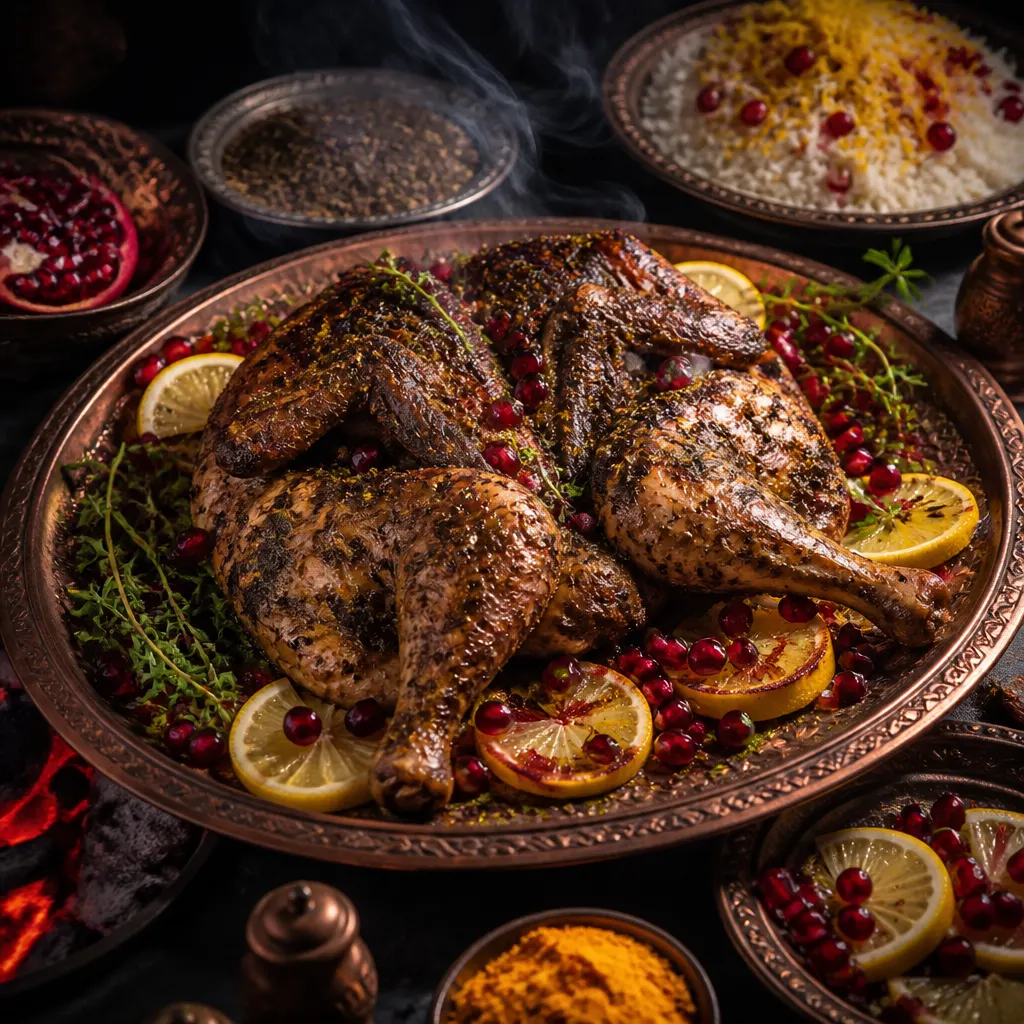
Sumac & Za'atar Smoked Chicken
The elegant Levantine cousin to shawarma — bright, clean, and herbal. Za'atar and fresh lemon make a smoked bird that proves Middle Eastern smoke doesn't have to be spicy or rich.
Cook Mode
One step at a time, big text, timers, and your screen stays awake. 0/8 steps done.
Ingredients
Tap to tick off · 0/8 gathered
Method
- 10 min
Begin by whisking together 3 tbsp of high-quality Za'atar, 2 tbsp of Sumac, 0.25 cup of Olive oil, 3 tbsp of fresh Lemon juice, 5 cloves of grated Garlic, 1 tbsp of Salt, and 1 tsp of Black pepper. This mixture should form a thick, spreadable paste that balances the earthiness of the thyme with the bright acidity of the sumac and lemon. Whisk until the salt crystals are well-distributed so the marinade can act as a wet brine, facilitating osmotic flavor transfer into the bird's muscle fibers.
Why it matters
The high acid content from the lemon and sumac works with the salt to tenderize the meat while the oil carries fat-soluble flavor into the tissue.
Common mistake
Using pre-ground, stale spices which result in a dusty, muted flavor instead of the bright, herbal profile required for this dish.
- 15 min
Ensure your 4.5 lb whole chicken is spatchcocked by removing the backbone and pressing the breastbone flat. Use your fingers to gently separate the skin from the meat over the breast and thighs, being careful not to tear it. Apply one-third of your prepared paste directly onto the meat under the skin, then slather the remaining two-thirds over the entire exterior of the bird. This 'under-the-skin' technique ensures that the meat is seasoned directly even if the skin is removed later.
Why it matters
Spatchcocking increases the surface area exposed to heat and smoke, ensuring the dark meat and white meat finish closer to the same time.
Common mistake
Failing to season under the skin, which prevents the herbs and salt from penetrating the dense breast meat.
- 12h
Place the coated bird in a food-safe container or vacuum bag and refrigerate. Allow the chicken to marinate for a minimum of 4 hours, though 12 hours is ideal for maximum flavor depth. During this time, the salt draws moisture in while the lemon juice begins to break down tough proteins. This is equivalent to a wet brine but with high-density aromatics to ensure the smoke doesn't overpower the delicate Levantine herbs later.
Why it matters
Time allows the salt to reach the center of the bird, preventing the common problem of poultry being flavorful on the outside but bland on the inside.
Common mistake
Leaving the bird at room temperature to 'marinate faster,' which risks entering the 40-140°F danger zone for bacterial growth.
- 275°F30 min
Preheat your smoker to a consistent 275°F using oak or apple wood. You are looking for thin, blue smoke (TBS) rather than thick white billows, which contain bitter creosote. Remove the chicken from the refrigerator 20 minutes before smoking to slightly reduce the temperature delta, which promotes more even heat penetration and helps the skin start the rendering process more quickly once it hits the grates.
Why it matters
Clean smoke is essential for poultry because the skin is highly absorbent; poor fire management will result in an acrid, 'ashy' taste.
Common mistake
Putting meat on before the smoker has stabilized, exposing the bird to the 'dirty' smoke of a starting fire.
- 275°F2h
Place the chicken skin-side up on the center of the cooking grate. Ensure it is laid out perfectly flat to maximize airflow. Close the lid and maintain a steady 275°F. During this phase, the sumac in the rub will react with the wood smoke to develop a deep, mahogany-red hue. Avoid the temptation to spritz, as the oil in the marinade will naturally baste the skin and we want to preserve the herbal crust we've built.
Why it matters
A temperature of 275°F is high enough to render poultry fat effectively, preventing the 'rubbery' skin common in lower-temperature smoking.
Common mistake
Opening the lid frequently to peek, which causes massive temperature swings and adds significantly to the cook time.
- 165°F30 min
Monitor the internal temperature using a calibrated probe. You are looking for the breast meat to hit a minimum of 165°F and the thighs to reach 175°F. While 165°F is the safety standard, the dark meat in the thighs contains more connective tissue that requires the higher 175°F mark to fully soften and pull away from the bone cleanly. Once these targets are hit, immediately remove the bird from the heat to prevent overcooking from carryover.
Why it matters
Hitting these specific internal temps ensures the bird is juicy and safe, staying above the 140°F threshold for safety while preserving moisture.
Common mistake
Judging doneness by the color of the juices instead of using a thermometer, which is inaccurate and can lead to foodborne illness.
- 15 min
Transfer the chicken to a warm cutting board and let it rest undisturbed for 15 minutes. Do not tent tightly with foil, as this will trap steam and turn your carefully crafted herbal skin soggy. During the rest, the muscle fibers relax and reabsorb the internal juices; if you cut too early, those juices will end up on the board rather than in the meat. Expect a slight carryover rise in temperature of about 3-5 degrees.
Why it matters
Resting allows the internal pressure of the meat to equalize, ensuring every bite is moist and the texture is consistent.
Common mistake
Carving the bird immediately after removal, which results in dry meat and a loss of the savory lemon-herb juices.
- 10 min
Carve the bird into eight pieces (two breasts, two wings, two thighs, two drumsticks). For an authentic Levantine presentation, apply a final light dusting of fresh sumac over the skin to provide a vibrant, acidic 'pop.' Serve with sides that cut through the smoke, such as a garlic toum or pickled turnips. The final product should display a visible smoke ring and a fragrant, herbal crust that mirrors the high standards of professional competition BBQ.
Why it matters
The final application of fresh sumac replaces the volatile oils lost during the cook, hitting the judge’s palate with an immediate bright note.
Common mistake
Drowning the smoked chicken in heavy, molasses-based BBQ sauce which completely masks the delicate za'atar and sumac profile.
Sauce It
Cooks & Reviews
Guild members can rate this recipe, log their cooks and share photos.
Sign in to continueMember reviews
No reviews yet — be the first to rate this cook.
Ask the Pitmaster about this recipe
Substitutions, scaling, technique, troubleshooting — get answers grounded in this cook.
Sign in to try the AI Pitmaster on Sumac & Za'atar Smoked Chicken. New members get 3 free questions.
Sign in to tryComments(0)
Loading comments…