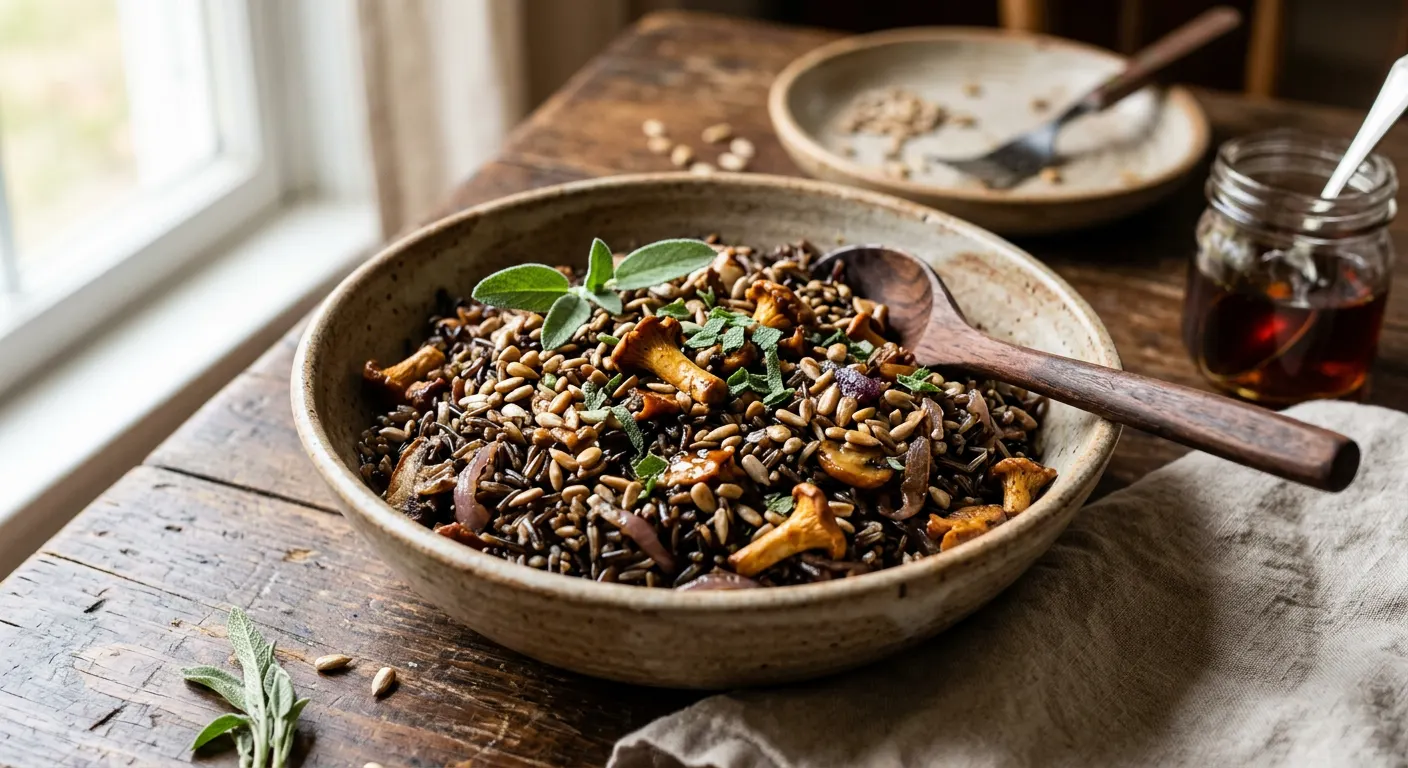
Smoked Wild Rice with Mushrooms & Maple
Great Lakes (Anishinaabe / Ojibwe). True wild rice (manoomin) is a sacred food of the Anishinaabe peoples of the Great Lakes, hand-harvested from canoes and utterly different from the cultivated black rice sold as wild rice. This dish smokes mushrooms and onions, then folds them through nutty wild rice with maple and herbs. It's earthy, chewy, and deeply tied to place, a side dish that carries real cultural weight and pairs with every game and fish dish on this card.
Cook Mode
One step at a time, big text, timers, and your screen stays awake. 0/7 steps done.
Ingredients
Tap to tick off · 0/9 gathered
Method
- 10 min
In a large mixing bowl, combine 8.0 oz of halved mushrooms and 1.0 whole diced onion with 2.0 tbsp of oil or rendered fat. Standard technique for smoking vegetables requires a fat coating to act as an adhesive for smoke molecules (adsorption). Ensure every surface is glistened; this fat barrier also prevents the mushrooms from dehydrating into leather. Spread the vegetables in a single layer on a perforated grill tray or a wide cast-iron skillet to maximize surface area for smoke contact.
Why it matters
Fat acts as a smoke magnet and prevents the vegetables from becoming dry and leathery during the cook.
Common mistake
Crowding the tray, which causes the vegetables to steam rather than absorb smoke.
- 275°F20 min
Preheat your smoker to a steady 275°F using maple or apple wood. These fruitwoods are preferred for indigenous Great Lakes cuisine because they offer a sweet, mellow smoke that won't overpower the delicate earthy notes of the manoomin. Ensure you have 'blue smoke'—a thin, translucent stream—before adding the food; heavy white smoke indicates incomplete combustion and will leave a bitter, creosote flavor on the porous mushrooms.
Why it matters
Clean combustion is essential for delicate ingredients like mushrooms that absorb flavor quickly.
Common mistake
Putting the food in while the smoker is still producing thick, billowy white smoke.
- 275°F45 min
Place the vegetable tray on the smoker grate. Smoke for approximately 45 minutes until the mushrooms have shrunk by about 20% and the onions are soft and translucent. Periodically rotate the tray if your smoker has hot spots. You are looking for a deep mahogany color on the mushrooms and a soft, smoky fragrance. Do not overcook; the goal is to soften and flavor, not to crisp or char the vegetables.
Why it matters
Mushrooms are incredibly porous and absorb smoke faster than meat, requiring a shorter window of exposure.
Common mistake
Leaving the vegetables in too long until they become bitter from excessive smoke saturation.
- 40 min
While the vegetables smoke, combine 1.0 cup of true wild rice and 3.0 cups of stock or water in a medium saucepan. Bring the liquid to a rolling boil, then immediately drop to a low simmer and cover. True hand-harvested manoomin is far more delicate than commercial black rice and requires a gentle simmer to prevent the grains from breaking. This step provides the neutral, nutty base that the smoke will eventually season.
Why it matters
Gentle simmering preserves the integrity and unique texture of hand-harvested indigenous rice.
Common mistake
Boiling the rice too vigorously, which results in a gummy, mushy texture.
- 10 min
Begin checking the rice after 35 minutes. You are looking for the 'bloom'—where the dark husks split and curl back to reveal a pale, tender interior. Taste the rice; it should be tender with a slight nutty resistance, but no hard crunch. Once the majority of grains have bloomed, immediately drain any excess liquid through a sieve to stop the hydration process; allowing rice to sit in hot water after it is done will lead to over-saturation.
Why it matters
Properly timed draining prevents the rice from reaching 'mush' status and keeps the grains distinct.
Common mistake
Using a fixed timer instead of visual cues, leading to overcooked, broken rice grains.
- 5 min
Return the hot, drained rice to the saucepan and gently fold in the smoked mushrooms and onions. Add 1.0 tbsp of maple syrup, 1.0 tbsp of dried sage or thyme, and salt to taste. The residual heat from the rice will bloom the dried herbs and thin the maple syrup, allowing it to coat each grain. This is a delicate process—use a spatula to fold rather than a spoon to stir to keep the grains intact.
Why it matters
Folding gently ensures the smoked components are distributed without mashing the tender rice.
Common mistake
Over-mixing the rice until it loses its individual grain structure and becomes a paste.
- 145°F
Transfer the mixture to a serving vessel and top with 0.25 cup of toasted sunflower seeds or hazelnuts. These provide a critical fatty, crunchy contrast to the soft chew of the rice and the umami of the mushrooms. Serve immediately while warm. If holding for service, keep the dish above 140°F to stay out of the bacterial danger zone, though best texture is achieved when served immediately after folding.
Why it matters
The addition of toasted nuts introduces a necessary textural layer that defines the dish.
Common mistake
Adding the nuts too early, which causes them to lose their crunch from the steam of the rice.
Cooks & Reviews
Guild members can rate this recipe, log their cooks and share photos.
Sign in to continueMember reviews
No reviews yet — be the first to rate this cook.
Ask the Pitmaster about this recipe
Substitutions, scaling, technique, troubleshooting — get answers grounded in this cook.
Sign in to try the AI Pitmaster on Smoked Wild Rice with Mushrooms & Maple. New members get 3 free questions.
Sign in to tryComments(0)
Loading comments…