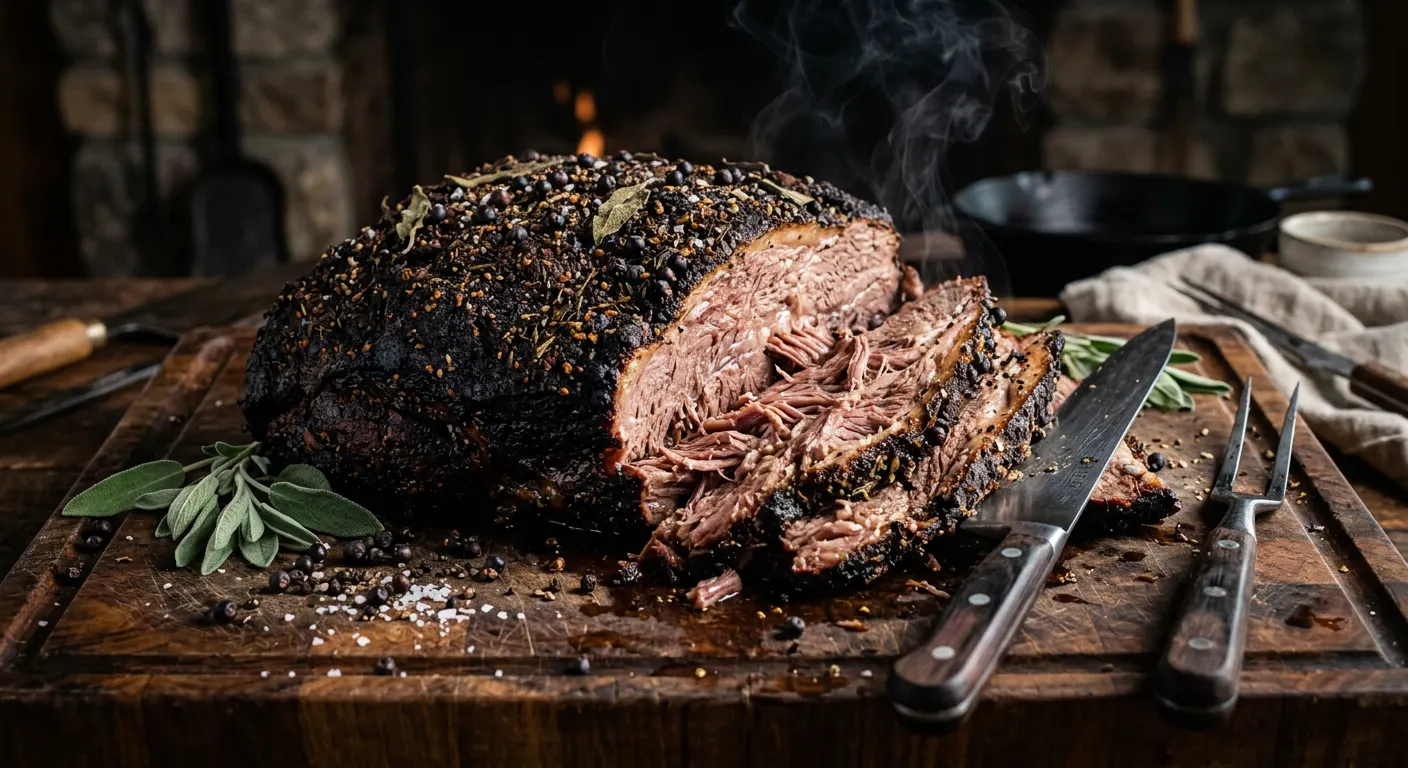
Smoked Whole Bison Roast (Plains-Style)
Great Plains (Lakota / Blackfoot / Plains nations). The bison was everything to the Plains nations, food, shelter, tools, and the spiritual center of life, and a whole smoked bison roast is a fitting centerpiece for a feast. A chuck or shoulder roast, rubbed with juniper, sage, and salt, smoked low and slow until it pulls apart. Bison's leanness makes a big roast genuinely challenging, it can dry out where beef wouldn't, so this is an advanced cook that rewards a careful hand and a wrap. Deeply flavorful and deeply meaningful.
Cook Mode
One step at a time, big text, timers, and your screen stays awake. 0/8 steps done.
Ingredients
Tap to tick off · 0/9 gathered
Method
- 24h
Begin by patting the 6 lbs bison chuck or shoulder roast completely dry with paper towels. In a bowl, combine 3 tbsp coarse salt, 2 tbsp coarse black pepper, 2 tbsp crushed juniper berries, 2 tbsp dried sage, and 1 tbsp garlic powder. Apply this mixture heavily to all surfaces of the roast, pressing firmly so the spices adhere. This 'dry brine' technique is essential for bison; the salt draws moisture out, dissolves the spices, and then pulls that seasoned brine back into the lean muscle fibers. Place the roast in a glass dish, cover tightly, and refrigerate for 12 to 24 hours to allow the juniper and sage to penetrate the meat deeply.
Why it matters
The brine equilibrates moisture and seasons through the lean bison muscle; skipping it results in a bland, dry roast.
Common mistake
Using fine table salt instead of coarse salt, which will over-salt the meat and ruin the flavor balance.
- 250°F45 min
Preheat your smoker to a stable 250°F using a blend of oak and maple wood; the oak provides a traditional foundational smoke while maple adds a subtle sweetness that complements the bison's mineral notes. While the pit stabilizes, whisk together 1 cup beef or bison stock, 0.25 cup maple syrup, and 2 tbsp rendered fat or oil in a saucepan over low heat. It is critical to keep this mop warm; applying cold liquid to the meat during the cook will 'shock' the muscle fibers and cause them to contract, pushing out valuable moisture.
Why it matters
Preheating the mop liquid prevents the meat temperature from plummeting during basting, which maintains cooking momentum.
Common mistake
Using a cold mop liquid that stalls the internal temperature and toughens the exterior bark.
- 250°F1h 30m
Place the cold roast on the center of the grate and insert a digital probe thermometer into the thickest part of the meat. Ensure the meat is not in the 'danger zone' (40-140°F) for more than 4 hours to ensure food safety. Close the lid and smoke undisturbed for the first 90 minutes. This initial phase is where the smoke particles adhere to the moisture on the surface to form the 'bark.' Avoid the temptation to peek; maintaining a consistent 250°F environment is key to beginning the slow breakdown of connective tissue in the shoulder.
Why it matters
Undisturbed early smoke is necessary for the Maillard reaction and smoke ring development to occur properly.
Common mistake
Opening the lid too frequently, which fluctuates the temperature and dries out the lean exterior.
- 250°F3h
After the initial 90 minutes, begin mopping the roast every 60 minutes using your warm stock, syrup, and fat mixture. Use a soft brush or mop to gently dab the liquid onto the meat rather than wiping, which could strip away the spice crust. Because bison is significantly leaner than beef, it lacks the internal fat to self-baste; this manual hydration adds surface moisture and sugar from the maple syrup, which helps build a complex, tacky bark while keeping the exterior supple.
Why it matters
Frequent mopping replaces the missing intramuscular fat and prevents the lean bison from becoming leathery.
Common mistake
Wiping the mop across the meat instead of dabbing, which removes the herb rub.
- 160°F1h
Monitor the internal temperature closely until it reaches approximately 160°F. At this point, the roast will likely 'stall' as evaporative cooling equals the heat input. Lay out two overlapping sheets of heavy-duty aluminum foil or peach butcher paper. Place the roast in the center, pour any remaining mop liquid over it, and wrap it tightly. This creates a high-moisture 'braising' environment inside the wrap, which is the only way to ensure a 6 lb bison chuck roast becomes tender without drying out completely.
Why it matters
The wrap creates a micro-environment of steam that forces the meat through the stall and softens collagen.
Common mistake
Wrapping too loosely, which allows steam to escape and results in a 'pot-roast' texture rather than smoked bark.
- 195°F2h
Continue cooking the wrapped roast at 250°F until the internal temperature reaches 195°F to 203°F. While temperature is a guide, tenderness is the ultimate indicator. Use a temperature probe or skewer to poke through the wrap into the meat; it should slide in with zero resistance, feeling like it is entering a jar of peanut butter. If you feel 'grip' or resistance, the connective tissues haven't fully gelatinized yet—continue cooking in 20-minute increments until it yields.
Why it matters
Connective tissue only melts into gelatin at these high internal temperatures, which is what makes a tough cut edible.
Common mistake
Pulling the meat based solely on time rather than the 'probe-tender' feel, leading to a chewy roast.
- 1h
Remove the wrapped roast from the smoker and place it in an insulated cooler (without ice) or a cold oven. Let it rest for a minimum of 60 minutes. During this time, the carryover heat finishes the rendering process, and the internal pressure drops, allowing the muscle fibers to reabsorb the juices. If you cut into the bison immediately, the moisture will rush out, and the meat will turn grey and dry in minutes. The internal temperature will typically rise about 5 degrees during the first part of the rest.
Why it matters
Resting allows meat fibers to relax and hold onto juice; for lean bison, this is the difference between success and failure.
Common mistake
Cutting the roast too early out of hunger, which wastes hours of careful hydration work.
- 15 min
Unwrap the roast carefully on a large cutting board, being sure to save the 'liquid gold' (jus) captured in the foil. For a traditional Plains-style presentation, you can pull the roast into large, succulent chunks or slice it against the grain into thick slabs. Drizzle the reserved jus over the meat before serving. Serve the bison alongside traditional indigenous sides like wild rice or squash to honor the spirit of the animal and the culinary heritage of the Great Plains.
Why it matters
Slicing against the grain further breaks down the muscle fibers, ensuring every bite is tender for the guests.
Common mistake
Discarding the foil juices, which contain the concentrated flavor of the juniper, sage, and bison fat.
6 more steps locked
You've seen the ingredients and the first two steps. Pit Members get every step, every temp, every glaze — plus the Cook Monitor and Pitmaster AI.
See Membership OptionsAlready a member? Sign in.
Cooks & Reviews
Guild members can rate this recipe, log their cooks and share photos.
Sign in to continueMember reviews
No reviews yet — be the first to rate this cook.
Ask the Pitmaster about this recipe
Substitutions, scaling, technique, troubleshooting — get answers grounded in this cook.
Sign in to try the AI Pitmaster on Smoked Whole Bison Roast (Plains-Style). New members get 3 free questions.
Sign in to tryComments(0)
Loading comments…