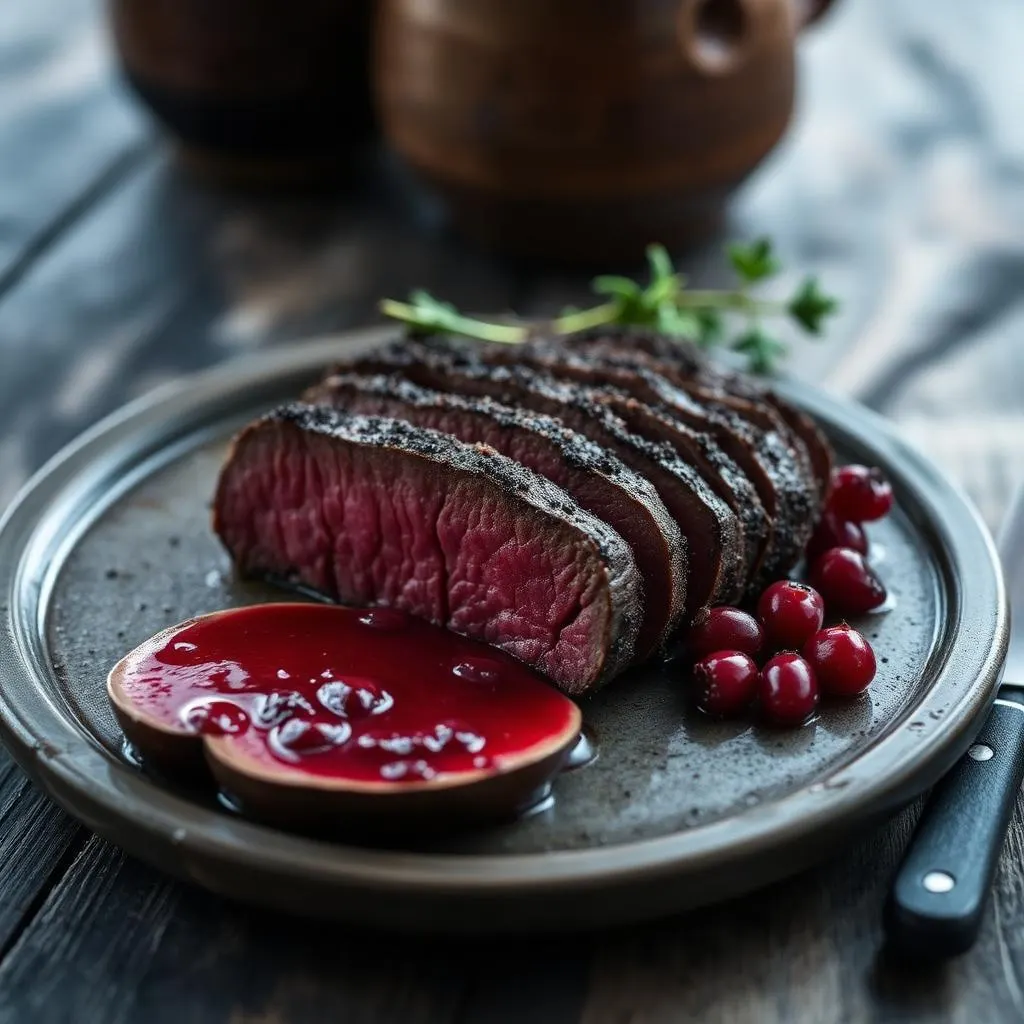
Smoked Venison Loin with Juniper
The meat of the far north — lean, dark, deeply tied to Sami and Nordic tradition. A precision smoke with juniper aromatics, pulled early at medium-rare.
Cook Mode
One step at a time, big text, timers, and your screen stays awake. 0/9 steps done.
Ingredients
Tap to tick off · 0/11 gathered
- — MAIN —
- — BRINE —
- — RUB & FINISH —
Method
- 20 min
In a medium saucepan, combine 4 cups water, 3 tbsp kosher salt, 2 tbsp brown sugar, 2 tbsp crushed juniper berries, 1 tbsp black peppercorns, and 2 thyme sprigs. Bring the mixture to a simmer over medium heat, stirring until the salt and sugar are fully dissolved. It is critical to cool this brine to below 40°F before adding the meat; placing raw venison in warm liquid initiates the 'danger zone' for bacterial growth and ruins the protein structure. This brine uses a specific salt-to-water ratio to denature the lean proteins of the backstrap, allowing them to hold onto moisture during the smoke.
Why it matters
The brine equilibrates moisture and seasons through the flesh; skipping it gives you dry, bland venison.
Common mistake
Adding the meat to a warm brine, which partially cooks the exterior and compromises food safety.
- 12h
Submerge the 2 lbs of trimmed venison loin (all silverskin must be removed) into the chilled brine. Ensure the meat is completely covered and refrigerate for 4 to 12 hours. Venison is an ultra-lean muscle with very little intramuscular fat; the brine acts as an insurance policy by increasing the cellular water capacity. Do not exceed 12 hours, as the high salt concentration can begin to cure the meat too deeply, resulting in a tight, ham-like texture rather than a tender steak profile.
Why it matters
Brining lean game ensures that the protein fibers don't contract and squeeze out all moisture when they hit the heat.
Common mistake
Leaving the meat in the brine for too long, which results in an overly salty, rubbery texture.
- 30 min
Remove the loin from the brine and discard the liquid. Pat the meat completely dry with paper towels on all sides. Place the venison on a wire rack over a sheet pan and let it sit at room temperature for 30 minutes. This air-drying phase forms a 'pellicle'—a slightly tacky surface layer. This is vital for the smoke step, as smoke particles (phenolics) adhere more efficiently to a tacky surface than a wet or bone-dry one, creating a deep mahogany color.
Why it matters
A proper pellicle provides the surface tension needed for smoke to stick and create a rich color.
Common mistake
Leaving surface moisture on the meat, which causes it to steam and creates a grey, unappealing exterior.
- 5 min
Combine 1 tbsp of toasted and ground juniper berries with 1 tsp coarse salt and 1 tsp cracked black pepper. Evenly coat the entire surface of the loin, pressing the spices firmly into the tacky pellicle. We use toasted juniper to unlock the resinous oils that pair specifically with the wild, lean notes of the backstrap. This rub isn't just for flavor; the coarse salt and pepper provide the texture for the 'crust' once the meat hits the heat.
Why it matters
Toasting the juniper berries transforms their flavor from medicinal to savory and aromatic.
Common mistake
Using pre-ground juniper which has lost its volatile oils and lacks the punch needed for game.
- 225°F45 min
Preheat your smoker to a steady 225°F using alder wood or a mix of oak and dried juniper branches. Place the loin in the center of the grate. Smoke is a flavor ingredient here, not a preservation method. Use a digital probe to track the internal temperature carefully. Because venison is so lean, it has almost no thermal mass to shield it from overcooking; you are aiming for a slow climb to ensure the internal temperature is uniform from edge to center.
Why it matters
Low and slow heat allows for a gradual rise in temperature, preventing the exterior from toughening before the center is done.
Common mistake
Forgetting that venison cooks significantly faster than beef due to its lack of fat.
- 130°F
Monitor the internal temperature until it reaches exactly 130°F. This is the critical threshold for venison backstrap. At 130°F, the meat is a perfect medium-rare. Because of the lean nature of game, 'well-done' is synonymous with 'inedible.' Remove the meat from the smoker immediately once it hits the target. Have your cast iron skillet preheated and ready for the final step to minimize the time the meat sits in the cooling air.
Why it matters
Precision temperature control is the only way to ensure the meat remains juicy and tender in the absence of fat.
Common mistake
Pulling the meat too late; even a 5-degree overshoot can result in a dry, livery flavor.
- 135°F3 min
In a screaming-hot cast iron pan, melt a generous knob of butter. Place the smoked loin in the pan and sear for 45-60 seconds per side. Use a spoon to continuously pour the foaming butter over the meat (basting). This fat-wash adds a rich mouthfeel back to the lean protein and creates a Maillard reaction crust. The butter also acts as a carrier for the smoke flavor you've already established, intensifying the finished profile.
Why it matters
The hot sear adds complex roasted flavors and the essential fat that venison naturally lacks.
Common mistake
Searing for too long, which creates a thick grey band of overcooked meat beneath the surface.
- 135°F10 min
Transfer the seared loin to a warm board and let it rest, uncovered, for 10 minutes. During this time, carryover cooking will bring the final internal temp to roughly 135°F. More importantly, the heat allows the pressurized muscle fibers to relax and reabsorb the internal juices. If you slice now, the brine-held moisture will run out on the board, leaving you with dry meat regardless of how perfectly you smoked it.
Why it matters
Resting allows the internal pressure to equalize so the juices stay inside the medallions when sliced.
Common mistake
Cutting into the meat immediately because it smells good, causing all the juice to be lost.
- 5 min
Slice the loin against the grain into medallions roughly 3/4 inch thick. The interior should be a uniform ruby red. Serve immediately on warmed plates. This cut is a showpiece of Nordic tradition; the combination of the juniper brine, the alder smoke, and the butter baste creates a layer of flavor that honors the animal and the technique. Pair with traditional sides like lingonberries to provide an acidic counterpoint to the rich smoke.
Why it matters
Slicing against the grain breaks up the long muscle fibers, ensuring every bite is tender.
Common mistake
Slicing too thin, which causes the lean meat to lose its heat and moisture rapidly.
7 more steps locked
You've seen the ingredients and the first two steps. Pit Members get every step, every temp, every glaze — plus the Cook Monitor and Pitmaster AI.
See Membership OptionsAlready a member? Sign in.
Cooks & Reviews
Guild members can rate this recipe, log their cooks and share photos.
Sign in to continueMember reviews
No reviews yet — be the first to rate this cook.
Ask the Pitmaster about this recipe
Substitutions, scaling, technique, troubleshooting — get answers grounded in this cook.
Sign in to try the AI Pitmaster on Smoked Venison Loin with Juniper. New members get 3 free questions.
Sign in to tryComments(0)
Loading comments…