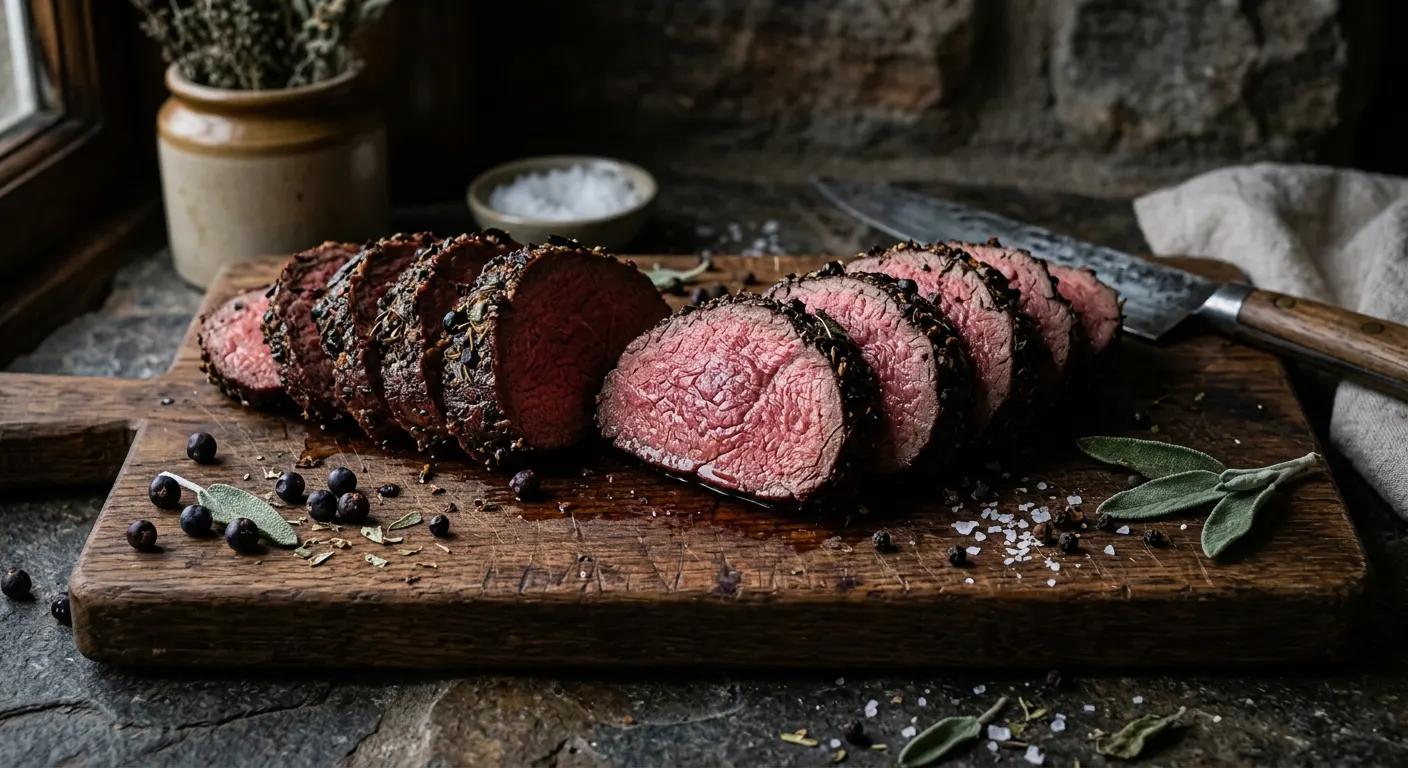
Smoked Venison Backstrap with Juniper & Sage
Eastern Woodlands / Plains. Venison has fed Indigenous peoples across the continent for millennia, and it's still the most widely hunted game in North America. The backstrap (loin) is the prime cut, lean and tender, and it takes a juniper-sage rub and a gentle smoke beautifully. The whole challenge is its leanness, there's no fat to forgive overcooking, so this is a precision smoke with an early pull. Earthy, clean, and deeply traditional.
Cook Mode
One step at a time, big text, timers, and your screen stays awake. 0/8 steps done.
Ingredients
Tap to tick off · 0/7 gathered
Method
- 15 min
Begin by meticulously removing every trace of the silvery, translucent connective tissue known as silverskin from the 2.0 lbs of venison backstrap using a sharp boning knife. Silverskin does not break down during the short smoking window and will cause the lean loin to curl and become chewy. Once trimmed, pat the meat completely dry with paper towels to ensure the rub adheres to the muscle rather than sliding off on a film of moisture.
Why it matters
Removing silverskin is non-negotiable for venison as it is tough, bitter, and prevents smoke and seasoning from reaching the meat.
Common mistake
Leaving silverskin on, which results in a rubbery texture that ruins the tenderness of the prime cut.
- 10 min
In a small bowl, combine 1.0 tbsp crushed juniper berries, 1.0 tbsp dried sage, 1.0 tbsp coarse salt, and 1.0 tsp black pepper. Whisk in 2.0 tbsp maple syrup and 2.0 tbsp oil to create a thick, gritty paste. The oil serves as a fat-soluble carrier for the sage and juniper aromatics, while the maple syrup provides the necessary sugars for surface caramelization during the later searing phase.
Why it matters
The oil and syrup create an emulsion that binds the dry spices to the lean meat while providing a buffer against the dry heat of the smoker.
Common mistake
Using pre-ground juniper, which lacks the essential oils found in freshly crushed berries.
- 40°F4h
Apply the paste to the venison, massaging it firmly into all surfaces. Wrap the meat tightly in plastic wrap to force the salt into the muscle fibers and refrigerate for 4 to 8 hours. This duration is critical for food safety and texture; the salt denatures the proteins to help the lean meat retain moisture, while the 40°F environment prevents the growth of harmful bacteria during the long marination.
Why it matters
Proper curing seasons the meat to the core and helps prevent the 'livery' taste often associated with poorly handled game.
Common mistake
Skipping the refrigeration time, which leads to a surface-only seasoning and a lack of moisture retention.
- 225°F45 min
Preheat your smoker to a steady 225°F using a maple-oak wood blend. Aim for 'blue smoke'—a nearly invisible, thin vapor—rather than thick white billows, which can turn lean venison bitter. Fill your water pan with hot water to create a humid environment; because venison carries almost no intramuscular fat, humidity is your only defense against the meat drying out during the cook.
Why it matters
A stable, humid temperature of 225°F allows the heat to penetrate the meat slowly without tightening the lean fibers too quickly.
Common mistake
Smoking with 'dirty' white smoke, which overwhelms the delicate, earthy flavor of the venison.
- 120°F1h
Insert a digital probe into the center of the thickest part of the backstrap and place it on the grates. Smoke the meat until it reaches an internal temperature of 120°F. Do not open the lid frequently, as heat fluctuations can cause the lean muscle to contract. The goal here is to infuse the wood aromatics while bringing the internal temperature up evenly to the edge of rare.
Why it matters
Stopping at 120°F provides the necessary thermal 'headroom' to perform a sear without overcooking the center.
Common mistake
Relying on time rather than an internal thermometer, leading to overcooked, dry meat.
- 130°F5 min
Remove the venison from the smoker once it hits 120°F. Immediately place it in a preheated cast iron skillet or over a direct flame at 500°F+. Sear for only 45-60 seconds per side. You are looking for the maple syrup in the rub to caramelize into a dark crust. Pull the meat the moment the internal temperature hits 130°F for medium-rare; venison becomes dry and 'gamey' if it climbs even five degrees higher.
Why it matters
Searing creates the Maillard reaction, providing a savory depth that complements the sweetness of the maple and the earthy juniper.
Common mistake
Searing for too long, which creates a thick, gray band of overcooked meat beneath the surface.
- 135°F15 min
Transfer the backstrap to a warm plate and tent very loosely with foil—do not wrap it tightly or the crust will soften. Allow the meat to rest for 10 to 15 minutes. During this time, the carryover heat will finish the cook, and the muscle fibers will relax, reabsorbing the juices that were pushed to the center during the sear.
Why it matters
Cresting at 135°F during the rest ensures the juices stay in the meat fiber instead of spilling onto the cutting board.
Common mistake
Cutting the meat too soon, which causes a total loss of moisture in a cut that already lacks fat.
- 5 min
Identify the direction of the muscle fibers and slice the backstrap across the grain into 1/2-inch thick medallions. Slicing against the grain shortens the fibers, making each bite significantly more tender. Serve immediately while the meat is at its peak temperature of 135°F, ideally alongside the juices collected on the resting plate.
Why it matters
Correct slicing across the grain is the final step in ensuring the lean backstrap has a melt-in-the-mouth texture.
Common mistake
Slicing with the grain, which results in a stringy, difficult-to-chew experience regardless of how well it was cooked.
Cooks & Reviews
Guild members can rate this recipe, log their cooks and share photos.
Sign in to continueMember reviews
No reviews yet — be the first to rate this cook.
Ask the Pitmaster about this recipe
Substitutions, scaling, technique, troubleshooting — get answers grounded in this cook.
Sign in to try the AI Pitmaster on Smoked Venison Backstrap with Juniper & Sage. New members get 3 free questions.
Sign in to tryComments(0)
Loading comments…