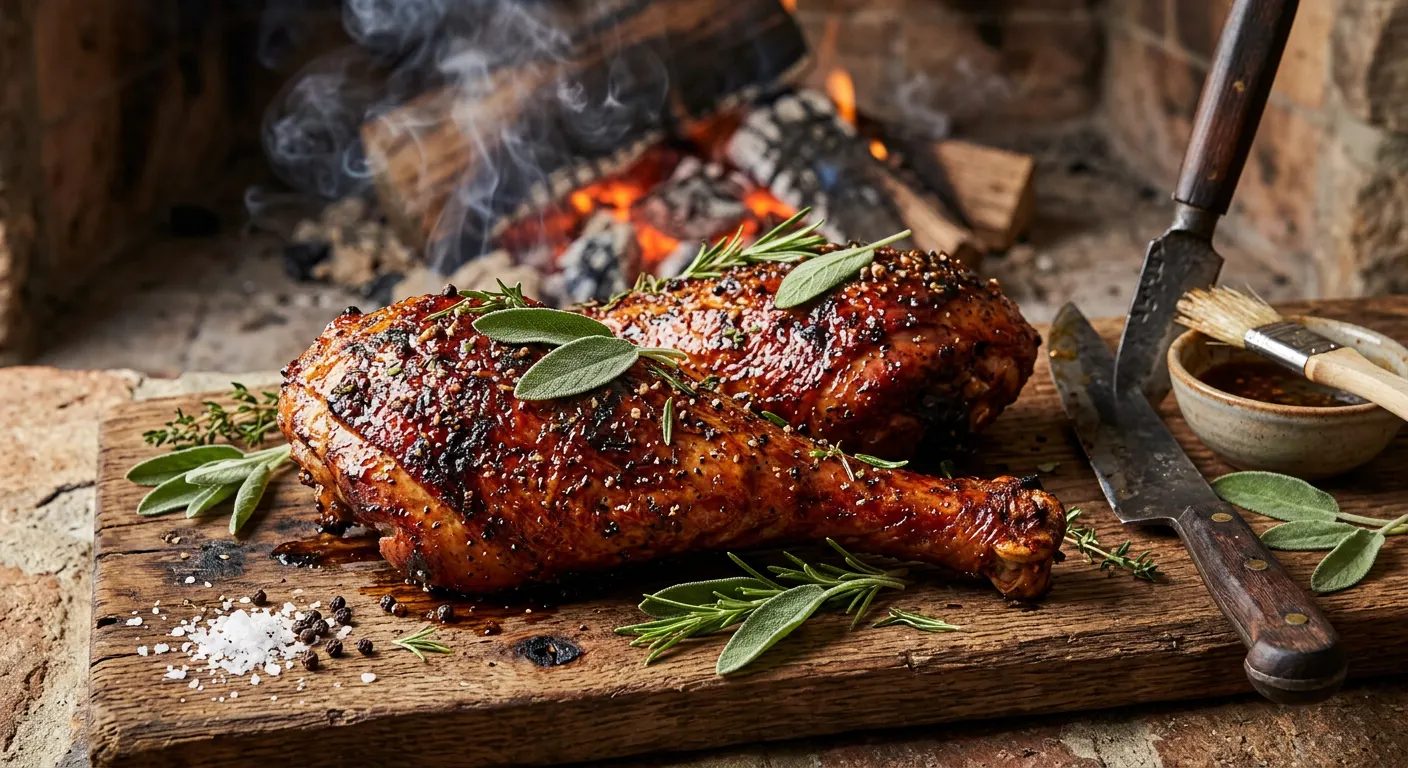
Smoked Turkey Legs with Maple & Sage
Eastern Woodlands. Wild turkey is native to North America and was hunted across the Eastern Woodlands long before it became a holiday centerpiece. Turkey legs are the forgiving cut, all dark meat that stays juicy through a long smoke, and a maple-sage brine gives them a sweet-savory depth. These are crowd-pleasers, easy to cook and easy to love, and they connect a familiar bird back to its Indigenous and wild roots.
Cook Mode
One step at a time, big text, timers, and your screen stays awake. 0/8 steps done.
Ingredients
Tap to tick off · 0/7 gathered
Method
- 15 min
Begin by creating a foundational brine to hydrate and season the dark meat. In a large stockpot, combine 8 cups of water with 0.5 cup coarse salt, 0.33 cup maple syrup, 2 tbsp dried sage, 1 tbsp black peppercorns, and 3 bay leaves. Bring this mixture to a simmer over medium heat, stirring until the salt and maple syrup are completely dissolved. This process extracts the essential oils from the sage and peppercorns, ensuring the aromatics are carried deep into the muscle fiber during the soak rather than just sitting on the surface.
Why it matters
The brine equilibrates moisture and seasons through the flesh; skipping it gives you dry, bland turkey.
Common mistake
Using hot brine on raw poultry, which partially cooks the meat and creates a bacterial breeding ground.
- 12h
Cool the brine completely to below 40°F before introducing the 5 turkey legs; you can expedite this by replacing 2 cups of the brine water with ice. Submerge the legs fully in the cold liquid, using a ceramic plate to weight them down if they float. Place the vessel in the refrigerator for 8 to 24 hours. During this phase, osmosis pulls the seasoned liquid into the meat cells, which is vital for turkey legs as the dark meat and connective tissue require this extra moisture to withstand the long smoking process.
Why it matters
Time allows the salt to denature proteins, creating a matrix that traps moisture during the cook.
Common mistake
Brining for too long, which results in a spongy, ham-like texture rather than natural poultry flakes.
- 2h
Remove the turkey legs from the brine and discard the liquid. Do not rinse the meat, as you want the maple and sage residue to remain on the surface. Pat each leg extremely dry with paper towels until the skin feels tacky. Place the legs on a wire rack over a baking sheet and return them to the refrigerator, uncovered, for 2 to 4 hours. This air-drying creates a 'pellicle,' a thin, sticky protein film that allows smoke to adhere uniformly and helps the skin crisp up rather than becoming rubbery.
Why it matters
A dry surface is the only way to achieve mahogany color and smoke adhesion; wet skin merely steams.
Common mistake
Skipping the air-drying step, which leads to splotchy smoke coverage and tough, rubbery skin.
- 275°F30 min
Preheat your smoker to 275°F using a blend of maple and oak wood. Maple provides a mild, sweet smoke profile that complements the syrup in the brine, while oak provides the consistent heat and traditional 'woodlands' depth. Ensure your fire is producing 'thin blue smoke' rather than thick white clouds; the latter contains bitter creosote that will ruin the delicate balance of sage. This temperature is high enough to render the thick turkey fat while keeping the meat in the smoke long enough for flavor penetration.
Why it matters
Consistent temperature and clean smoke are the pillars of professional-grade BBQ flavor.
Common mistake
Placing meat in the smoker before the fire has stabilized, resulting in a bitter, acrid taste.
- 275°F2h
Arrange the turkey legs on the grates with at least 2 inches of space between each piece to allow for total air convection. Close the lid and maintain a steady 275°F. During the first two hours, the meat will move through the 40-140°F danger zone; the high heat of the smoker ensures this happen safely. Monitor the skin as it transitions from pale to a deep, burnished copper. The dark meat is forgiving, but you must keep the lid closed to maintain the moist environment needed to break down the tough tendons in the drumsticks.
Why it matters
Convection airflow ensures that every inch of the leg is hit by smoke and heat equally.
Common mistake
Peeking repeatedly, which drops the temperature and adds significant time to the cook.
- 175°F45 min
Begin checking the internal temperature of the thickest part of the leg, avoiding the bone. While poultry is technically safe at 165°F, turkey legs contain heavy connective tissue and collagen that only begin to soften at higher heats. Continue smoking until the internal temperature reaches 175°F. At this stage, you can apply a light brush of maple syrup if desired to tack up the exterior, but the primary goal is reaching the thermal tipping point where the meat pulls cleanly away from the bone and tendons.
Why it matters
Taking dark meat to 175°F transforms tough connective tissue into succulent gelatin.
Common mistake
Pulling the legs at 165°F, resulting in meat that is safe to eat but difficult to chew.
- 15 min
Transfer the finished turkey legs to a warm platter and tent loosely with foil—do not wrap them tightly, or the steam will soften the skin you worked to crisp. Allow the meat to rest for 15 minutes. This allows the internal pressure to normalize and the juices to redistribute from the center back to the surface. During this time, carryover cooking may nudge the internal temperature up another 2-3 degrees, finalizing the rendering process for a perfect, tender bite.
Why it matters
Resting prevents the juices from purging onto the plate, keeping the meat moist for the consumer.
Common mistake
Cutting into the meat immediately, which causes all the internal moisture to leak out.
- 5 min
Serve the legs whole for a traditional 'woodsman' presentation. The bone serves as a natural handle, making this an ideal street-food style protein. Ensure guests are aware of the small, pin-like bones common in turkey drumsticks. Pair with seasonal roasted squash or wild rice to honor the Eastern Woodlands heritage of the dish. The final product should have a clear sage aroma, a hint of maple sweetness, and meat that is juicy, tender, and deeply smoke-kissed.
Why it matters
Proper presentation and temperature service finalize the culinary experience.
Common mistake
Serving the legs cold, which causes the rendered fats to solidify and feel greasy.
Sauce It
Cooks & Reviews
Guild members can rate this recipe, log their cooks and share photos.
Sign in to continueMember reviews
No reviews yet — be the first to rate this cook.
Ask the Pitmaster about this recipe
Substitutions, scaling, technique, troubleshooting — get answers grounded in this cook.
Sign in to try the AI Pitmaster on Smoked Turkey Legs with Maple & Sage. New members get 3 free questions.
Sign in to tryComments(0)
Loading comments…