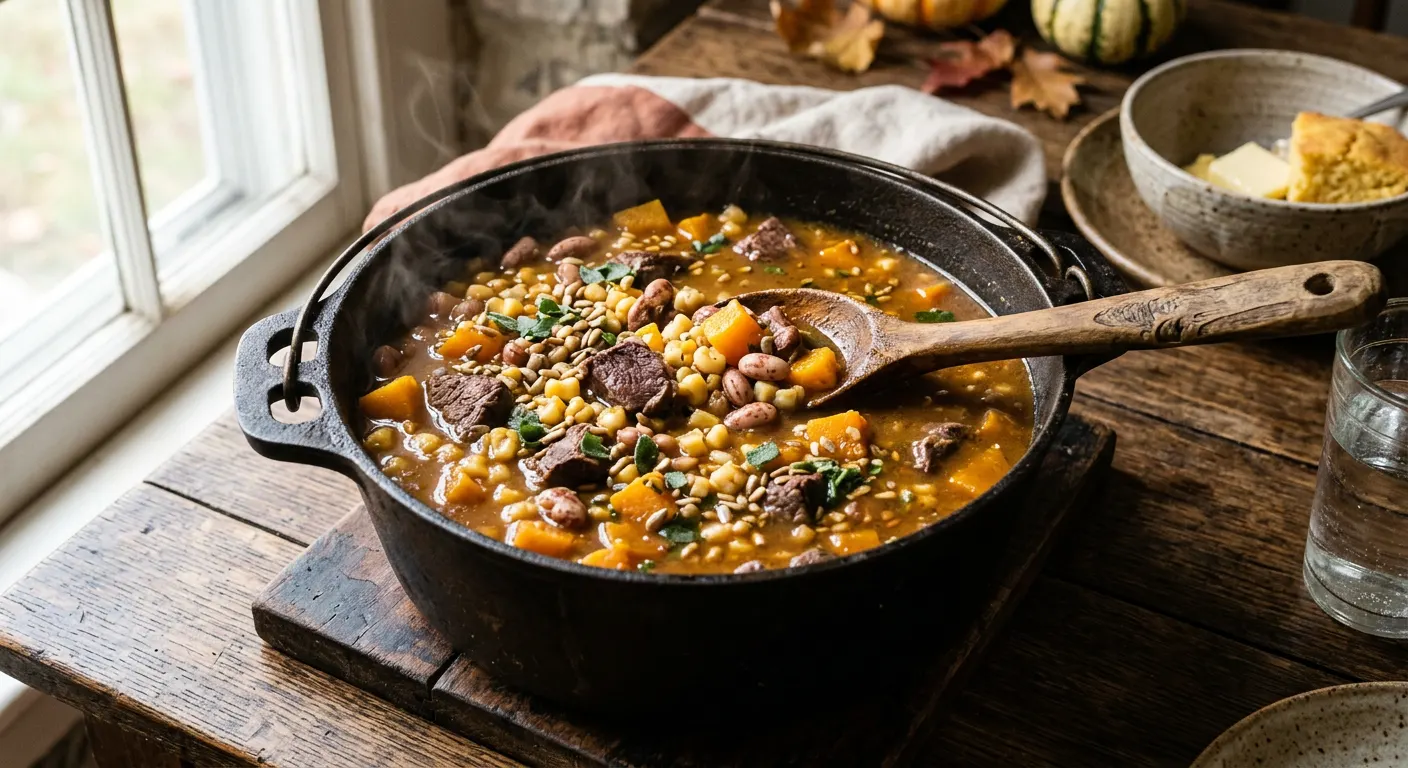
Smoked Three Sisters & Game Stew
Eastern Woodlands / Haudenosaunee. This is a feast-worthy stew that brings together the two pillars of Eastern Woodlands cooking, the Three Sisters (corn, beans, squash) and smoked game, in one pot. Venison or bison is smoked hard for depth, then simmered with hominy, beans, and squash into a rich, soul-warming stew thickened the traditional way. It's a two-stage project that tells a complete story of Indigenous foodways on a single plate, and it feeds a crowd. The most complete dish on the card.
Cook Mode
One step at a time, big text, timers, and your screen stays awake. 0/7 steps done.
Ingredients
Tap to tick off · 0/14 gathered
Method
- 15 min
Begin by patting the 2 lbs of venison or bison stew meat dry with paper towels to ensure the seasonings adhere properly to the protein fibers. In a small bowl, combine 1 tbsp salt, 1 tbsp dried sage, and 1 tsp crushed juniper berries to create a concentrated dry rub. Apply this mixture evenly to all surfaces of the meat chunks; the juniper and sage will act as the aromatic foundation that penetrates the lean game meat during the smoke phase, while the salt begins the denaturing process to help retain moisture in the lean tissue.
Why it matters
Dry surfaces and early salting are essential for creating the tacky surface needed for smoke particles to bond to the meat.
Common mistake
Leaving the meat wet, which causes the spices to slide off and creates steam rather than a pellicle.
- 250°F3h
Preheat your smoker to 250°F using a maple and oak wood blend, which provides a traditional Eastern Woodlands sweetness. Arrange the seasoned game meat on the grates, ensuring at least one inch of space between each chunk to allow for total smoke circulation. Smoke the meat for 180 minutes or until it reaches a deep mahogany color; we are not cooking for tenderness at this stage, but rather using the meat as a 'smoke sponge' to carry flavor into the finished stew broth.
Why it matters
Smoking the meat separately allows for a high-surface-area smoke infusion that would be impossible to achieve in a liquid-based stew.
Common mistake
Pulling the meat too early before the smoke color has fully set on the exterior.
- 15 min
While the meat finishes its smoke, place a heavy-bottomed Dutch oven over medium heat and melt 2 tbsp of rendered fat or oil. Add the 2 diced onions and a pinch of salt, sautéing for approximately 10-12 minutes until they transition from translucent to a light golden brown. This caramelization creates the Maillard reaction base that balances the lean, gamey notes of the bison or venison and provides the foundational sweetness for the broth.
Why it matters
Properly sautéed onions provide a complexity of flavor that raw boiled onions cannot replicate.
Common mistake
Rushing the onions and burning them, which will make the final stew broth bitter.
- 212°F1h
Transfer the smoked game meat directly from the smoker into the Dutch oven with the onions. Immediately add 6 cups of stock and 2 bay leaves, scraping the bottom of the pot to deglaze the flavorful bits (fond). Bring the liquid to a rapid boil for 2 minutes to ensure the total contents have moved through the 40-140°F danger zone safely, then reduce the heat to a low simmer. Cover and braise for 60 minutes to begin the breakdown of the tough connective tissues in the game meat.
Why it matters
Boiling the stock ensures that any surface bacteria from the smoking phase are neutralized rapidly.
Common mistake
Adding cold stock and letting the meat sit in the 'danger zone' for too long before it reaches a simmer.
- 10 min
Incorporate the 'Three Sisters' by adding 3 cups of hominy (corn), 2 cups of cooked beans, and 1 whole winter squash (cut into 1-inch chunks). Supplement the flavor profile with the remaining 1 tbsp of dried sage at this stage. The hominy provides an alkaline, earthy backbone due to nixtamalization, while the starch from the squash and beans will begin to naturally thicken the stew, eliminating the need for a flour-based roux.
Why it matters
Adding the sisters at this mid-point ensures the squash softens enough to thicken the stew without turning into a total puree.
Common mistake
Adding the squash too early, which results in it disintegrating completely before the meat is tender.
- 203°F1h 30m
Continue to simmer the stew uncovered for an additional 60 to 90 minutes. This open-pot method allows the liquid to reduce, concentrating the maple smoke and juniper flavors while ensuring the game meat reaches an internal temperature of roughly 203°F for fork-tender results. Stir every 15 minutes, specifically focused on the bottom of the pot, as the heavy hominy and beans are prone to settling and scorching as the liquid thickens.
Why it matters
The reduction phase is where the smoke flavor transforms from a surface coating into a deep, integrated broth profile.
Common mistake
Failing to stir, which leads to scorched beans on the bottom of the Dutch oven.
- 5 min
Once the meat is tender and the liquid coats the back of a spoon, stir in 2 tbsp of maple syrup to brighten the earthy, smoky notes with a traditional woodland sweetener. Perform a final taste test and add salt as needed to sharpen the flavors. Serve the stew in wide bowls, garnishing with toasted sunflower seeds. The seeds provide a necessary textural contrast (crunch) to the soft squash and chewy hominy, completing the nutritional and culinary profile of the dish.
Why it matters
The maple syrup acts as a flavor bridge between the smoke of the wood and the gaminess of the meat.
Common mistake
Neglecting the final salt season, which is necessary to make the juniper and sage notes pop.
5 more steps locked
You've seen the ingredients and the first two steps. Pit Members get every step, every temp, every glaze — plus the Cook Monitor and Pitmaster AI.
See Membership OptionsAlready a member? Sign in.
Cooks & Reviews
Guild members can rate this recipe, log their cooks and share photos.
Sign in to continueMember reviews
No reviews yet — be the first to rate this cook.
Ask the Pitmaster about this recipe
Substitutions, scaling, technique, troubleshooting — get answers grounded in this cook.
Sign in to try the AI Pitmaster on Smoked Three Sisters & Game Stew. New members get 3 free questions.
Sign in to tryComments(0)
Loading comments…