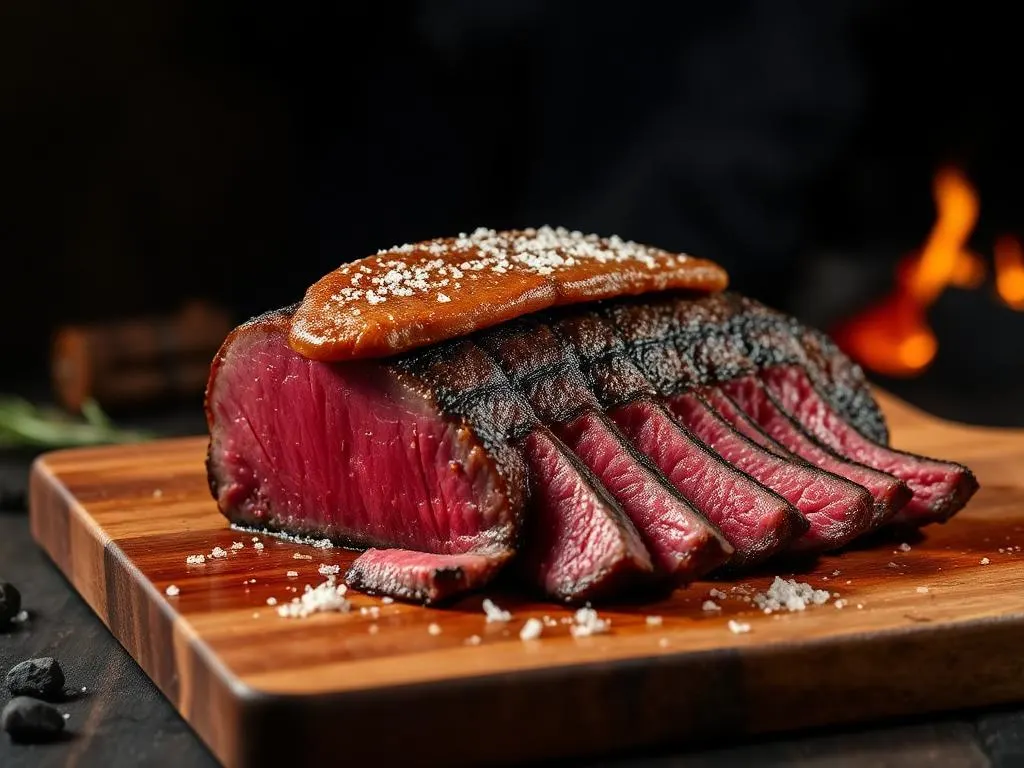
Smoked & Seared Picanha
If you only learn one Brazilian cut, learn this one. Picanha is the top sirloin cap, and it's the king of the churrascaria. The reverse sear takes all the guesswork out, smoke it gentle, then blast it hot to finish. Coarse rock salt does the seasoning. That's it.
Cook Mode
One step at a time, big text, timers, and your screen stays awake. 0/7 steps done.
Ingredients
Tap to tick off · 0/2 gathered
- — MAIN —
Method
- 10 min
Take 1 whole picanha and place it fat-side up. Using a sharp knife, score the thick white fat cap in a crosshatch diamond pattern, cutting roughly 1/4 inch deep. Ensure you do not slice into the red muscle meat below. Scoring the fat increases the surface area for salt penetration and prevents the fat cap from curling or contracting during the high-heat sear, which would result in uneven cooking.
Why it matters
Scoring allows heat and salt to penetrate the dense fat, aiding in rendering and preventing the meat from buckling.
Common mistake
Cutting too deep into the muscle fiber which causes the juices to leak out prematurely during the smoke.
- 40 min
Apply 3 tbsp of coarse rock salt (sal grosso) liberally over all surfaces of the beef, pressing the large crystals into the crosshatch crevices of the fat cap. Place the meat on a wire rack over a baking sheet and refrigerate uncovered for at least 40 minutes, but ideally up to 4 hours. This dry brine period allows the salt to dissolve into a concentrated brine that then re-absorbs into the muscle, seasoning the interior and altering the protein structure to retain more moisture.
Why it matters
The rock salt creates a targeted salinity that enhances the beef's natural flavor without the need for complex spices.
Common mistake
Using fine table salt instead of rock salt, which will over-salt the meat due to the higher surface area contact.
- 250°F20 min
Before smoking, gently brush off any large, undissolved chunks of rock salt from the surface so the final bite isn't abrasive. Preheat your smoker to 250°F using a clean-burning oak fire. Ensure your wood is well-seasoned to produce 'blue smoke'—a nearly invisible, translucent exhaust. This is critical for picanha because the large fat cap easily absorbs bitter creosote if the fire is oxygen-starved or smoldering with thick white smoke.
Why it matters
Clean-burning oak provides a mild, nutty smoke profile that complements rather than masks the flavor of the fat.
Common mistake
Placing the meat in the smoker before the fire has stabilized, leading to a bitter ashy flavor on the fat.
- 250°F45 min
Place the picanha on the indirect side of the smoker, fat-side up. In this position, the melting fat cap acts as a natural baster, shielding the lean meat from drying out while dripping flavor down the sides. Smoke the meat until the internal temperature reaches a precise 115°F for a medium-rare finish. This low-and-slow approach ensures the meat moves through the 40-140°F danger zone efficiently while preventing the 'gray ring' of overcooked meat common in traditional searing.
Why it matters
Reverse searing at 250°F creates edge-to-edge pink doneness by minimizing the temperature gradient.
Common mistake
Opening the lid frequently to check the meat, which fluctuates the temperature and extends the cooking time.
- 600°F5 min
Remove the meat from the smoker and let it rest briefly while you crank your grill or sear station to 600°F+. Place the picanha directly over the heat source, fat-side down first. The goal is to trigger the Maillard reaction and render the fat until it is crispy and mahogany brown. Monitor the meat constantly; the high fat content will cause flare-ups. Sear each face for 60-90 seconds, then sear the edges for 30 seconds until the internal temperature hits 125°F.
Why it matters
The high-heat finish creates the essential texture and flavor profile of traditional Brazilian churrasco.
Common mistake
Leaving the meat unattended during the sear, leading to carbonized, burnt fat from grease flare-ups.
- 130°F10 min
Transfer the picanha to a warm plate and let it rest for 10 minutes. During this time, the internal temperature will carry over to a perfect 130-135°F. This rest period allows the pressurized juices within the muscle fibers to redistribute. If you cut the picanha now, the liquid will stay centered within the meat rather than spilling onto the cutting board, ensuring a succulent, juicy result.
Why it matters
Resting prevents the loss of internal moisture that was built up during the smoking and searing phases.
Common mistake
Tenting the meat too tightly with foil, which steams the crust you just worked hard to develop.
- 5 min
Identify the direction of the muscle fibers (the grain). Slice the picanha into 1-inch thick steaks, ensuring your knife cuts perpendicular to the grain. Because picanha is part of the sirloin, it can be chewy if sliced with the grain; cutting against the grain shortens the fibers, providing the legendary 'tender as butter' texture found in the best gaucho steakhouses. Serve immediately while the fat is warm and yielding.
Why it matters
Proper slicing technique is the final step in ensuring the mechanical tenderness of the cut.
Common mistake
Slicing with the grain, which results in a stringy and tough mouthfeel regardless of how well it was cooked.
Sauce It
Free Guide
5 Techniques Competition Smokers Use That Home Cooks Don't
Join the Guild email list and we'll send you the free guide — the exact moves that separate backyard cooks from competition pitmasters.
Cooks & Reviews
Guild members can rate this recipe, log their cooks and share photos.
Sign in to continueMember reviews
No reviews yet — be the first to rate this cook.
Ask the Pitmaster about this recipe
Substitutions, scaling, technique, troubleshooting — get answers grounded in this cook.
Sign in to try the AI Pitmaster on Smoked & Seared Picanha. New members get 3 free questions.
Sign in to tryComments(0)
Loading comments…