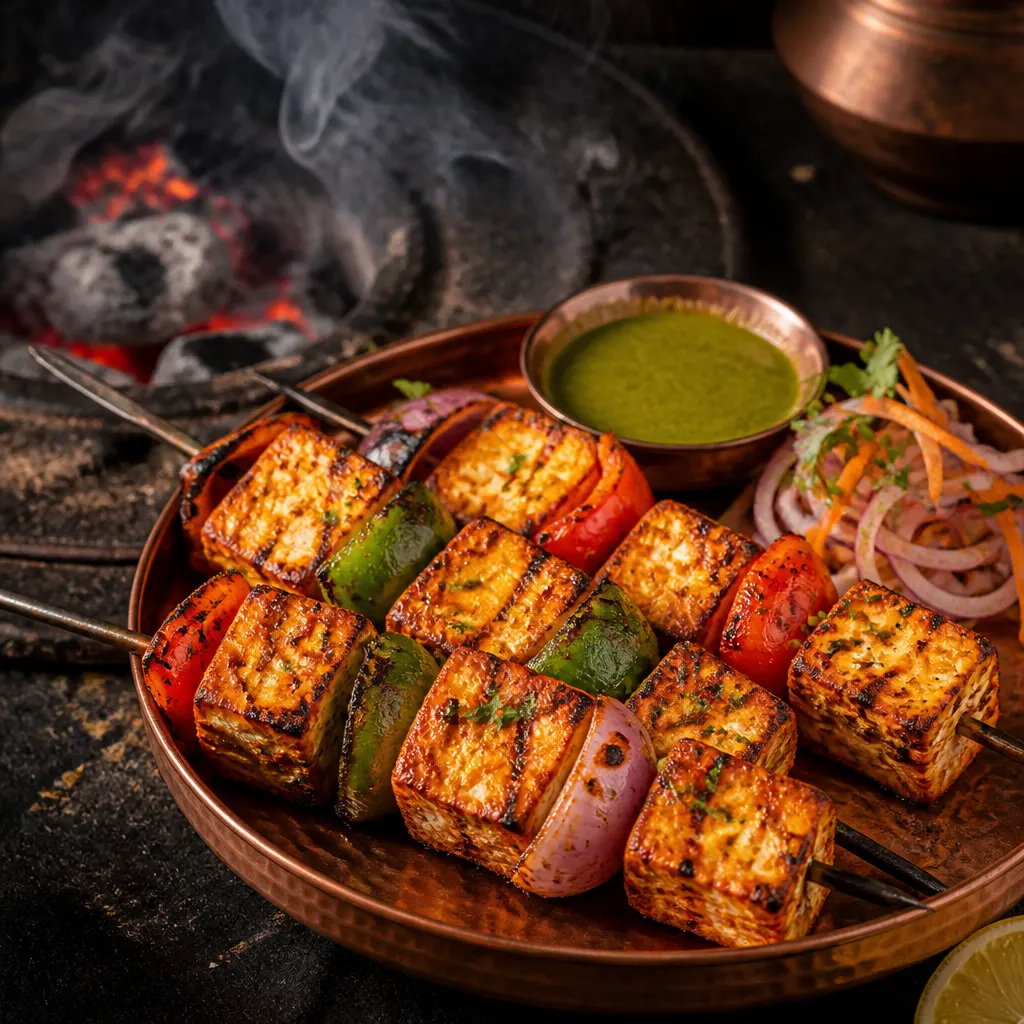
Smoked Paneer Tikka
The vegetarian star of any tandoori spread. Cubes of firm paneer cheese, peppers, and onion get the same yogurt treatment as tandoori chicken, then take light smoke and char on skewers.
Cook Mode
One step at a time, big text, timers, and your screen stays awake. 0/7 steps done.
Ingredients
Tap to tick off · 0/14 gathered
Method
- 15 min
In a large non-reactive bowl, whisk 0.75 cup thick yogurt with 1 tbsp ginger-garlic paste, 1 tbsp Kashmiri chili powder, 1 tsp garam masala, 1 tsp cumin, and 1 tsp salt. Incorporate 1 tbsp toasted besan (chickpea flour) and 1 tbsp mustard oil, whisking until the mixture forms a thick, cohesive paste. The besan acts as a binding agent that prevents the yogurt from 'splitting' or running off the smooth surface of the cheese during the cook, while the mustard oil provides a characteristic pungent base notes common in North Indian tandoori styles.
Why it matters
The besan creates a protein-matrix that allows the spices to adhere to the non-porous surface of the paneer during the smoking process.
Common mistake
Using thin or watery yogurt which leads to a runny marinade that slides off the skewers.
- 40°F3h
Add 1 lb of paneer (cut into 1.5-inch cubes), 1 red bell pepper (chunks), 1 green bell pepper (chunks), and 1 red onion (petals) to the bowl. Fold gently to ensure every surface is submerged in the marinade; then add 1 tsp crushed dried fenugreek leaves (kasuri methi). Cover with plastic wrap and refrigerate for 120-240 minutes. This refrigeration step is practical food safety for the dairy, but it also allows the spices to hydrate and the mustard oil to penetrate the outer layer of the cheese.
Why it matters
Time allows the lactic acid in the yogurt to lightly season the cheese while the chilling period helps the marinade 'set' firmly before hitting the heat.
Common mistake
Marinating longer than 4 hours which can cause the paneer to become mushy and lose its structural integrity.
- 275°F30 min
Preheat your smoker to 275°F using apple wood chunks or pellets. Fruit wood is preferred here as the high fat content of the paneer (up to 20-30%) absorbs smoke molecules very efficiently, and heavier woods like hickory can make the dairy taste acrid or 'ashy.' Ensure your smoke is 'blue' and translucent rather than thick and white to avoid depositing bitter creosote on the yogurt coating.
Why it matters
Dairy is a highly effective smoke-absorber, necessitating a clean-burning fire to prevent the flavor from becoming overpowering.
Common mistake
Starting the cook before the smoker has stabilized, resulting in dirty smoke being trapped in the yogurt coating.
- 275°F10 min
Thread the marinated paneer and vegetables onto skewers, alternating between the cheese and the aromatics. Leave a 1/4-inch gap between each piece; tight packing creates 'cold spots' where the marinade won't set and the smoke cannot reach. If using wooden skewers, ensure they have been soaked in water to prevent combustion. Place the skewers on a perforated grill topper to prevent the vegetables from falling through the grates while maintaining maximum surface area exposure.
Why it matters
Proper spacing ensures even heat distribution and allows smoke to circulate 360 degrees around the cheese.
Common mistake
Overcrowding the skewers, which leads to soggy, steamed vegetables instead of smoked ones.
- 160°F35 min
Place the skewers in the smoker. Cook for 30 to 40 minutes, or until the yogurt marinade has completely lost its wet sheen and transitioned to a matte, firm texture. You are looking for an internal temperature of approximately 150°F-160°F in the center of the cheese cubes. The paneer should feel bouncy and resilient when pressed; it will not melt like cheddar because it is an acid-set cheese, making it the perfect candidate for high-heat smoking.
Why it matters
Heating the paneer through the 'danger zone' quickly is essential for safety, while the set marinade provides the signature tikka texture.
Common mistake
Pulling the skewers too early when the marinade is still wet and sticky.
- 450°F2 min
Once the marinade is set, move the skewers to the hottest part of the grill or increase the heat to 450°F for a final 2-minute sear. Watch for 'leopard spotting'—small, charred black dots on the edges of the peppers and the corners of the paneer. This mimics the intense radiant heat of a clay tandoor oven, adding a necessary bitter counterpoint to the rich, creamy cheese and sweet peppers.
Why it matters
Maillard browning and slight carbonization provide the authentic 'charred' flavor expected in North Indian cuisine.
Common mistake
Walking away during the char step; the high sugar/fat content in the marinade can go from charred to burnt in seconds.
- 5 min
Remove the skewers from the heat and let them rest for 3-5 minutes to allow the internal juices to settle. Immediately before serving, apply a fresh squeeze of lemon juice over the hot skewers and a generous dusting of chaat masala. The citric acid in the lemon and the sulfurous, tangy notes of the chaat masala cut through the dense fat of the paneer and the smoky notes from the apple wood.
Why it matters
Finishing salts and acids brighten the flavor profile and balance the heavy minerals in the smoke.
Common mistake
Applying lemon too early, which can make the crispy charred edges of the paneer soggy.
Cooks & Reviews
Guild members can rate this recipe, log their cooks and share photos.
Sign in to continueMember reviews
No reviews yet — be the first to rate this cook.
Ask the Pitmaster about this recipe
Substitutions, scaling, technique, troubleshooting — get answers grounded in this cook.
Sign in to try the AI Pitmaster on Smoked Paneer Tikka. New members get 3 free questions.
Sign in to tryComments(0)
Loading comments…