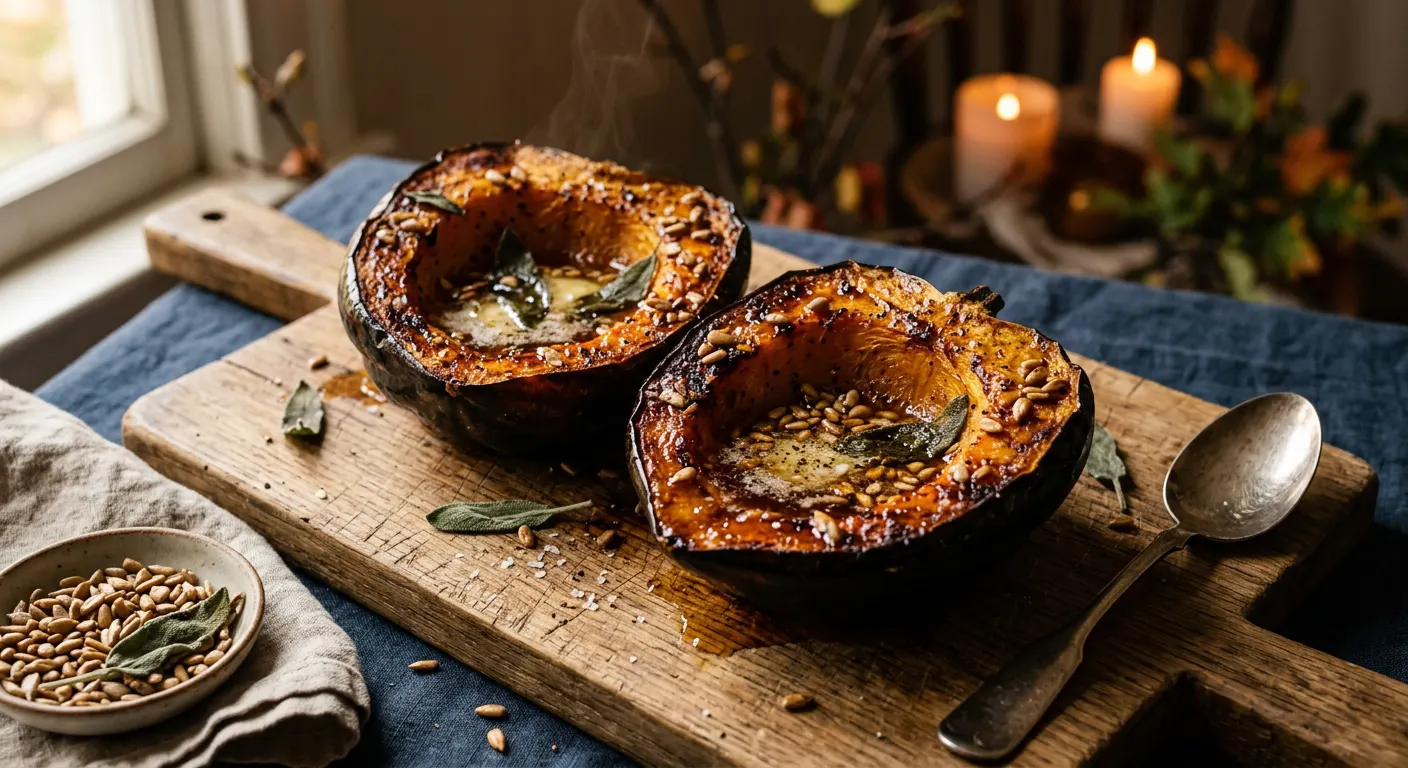
Smoked Maple Acorn Squash
Eastern Woodlands / Northeast. Squash and maple are both gifts of the Eastern Woodlands, and together over smoke they make something simple and soulful. Halved acorn squash, smoked until the flesh goes silky and the edges caramelize, then finished with maple and a little rendered fat or butter. It's the easiest vegetarian smoke on the card and a natural partner to bison and venison. Sweet, smoky, and rooted in the land.
Cook Mode
One step at a time, big text, timers, and your screen stays awake. 0/7 steps done.
Ingredients
Tap to tick off · 0/6 gathered
Method
- 15 min
Begin by halving 3 whole acorn squash vertically from stem to point. Use a heavy metal spoon to aggressively scoop out the seeds and the stringy placental tissue until the inner cavity is perfectly smooth. This step is vital because any remaining fibers will become unpleasantly tough during the smoke. Once cleaned, use a sharp knife to trim a tiny sliver off the rounded back of each half to create a flat 'stand' so the squash sits level on the smoker grate without wobbling or spilling its eventual glaze.
Why it matters
A clean cavity and stable base ensure even cooking and prevent the loss of flavorful juices and fats during the long smoke.
Common mistake
Leaving stringy bits in the center which turn into woody, unappetizing threads after cooking.
- 5 min
Evenly apply 2 tbsp of softened butter (or rendered fat such as duck fat or bison tallow) across the cut faces and throughout the interior of the 6 squash halves. Once the fat layer is applied, sprinkle 1 tsp of coarse salt across all surfaces. The fat acts as a thermal conductor to help the squash flesh reach temperature while simultaneously creating a barrier that prevents the surface from drying out and 'skinning' over before it becomes tender.
Why it matters
Fat facilitates heat transfer into the dense vegetable flesh while salt draws out moisture to help dissolve the later maple glaze.
Common mistake
Using cold, hard butter chunks which results in uneven seasoning and dry patches on the squash face.
- 275°F20 min
Preheat your smoker to a consistent 275°F using maple or apple wood. These woods provide a light, sweet smoke profile that enhances rather than masks the delicate sugars of the squash. Ensure you have achieved 'thin blue smoke' before loading the cooker; heavy, white, creosote-heavy smoke will turn the absorbent squash flesh bitter and gray. Because squash are dense, maintain a steady airflow to prevent the temperature from dipping into the danger zone for extended periods.
Why it matters
The high surface-to-volume ratio of halved squash makes them highly absorbent of smoke flavors, requiring a clean burn.
Common mistake
Using heavy hardwoods like mesquite or hickory which produce an acrid flavor that dominates the maple.
- 275°F1h 10m
Place the squash halves directly on the grates, skin-side down. This orientation is non-negotiable as the thick skin acts as a natural bowl, catching the melting fats and prevent the meat from scorching against the grate. Smoke undisturbed for 60 to 75 minutes. During this stage, the squash must pass through the 'stall' where moisture evaporates from the surface; the goal is to reach a point where the orange flesh looks darkened and feels slightly yielding when pressed with a finger.
Why it matters
The skin protects the vegetable from direct convective heat, allowing the interior to steam in its own juices.
Common mistake
Placing the squash cut-side down, which allows all the flavorful moisture and fat to drain into the fire.
- 275°F25 min
Once the squash is tender to a light touch, distribute 3 tbsp of maple syrup evenly among the 6 halves (roughly 1/2 tablespoon per cavity). The syrup will mix with the melted butter and squash juices to create a rich emulsion. Continue smoking for 20-30 minutes. This allows the sugars to undergo Maillard browning and caramelization without burning, which would happen if the syrup were applied at the very beginning of the cook.
Why it matters
Late application of sugars prevents the maple from scorching and turning bitter while ensuring a thick, tacky glaze.
Common mistake
Adding maple syrup at the start of the cook, which leads to burnt, blackened sugar long before the squash is soft.
- 205°F10 min
Verify doneness using a probe thermometer or a paring knife. The internal temperature of the thickest part of the squash neck should reach approximately 205°F. Tactilely, a knife should slide into the flesh with absolutely no resistance, feeling like softened butter. If the texture is still somewhat 'toothy' or fibrous, the squash is underdone; it must reach a silky, mash-like consistency to be considered successful.
Why it matters
Squash pectin only fully breaks down at high internal temperatures, shifting from a vegetable texture to a custard-like consistency.
Common mistake
Pulling the squash too early based on appearance rather than the 'butter-soft' tactile test.
- 10 min
Remove the squash carefully from the smoker using a wide spatula to support the softened skins. While the glaze is bubbling and hot, sprinkle 0.5 tsp dried sage over the halves. The heat of the syrup will bloom the volatile oils in the sage, releasing its earthy aroma. Finally, top with toasted sunflower seeds. Allow the squash to rest for 5-10 minutes before serving; this allows the glaze to thicken slightly and the temperatures to equalize, making the squash safer and more pleasant to eat.
Why it matters
Blooming herbs in residual heat maximizes flavor, while the seeds provide a necessary textural contrast to the soft squash.
Common mistake
Adding the sage too early in the smoker, which can cause the delicate herb to lose its aromatic punch.
Cooks & Reviews
Guild members can rate this recipe, log their cooks and share photos.
Sign in to continueMember reviews
No reviews yet — be the first to rate this cook.
Ask the Pitmaster about this recipe
Substitutions, scaling, technique, troubleshooting — get answers grounded in this cook.
Sign in to try the AI Pitmaster on Smoked Maple Acorn Squash. New members get 3 free questions.
Sign in to tryComments(0)
Loading comments…