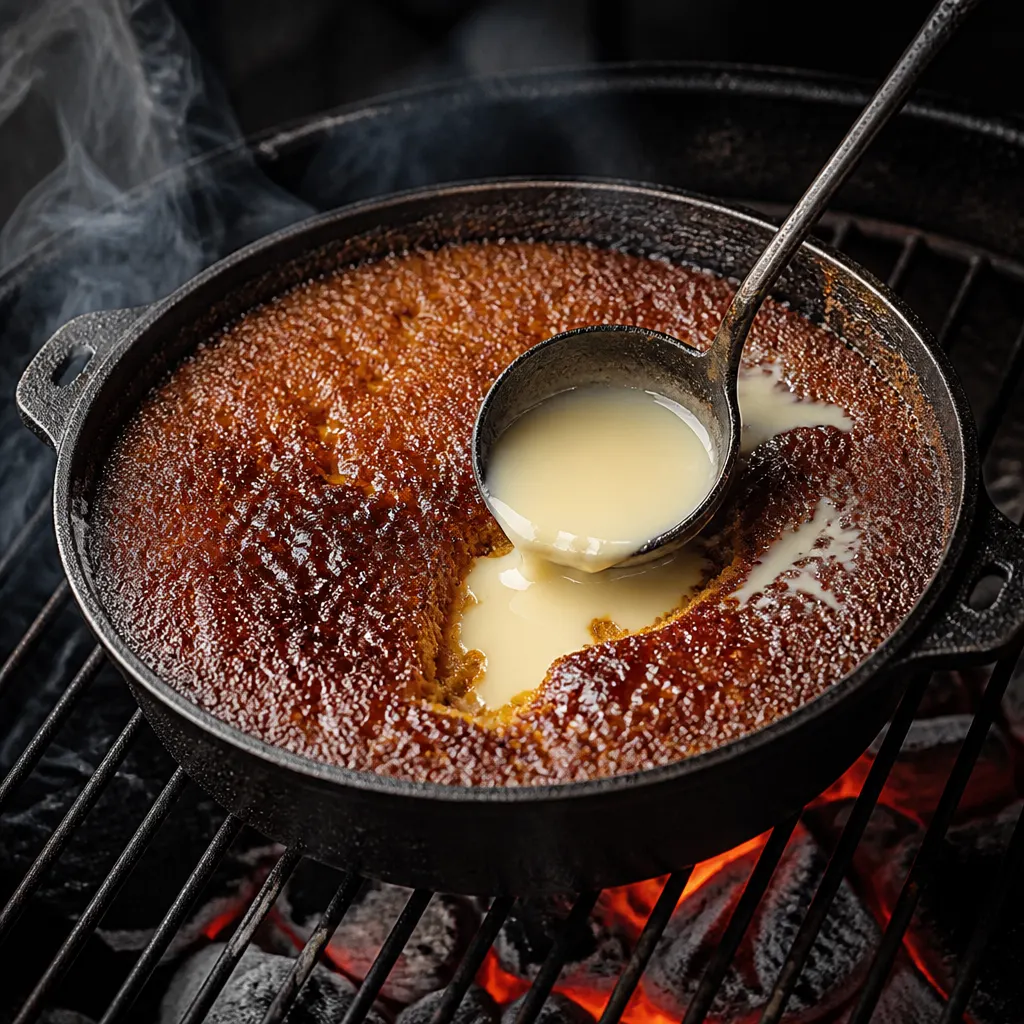
Smoked Malva Pudding
South Africa's beloved dessert — a sticky, spongy apricot-and-caramel baked pudding drenched in hot cream sauce. Baking it in the smoker gives the caramel notes a subtle smoky depth.
Cook Mode
One step at a time, big text, timers, and your screen stays awake. 0/7 steps done.
Ingredients
Tap to tick off · 0/14 gathered
Method
- 15 min
Begin by whisking 1 cup of sugar, 1 whole egg, and 1 tablespoon of apricot jam in a bowl until pale and frothy. Melt 1 tablespoon of butter and whisk it into the mixture along with 1 tablespoon of white vinegar. The vinegar's acidity is the vital catalyst that will react with the baking soda later to create the carbon dioxide bubbles required for a light, aerated sponge that can hold its weight under a heavy sauce. Ensure your 9-inch square baking dish is heavily greased with butter to prevent the high-sugar batter from bonding to the ceramic or glass during the caramelization phase.
Why it matters
The vinegar acts as an acid source to activate the leavening agent in an otherwise heavy, sugary batter.
Common mistake
Using a cold egg which can cause the melted butter to seize and clump in the batter.
- 10 min
Dissolve 1 teaspoon of baking soda into 1 cup of milk to ensure the leavening agent is fully dispersed, preventing bitter pockets of soda in the finished cake. Sift 1 cup of flour and a pinch of salt into your egg base, then gradually whisk in the milk mixture until smooth. The resulting batter will be significantly thinner than a standard cake batter; this high hydration is intentional, allowing the flour to fully gelatinize and create the signature springy, porous structure designed to absorb the cream sauce later.
Why it matters
Dispersing the baking soda in milk ensures an even rise and prevents the 'soapy' flavor of unreacted leavener.
Common mistake
Over-mixing the flour which develops too much gluten and results in a tough, rubbery pudding.
- 300°F30 min
Stabilize your smoker at 300°F using a clean-burning fire. For desserts, wood selection is critical; choose a mild fruit wood like apple or cherry which contains lower levels of lignin and produces a sweeter, less acrid smoke. Avoid heavy hardwoods like hickory or mesquite, as their high phenolic content will easily overwhelm the delicate apricot and dairy flavors. Ensure the smoke is 'blue' and translucent before placing the pudding inside to avoid depositing bitter creosote on the sugary surface of the batter.
Why it matters
Sugar and fat serve as high-efficiency magnets for smoke compounds, making clean wood management essential for desserts.
Common mistake
Putting the pudding in while the smoker is still producing thick white 'dirty' smoke.
- 300°F1h
Place the uncovered baking dish into the center of the smoker. During this 45 to 60 minute window, the pudding undergoes the Maillard reaction, where the sugars and milk proteins react with the heat and smoke to develop a deep mahogany color. The smoke phenolics will dissolve into the fats of the batter, creating a savory counterpoint to the sweetness. Monitor the internal temperature of the smoker closely; if it climbs too high, the exterior will dry out before the center sets. The pudding is done when it reaches an internal temperature of 200°F–205°F and a skewer comes out clean.
Why it matters
The open-air bake allows smoke to penetrate the fat phase of the batter while the sugar caramelizes.
Common mistake
Removing the pudding too early when it is pale; the deep brown color is where the flavor is concentrated.
- 10 min
In the final 10 minutes of the bake, combine 1 cup heavy cream, 0.5 cup butter, 0.5 cup sugar, 0.25 cup hot water, and 1 teaspoon vanilla in a saucepan over medium heat. Stir constantly until the sugar is fully dissolved and the fats are emulsified into a silky, uniform liquid. It is imperative that this sauce is near boiling when the pudding comes out; the temperature differential between the hot cake and the hot sauce is what drives the rapid absorption via capillary action.
Why it matters
A hot sauce penetrates the sponge's starch structure much more effectively than a room-temperature sauce.
Common mistake
Allowing the sauce to boil over, which can scorch the dairy and ruin the flavor.
- 205°F15 min
Immediately upon removing the pudding from the smoker, use a skewer to prick holes across the entire surface. While both the cake and sauce are at peak temperature, pour the hot sauce slowly over the top, starting at the edges where the sponge is driest. Within seconds, the porous cake will expand and 'pull' the sauce into its center. This creates the 'malva' (marshmallow-like) texture that defines the dish. The pudding should look briefly submerged before the liquid is fully pulled into the crumb.
Why it matters
This step converts a dry cake into a moist, custard-like pudding through immediate thermal shock and absorption.
Common mistake
Waiting for the pudding to cool before adding the sauce, which results in a soggy top and dry interior.
- 10 min
Allow a final 10-minute rest to let the sauce fully equilibrate and the starches to set. Slice into generous squares while still warm. The interior should be moist, dense, and gooey with a subtle hint of fruit wood smoke. Serve with a cold element like vanilla ice cream or cold custard; the temperature contrast between the hot, smoky sponge and the cold dairy highlights the complex caramel notes developed in the smoker.
Why it matters
The rest period prevents the pudding from falling apart and allows the sauce to reach the very center.
Common mistake
Serving immediately while the sauce is still pooling, leading to an uneven texture.
Cooks & Reviews
Guild members can rate this recipe, log their cooks and share photos.
Sign in to continueMember reviews
No reviews yet — be the first to rate this cook.
Ask the Pitmaster about this recipe
Substitutions, scaling, technique, troubleshooting — get answers grounded in this cook.
Sign in to try the AI Pitmaster on Smoked Malva Pudding. New members get 3 free questions.
Sign in to tryComments(0)
Loading comments…