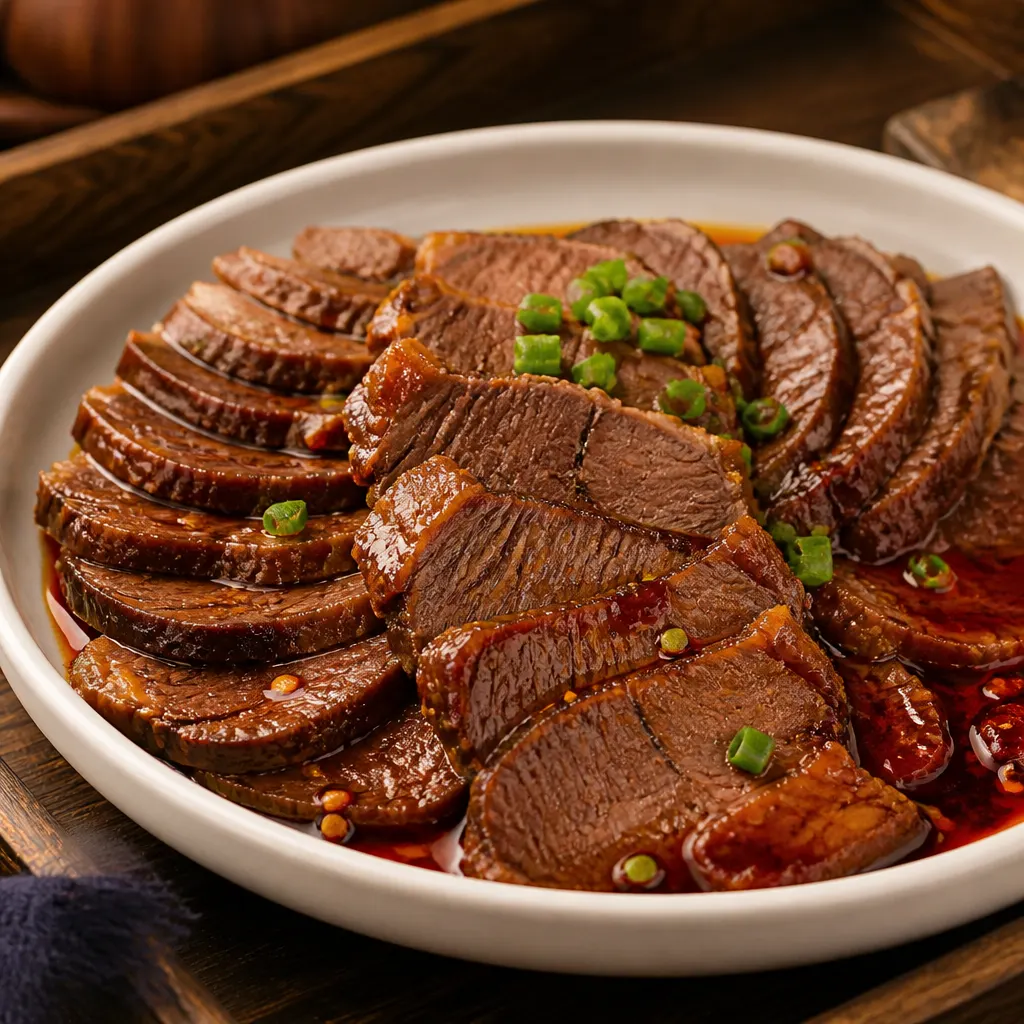
Smoked Soy-Braised Beef Shank & Brisket (Lu Wei)
Lu wei is the Chinese master-stock tradition, meats slowly braised in a deeply spiced soy broth (the lu) that's reused and built upon for years, growing richer over time. This version smokes beef shank and brisket hard first, then braises them in a five-spice master stock until sliceable and intensely savory. The smoke meets one of the oldest flavor-building techniques in Chinese cooking. Sliced thin and served cold or warm, it's a sophisticated showpiece and the start of your own master stock.
Cook Mode
One step at a time, big text, timers, and your screen stays awake. 0/6 steps done.
Ingredients
Tap to tick off · 0/18 gathered
Method
- 12h
Begin by whisking together 2 tbsp of salt, 1 tbsp of five-spice powder, and 1 tbsp of coarse black pepper. Apply this dry rub generously to all surfaces of the 2 lbs of beef shank and 2 lbs of beef brisket, pressing the spice granules firmly into the muscle fibers to ensure adhesion. This isn't just for flavor; the salt begins denaturing meat proteins, allowing them to hold more moisture during the cook. Set the meat on a wire rack over a sheet pan and refrigerate, uncovered, for 12 hours. This refrigerated rest allows the salt to penetrate deep into the center and dries the surface, creating the perfect dry pellicle necessary for smoke to 'grab' the meat.
Why it matters
The dry brine creates a tacky surface for smoke adhesion and seasons the meat to its core before the heat hits it.
Common mistake
Wrapping the meat while brining, which traps moisture and prevents the formation of a dry surface pellicle.
- 250°F5h
Preheat your smoker to 250°F using a blend of oak and apple wood; oak provides the structure while apple adds the sweetness that pairs with five-spice. Place the beef directly on the grates. Smoke for approximately 300 minutes (5 hours) or until the exterior reaches a deep, dark mahogany and the rub has 'set'—it shouldn't smudge when touched. We are looking for the Maillard reaction to create a heavy bark that will hold up against the upcoming braising liquid. Do not spritz during this phase, as moisture will soften the bark we are trying to build.
Why it matters
High-intensity smoke during the first five hours creates the foundational flavor and color that defines the Lu Wei tradition.
Common mistake
Opening the lid frequently to check the meat, which drops the pit temperature and stalls bark development.
- 30 min
While the beef is smoking, build the 'Lu' stock in a heavy-bottomed Dutch oven. Combine 1 cup soy sauce, 0.5 cup dark soy sauce, 0.5 cup Shaoxing wine, and 6 cups of stock or water. Add the aromatics: 0.25 cup rock sugar, 4 star anise, 2 cinnamon sticks, 1 tbsp Sichuan peppercorns, 6 cloves, the halved head of garlic, 4 inches of sliced ginger, 3 dried chilies, and 2 pieces of dried tangerine peel. Bring this mixture to a boil briefly to dissolve the sugar, then reduce to a very low simmer. This liquid is a living flavor profile that matures with age.
Why it matters
The balance of dark soy for color and rock sugar for gloss creates the signature aesthetic of professional Chinese braises.
Common mistake
Using granulated white sugar instead of rock sugar, which lacks the subtle sweetness and gloss required for the glaze.
- 200°F2h
Transfer the smoked shank and brisket into the simmering master stock, ensuring they are fully submerged. Maintain a very gentle simmer—look for 'lazy bubbles' rather than a rolling boil—which keeps the liquid around 190°F to 200°F. Cover the pot partially and braise for 120 minutes. We are looking to push the internal temperature of the beef through the final stall to reach total collagen conversion. The objective is 'sliceable tenderness,' meaning a probe slides in easily, but the meat does not shred like a pot roast.
Why it matters
Gentle braising allows the smoky bark to soften slightly while the interior connective tissues transform into silky gelatin.
Common mistake
Boiling the stock too hard, which toughens the muscle fibers and makes the beef dry despite being in liquid.
- 1h
Once the meat is tender, remove the pot from the heat but do NOT remove the meat from the liquid. Let the beef steep and cool in the stock for at least 60 minutes. As the temperature drops, the muscle fibers relax and act like a sponge, pulling the spiced soy liquor back into the meat. This is where the depth of flavor is truly achieved. For the most authentic cold-cut presentation, you can move the entire pot into the refrigerator once it has reached room temperature and let it steep overnight.
Why it matters
The rest allows the protein to reabsorb the flavorful braising liquid, ensuring the meat is juicy rather than just wet on the outside.
Common mistake
Slicing the meat immediately after braising, which causes all the flavorful juices to run out onto the cutting board.
- 15 min
Remove the beef from the liquid and pat dry. Slice the brisket and shank as thin as possible against the grain; the shank should show beautiful cross-sections of rendered tendon. To save your master stock, strain out the garlic, ginger, and whole spices through a fine-mesh sieve. Boil the remaining liquid for 5 minutes to sterilize it for food safety, then cool rapidly and freeze. Each time you reuse this stock, you add more beef drippings and smoke, building a legendary flavor over months or years.
Why it matters
Thinly slicing against the grain is the final step in ensuring the tough cuts like shank are easy to chew and appreciate.
Common mistake
Discarding the braising liquid, which is the most valuable byproduct and the 'soul' of future cooks.
4 more steps locked
You've seen the ingredients and the first two steps. Pit Members get every step, every temp, every glaze — plus the Cook Monitor and Pitmaster AI.
See Membership OptionsAlready a member? Sign in.
Sauce It
Cooks & Reviews
Guild members can rate this recipe, log their cooks and share photos.
Sign in to continueMember reviews
No reviews yet — be the first to rate this cook.
Ask the Pitmaster about this recipe
Substitutions, scaling, technique, troubleshooting — get answers grounded in this cook.
Sign in to try the AI Pitmaster on Smoked Soy-Braised Beef Shank & Brisket (Lu Wei). New members get 3 free questions.
Sign in to tryComments(0)
Loading comments…