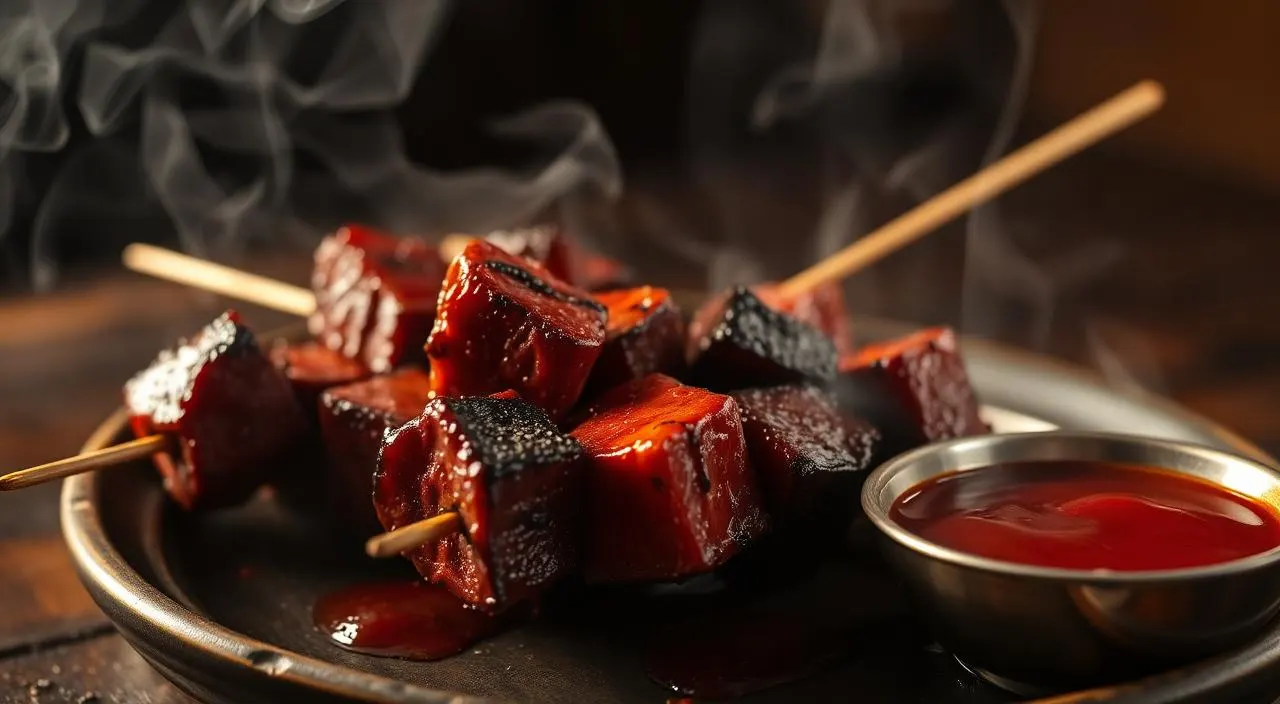
Smoked Anticucho Skewers — Beef Heart, Low Then High
Anticuchos are a Peruvian street food staple — beef heart marinated in ají panca and vinegar, skewered and grilled hard over charcoal. The smoking step before the sear is not traditional, but it adds a layer of depth that makes the char even better.
Cook Mode
One step at a time, big text, timers, and your screen stays awake. 0/8 steps done.
Ingredients
Tap to tick off · 0/11 gathered
- — MARINADE —
- — ANTICUCHOS —
- — DIPPING SAUCE —
Method
- 20 min
Begin by cleaning 2 lbs of beef heart with surgical precision. Unlike muscle meat, heart is a dense, hard-working organ with heavy silver skin and tough connective tissue that will not break down during a quick smoke. Use a sharp boning knife to remove all white exterior fat and every trace of silver skin until you have clean, dark red muscle. Cut the heart into uniform 1.5-inch cubes; uniformity is critical for even heat distribution so every piece reaches the target internal temperature simultaneously.
Why it matters
Removing silver skin ensures a tender bite, as this connective tissue becomes rubbery rather than melting like collagen.
Common mistake
Leaving too much connective tissue which makes the skewer difficult to chew.
- 6h
In a non-reactive bowl, whisk together 3 tbsp ají panca paste, 6 minced garlic cloves, 0.33 cup red wine vinegar, 2 tbsp vegetable oil, 2 tsp ground cumin, 1 tsp dried oregano, 1 tsp salt, and 1 tsp black pepper. The high vinegar content acts as a chemical tenderizer, breaking down the dense protein fibers of the heart. Submerge the beef heart cubes in this marinade, ensuring every surface is coated. Seal in a container or vacuum bag and refrigerate for 4 to 6 hours—do not exceed 12 hours or the vinegar will begin to 'cook' the meat and turn it mushy.
Why it matters
The vinegar and salts penetrate the dense organ meat to season the interior and provide a tenderizing effect before heat is applied.
Common mistake
Using a metal bowl which can react with the high vinegar content and impart a metallic taste.
- 20 min
Remove the meat from the marinade and thread onto metal skewers, placing 5 to 6 pieces per skewer. Leave a small gap between each cube to allow smoke to circulate around all four sides. Pat the surface slightly with a paper towel and let the skewers sit on a wire rack at room temperature for 15-20 minutes. You are looking for the surface to feel slightly tacky—this is the pellicle, and it acts as an adhesive for the smoke particles, ensuring your oak flavor sticks to the meat rather than just washing over it.
Why it matters
A dry, tacky surface is required for smoke adhesion; smoke will simply slide off wet meat.
Common mistake
Putting soaking wet skewers directly into the smoker, resulting in a steamed texture rather than a smoked one.
- 250°F15 min
Preheat your smoker to a steady 250°F using oak pellets for a clean, assertive smoke profile that complements the earthy ají panca. Configure your grill for two-zone cooking: one side should be set for the 250°F indirect smoke, while the other side is prepared for high-heat searing later. Ensure your grates are clean and lightly oiled. This setup allows for a 'reverse sear' approach, gently warming the meat to build flavor before the final carmelization step.
Why it matters
A two-zone setup prevents the lean heart from drying out during the flavoring stage and enables a rapid transition to searing.
Common mistake
Failing to stabilize the smoker temp before adding meat, leading to bitter 'dirty' smoke flavors.
- 250°F30 min
Place the skewers on the indirect side of the smoker. Close the lid and smoke for 30 minutes. We are not looking for full doneness here, but rather a flavor infusion and a gradual rise in internal temperature. The target is to get the heart to roughly 110°F-115°F internal. The oak smoke will react with the ají panca marinade to create a deep, mahogany color. Keep the lid closed as much as possible to maintain a consistent environment and prevent the lean meat from losing moisture.
Why it matters
Slowly raising the temp allows the smoke to penetrate the dense tissue before the exterior becomes sealed by high-heat searing.
Common mistake
Overcooking during the smoke phase, which leaves no room for the necessary high-heat char.
- 140°F8 min
Move the skewers immediately to the direct high-heat zone. Grill for 2 to 3 minutes per side, rotating to char all four sides. The goal is to reach a final internal temperature of 135°F to 140°F for a perfect medium. Because heart is an organ meat, it is exceptionally lean; cooking it past medium (145°F+) will result in a dry, liver-like texture and a metallic taste. Look for the edges to start crisping and the marinade to bubble and caramelize into a dark crust.
Why it matters
The high heat triggers the Maillard reaction, turning the sugars in the chili paste into a complex, savory crust.
Common mistake
Cooking the heart to well-done, which turns the texture from succulent to rubbery.
- 7 min
Transfer the skewers to a warm platter and tent loosely with foil. Allow the meat to rest for 5 to 7 minutes. During this time, carryover cooking will bring the final internal temp up by 3-5 degrees, and the muscle fibers will relax, allowing the juices to redistribute. This ensures that when your guests bite into the skewer, the moisture stays in the meat rather than running out onto the plate.
Why it matters
Proper resting is the difference between a juicy skewer and a dry one, especially with ultra-lean proteins like heart.
Common mistake
Slicing or eating immediately, causing all the internal moisture to leak out.
- 5 min
While the meat rests, prepare the fresh dipping sauce by whisking 0.25 cup ají panca paste, 2 tbsp vegetable oil, 1 tbsp red wine vinegar, and 1 tsp cumin until emulsified. Season with salt to taste. This sauce provides a bright, acidic counterpoint to the deep smoky notes of the beef. Serve the skewers hot with the sauce drizzled over or on the side, ideally accompanied by boiled potatoes or corn to round out the traditional Peruvian experience.
Why it matters
The acidity in the fresh sauce cuts through the intensity of the smoke and the richness of the heart.
Common mistake
Using the 'spent' marinade from earlier for dipping, which is a food safety hazard; always use fresh ingredients for the final sauce.
Sauce It
Cooks & Reviews
Guild members can rate this recipe, log their cooks and share photos.
Sign in to continueMember reviews
No reviews yet — be the first to rate this cook.
Ask the Pitmaster about this recipe
Substitutions, scaling, technique, troubleshooting — get answers grounded in this cook.
Sign in to try the AI Pitmaster on Smoked Anticucho Skewers — Beef Heart, Low Then High. New members get 3 free questions.
Sign in to tryComments(0)
Loading comments…