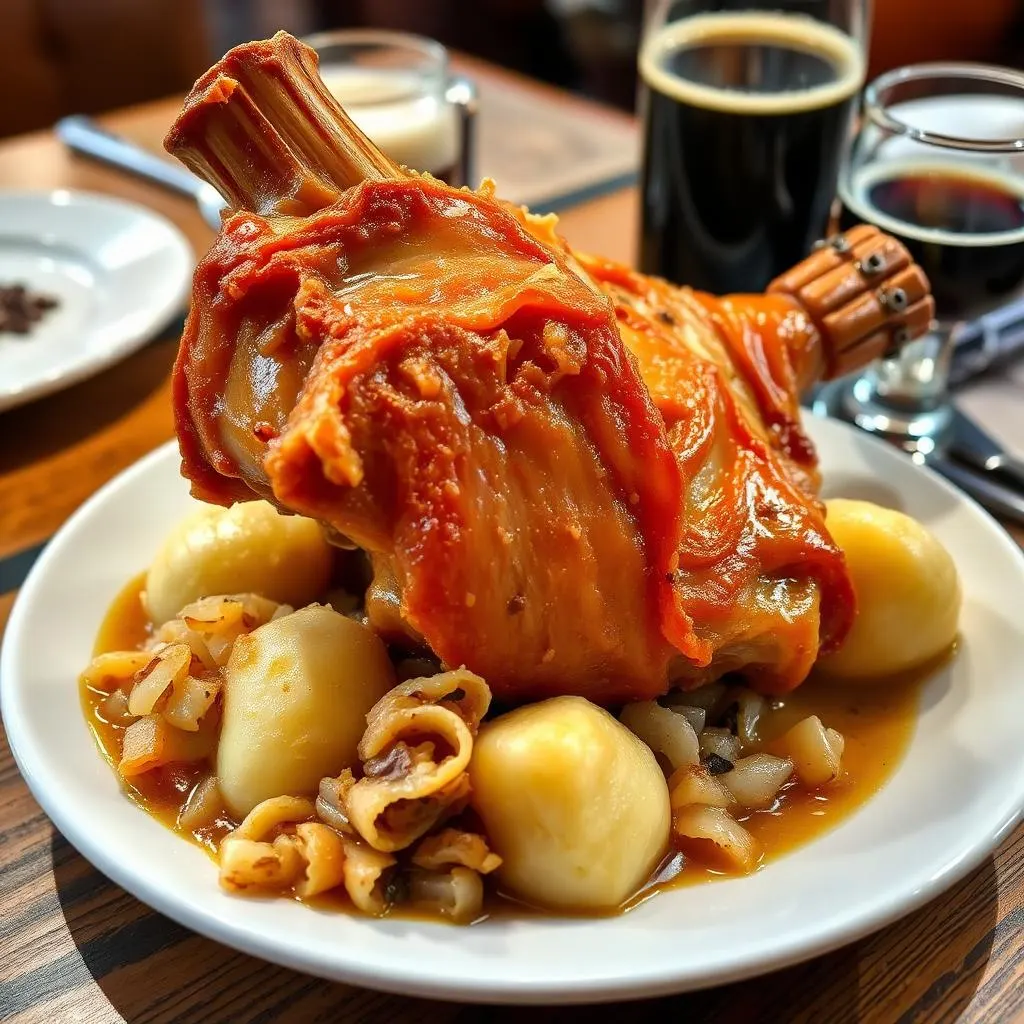
Schweinshaxe — Smoked & Roasted Pork Knuckle
The Bavarian beer-hall showpiece — crackling so crisp it shatters, meat underneath that pulls in strands. A long low smoke to render, then a hard hot blast for the skin.
Cook Mode
One step at a time, big text, timers, and your screen stays awake. 0/8 steps done.
Ingredients
Tap to tick off · 0/11 gathered
- — MAIN —
- — BRINE —
- — FINISH —
Method
- 20 min
Begin by simmering 8 cups of water with 0.5 cup kosher salt and 0.25 cup brown sugar until fully dissolved. Add 2 tbsp of crushed juniper berries, 1 tbsp caraway seed, 1 head of halved garlic, and 4 bay leaves to steep. This equilibrium brine is critical for penetrating the dense connective tissue of the 1.5-2 lb knuckles. Once simmered, you must cool the liquid completely to below 40°F before introducing the pork to ensure the meat stays out of the bacterial danger zone during the curing process.
Why it matters
The brine equilibrates moisture and seasons through the thick hock flesh; skipping it results in dry, bland pork.
Common mistake
Adding meat to a warm brine, which partially cooks the exterior and risks foodborne illness.
- 38°F24h
Submerge the 2 pork knuckles fully in the chilled brine. Use a weight to ensure no skin is exposed to air, which can lead to uneven curing. Refrigerate for 12 to 24 hours. During this period, the salt denatures proteins, allowing the fibers to hold more moisture, while the juniper and caraway infuse the fat. For an advanced uptick in umami, consider a light application of shio koji paste to the meat side (avoiding the skin) before the final smoke to accelerate tenderization.
Why it matters
A long cure ensures the seasoning reaches the bone and prevents the meat from drying out during the high-heat finish.
Common mistake
Curing for less than 12 hours, which leaves the center of the thick knuckle unseasoned.
- 15 min
Remove the knuckles from the brine and pat the skin bone-dry with paper towels. Using a sharp utility knife or a clean box cutter, score the skin in a 1/2-inch diamond pattern, cutting through the tough skin and into the fat but stopping before you hit the muscle. Place the knuckles on a wire rack and pour boiling water over the skin; you will see the scores peel back and open up. This 'shocks' the collagen and begins the rendering process that is essential for a glass-like finish.
Why it matters
Scoring and shocking allows the fat to escape and baste the skin from the inside out during the cook.
Common mistake
Cutting too deep into the meat, which causes the juices to leak out and dry the knuckle.
- 38°F2h
Apply a generous layer of coarse salt exclusively into the scored lines of the skin. Do not use a sugar-based rub, as it will burn during the roasting phase. Place the knuckles back in the refrigerator, uncovered, on a wire rack for at least 2 hours (or up to 4). This allows the skin to form a pellicle—a tacky surface that helps smoke adhesion—and significantly dehydrates the surface to ensure maximum crispness later.
Why it matters
A dry, salted skin is the only way to achieve the 'shatter' texture characteristic of authentic Schweinshaxe.
Common mistake
Covering the meat during this phase, which traps moisture and leads to rubbery skin.
- 250°F4h
Preheat your smoker to 250°F using beech wood, which provides the traditional Bavarian soot-free, mild smoke profile. Place the knuckles on the grate and smoke for 3 to 4 hours. Every 45 minutes, lightly baste the exposed meat—not the skin—with dark beer. This adds a malty, bitter complexity to the protein while the low heat slowly renders the thick layer of subcutaneous fat and breaks down the tough collagen into gelatin.
Why it matters
Low and slow beech smoke develops the deep mahogany color and internal tenderness required for pull-apart meat.
Common mistake
Basting the skin with beer, which introduces moisture and ruins the crunch.
- 450°F25 min
Once the internal temperature of the pork hits roughly 195°F and the meat feels tender to a probe, transition to the finishing phase. Crank your smoker to its maximum setting (at least 450°F) or move the knuckles to a preheated high-heat oven. Watch closely for 20 to 30 minutes. The salt-dehydrated skin will begin to blister and puff (crackling). The goal is a uniform, golden-brown texture that sounds hollow when tapped with a knife.
Why it matters
This thermal shock converts the rendered fat and dehydrated skin into an airy, crisp shell.
Common mistake
Pulling the pork too early before the skin has fully blistered across the entire surface.
- 203°F20 min
Transfer the knuckles to a cutting board but do not tent them with foil. Tenting creates steam, which will instantly soften the crackling you just spent hours perfecting. Let the meat rest for 15 to 20 minutes. This allows the internal juices to redistribute and the carryover cooking to settle the internal temperature at approximately 201-205°F, which is the sweet spot for pork connective tissue breakdown.
Why it matters
Resting prevents the juices from purging onto the plate, ensuring the meat stays moist under the brittle skin.
Common mistake
Failing to rest the meat or covering it with foil, which turns the crackling soggy.
- 5 min
Carve the knuckle by slicing through the crackling and pulling the meat away from the center bone in large chunks. Each guest should receive a portion of the glass-hard skin and a portion of the tender, juniper-scented meat. Serve alongside traditional sides like sauerkraut, mustard, and potato dumplings (Knödel) to balance the rich, fatty nature of the pork with acidity and starch.
Why it matters
Proper presentation honors the KCBS standard of uniform appearance while highlighting the contrast in textures.
Common mistake
Using a dull knife to carve, which shatters the crackling into unappealing shards.
Sauce It
Cooks & Reviews
Guild members can rate this recipe, log their cooks and share photos.
Sign in to continueMember reviews
No reviews yet — be the first to rate this cook.
Ask the Pitmaster about this recipe
Substitutions, scaling, technique, troubleshooting — get answers grounded in this cook.
Sign in to try the AI Pitmaster on Schweinshaxe — Smoked & Roasted Pork Knuckle. New members get 3 free questions.
Sign in to tryComments(0)
Loading comments…