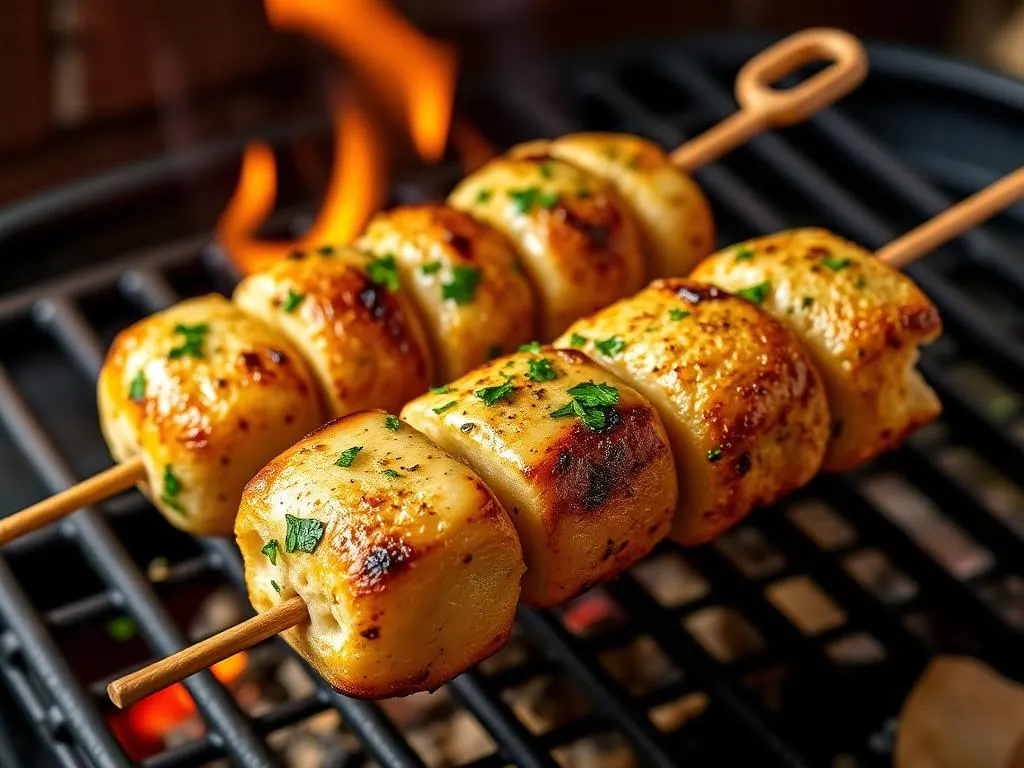
Pão de Alho — Smoked Brazilian Garlic Bread
Every churrasco has it and nobody can stop eating it. Brazilian garlic bread is skewered, slathered in a creamy garlic paste, and run over the fire until the edges char. It's the side dish people fight over. Vegetarian and dead simple.
Cook Mode
One step at a time, big text, timers, and your screen stays awake. 0/7 steps done.
Ingredients
Tap to tick off · 0/7 gathered
- — MAIN —
- — GARLIC PASTE —
Method
- 10 min
In a medium bowl, combine 1 stick of softened butter, 0.25 cup of cream cheese or mayo, 6 cloves of grated garlic, 0.25 cup grated parmesan, 1 handful of chopped parsley, and 0.5 tsp salt. Mash and whip these ingredients until they form a homogenous, creamy emulsion. Using grated garlic instead of minced ensures the oils are fully released, distributing the heat and flavor evenly throughout the fat phase of the paste.
Why it matters
The fat in the butter and cheese acts as a carrier for the garlic's volatile oils and captures the smoke particles during the cook.
Common mistake
Using cold butter which prevents the ingredients from emulsifying, leading to a greasy, separated paste.
- 10 min
Slice 2 loaves of French rolls or baguette into rounds approximately 1 to 1.5 inches thick. Slather the garlic paste generously over both cut sides of each round, ensuring full coverage to the edges to prevent burning. If following the traditional churrasco method, thread the rounds onto flat metal skewers; this allows for easy rotation and even heat exposure across the entire batch.
Why it matters
Uniform thickness ensures that the bread toasts and the moisture evaporates at the same rate across all pieces.
Common mistake
Applying too thin a layer of paste, which causes the bread to dry out into a hard rusk rather than staying tender inside.
- 275°F20 min
Preheat your smoker to 275°F using a light fruit wood like apple or cherry. Ensure the smoke is 'blue' and translucent before adding the bread; heavy, white smoke contains soot and creosote that will make the porous bread and high-fat paste taste bitter or metallic. We are aiming for a gentle infusion that complements the pungent garlic.
Why it matters
Bread is highly absorbent and will soak up 'dirty' smoke faster than meat, ruining the delicate flavor profile.
Common mistake
Placing the bread in the smoker while the fire is still producing thick, acrid white smoke.
- 275°F20 min
Place the skewers or individual rounds on the indirect side of the smoker. Close the lid and monitor for 20 minutes. During this phase, the butter and cheese will melt into the crumb of the bread, while the smoke particles dissolve into the liquefied fats. Look for the cheese to become bubbly and the garlic to lose its raw, sharp bite as it softens in the heat.
Why it matters
Indirect heat allows the interior of the bread to warm and the flavors to meld without burning the exterior sugars.
Common mistake
Opening the lid too frequently, which fluctuates the temperature and extends the cook time unnecessarily.
- 450°F3 min
Move the bread directly over the heat source or open your flame broiler. Watch these very closely for 1 to 2 minutes per side. You are looking for 'Maillard' reaction cues: deep golden browning and localized charring on the edges of the bread and the surface of the garlic paste. This adds a necessary bitter-sweet contrast to the rich fat.
Why it matters
The final sear provides the textural crunch and charred aroma characteristic of authentic Brazilian street food.
Common mistake
Walking away during the direct sear; the high fat content in the paste can cause rapid flare-ups and char the bread to ash in seconds.
- 2 min
Remove the bread from the heat and let it rest for exactly 2 minutes before serving. While bread doesn't have the same rest requirements as a brisket, this short window allows the molten fats to slightly firm up and re-adhere to the bread fibers, preventing the paste from sliding off when the guests take their first bite.
Why it matters
A brief rest prevents the 'roof of the mouth' burns associated with molten cheese and butter.
Common mistake
Serving immediately while the cheese is still in a liquid, 'sliding' state.
Slide the rounds off the skewers onto a communal platter. Dust with a final pinch of fresh parsley if desired. Serve while the internal crumb is still soft and the crust remains crisp. This dish is designed to be eaten by hand as an appetizer while the heavier meats are finishing their final rest.
Why it matters
Pão de alho is a social food intended to bridge the gap between the pit and the table.
Common mistake
Allowing the bread to sit too long, which results in the bread becoming tough as it cools and the fats congeal.
Cooks & Reviews
Guild members can rate this recipe, log their cooks and share photos.
Sign in to continueMember reviews
No reviews yet — be the first to rate this cook.
Ask the Pitmaster about this recipe
Substitutions, scaling, technique, troubleshooting — get answers grounded in this cook.
Sign in to try the AI Pitmaster on Pão de Alho — Smoked Brazilian Garlic Bread. New members get 3 free questions.
Sign in to tryComments(0)
Loading comments…