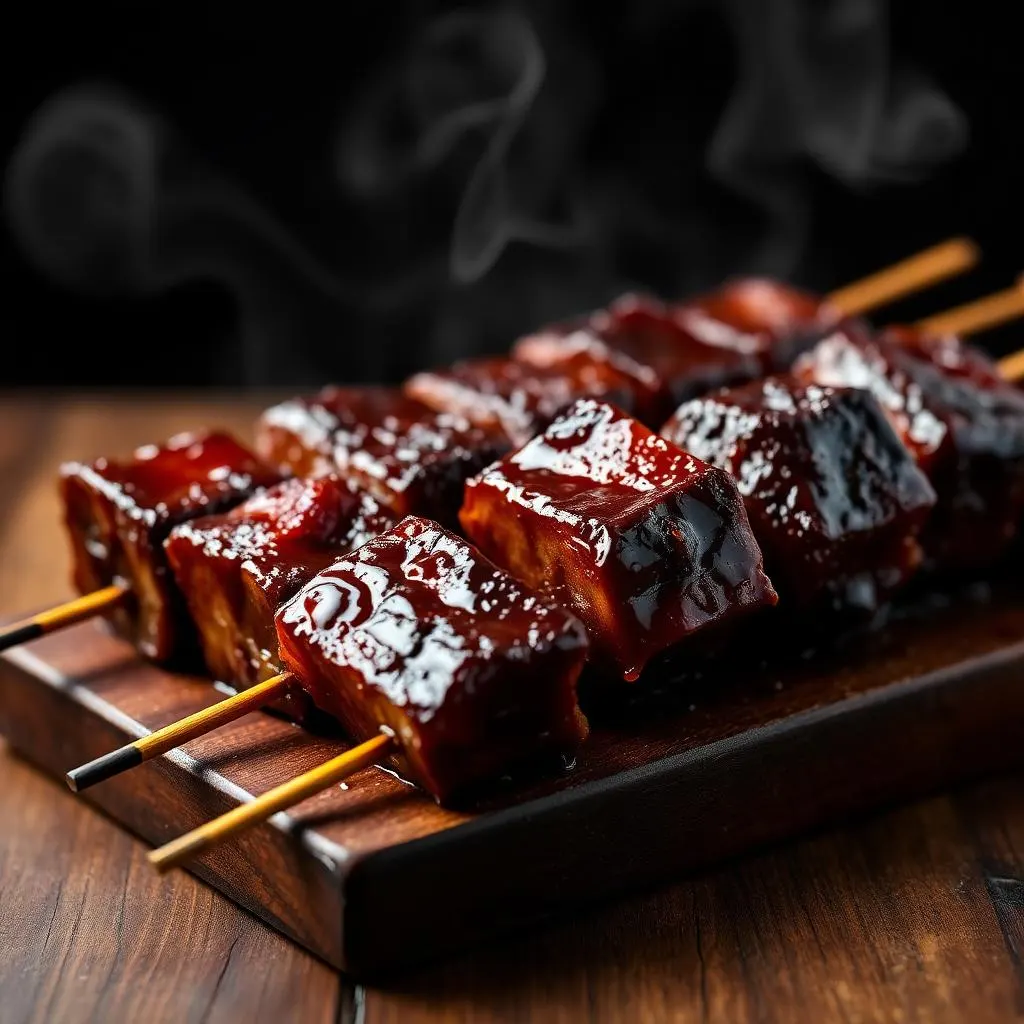
Caribbean Pork Belly Burnt Ends
The candy of the competition circuit, jerked. Belly cubes jerk-cured, smoked to tender, tossed in jerk-rum glaze, then set back in the smoke until they lacquer.
Cook Mode
One step at a time, big text, timers, and your screen stays awake. 0/9 steps done.
Ingredients
Tap to tick off · 0/16 gathered
- — MAIN —
- — JERK CURE —
- — JERK-RUM GLAZE —
Method
- 12h
Begin by blending the Jerk Cure: 6 scotch bonnet peppers, 1 bunch scallions, 6 garlic cloves, 2 inches of ginger, 3 tbsp ground allspice, 2 tbsp brown sugar, 2 tbsp fresh thyme, 2 tbsp soy sauce, 2 tbsp lime juice, 0.25 cup oil, and 1 tbsp salt until it forms a smooth paste. Reserve exactly 2 tbsp of this wet rub for the final glaze. Thoroughly coat 3 lbs of 1.5-inch pork belly cubes in the remaining mixture, ensuring every surface is covered. The salt and lime juice begin breaking down surface proteins, allowing the allspice and scotch bonnet heat to penetrate deep into the fat layers rather than just sitting on the surface.
Why it matters
The cure equilibrates moisture and seasons through the flesh; skipping it gives you dry, bland pork belly.
Common mistake
Using the entire cure volume and forgetting to reserve the 2 tbsp needed for the glaze.
- 1h
Arrange the cured cubes on a wire rack over a baking sheet and return them to the refrigerator uncovered for 60 minutes. This step is critical for developing a 'pellicle'—a thin, tacky skin on the surface of the meat. This layer provides the necessary adhesion for the smoke particles and the rendered fat to bond, ensuring a clean mahogany color rather than a grey, steamed appearance. Ensure the refrigerator is cold and do not stack the cubes; air must flow around all six sides.
Why it matters
A proper pellicle allows smoke compounds to stick and form a stable bark.
Common mistake
Moving straight from the wet marinade to the smoker, which causes the smoke to wash off with the moisture.
- 250°F30 min
Preheat your smoker to a steady 250°F using pimento wood for authentic Jamaican flavor, or cherry wood mixed with whole allspice berries in the firebox as a substitute. Stabilize the temperature for at least 30 minutes before adding the meat; clean blue smoke is vital here. Ensure your cooking grate is clean and lightly oiled to prevent the high sugar content in the jerk marinade from sticking and tearing the meat surface during the initial set.
Why it matters
A stable, clean-burning fire prevents bitter creosote from ruining the delicate balance of spices.
Common mistake
Putting meat on while the smoker is still billowing thick white smoke.
- 250°F3h
Place the pork belly cubes directly on the grates, spaced at least 1 inch apart to ensure even airflow. Smoke at 250°F for approximately 180 minutes. During this phase, you are looking for the 'push test': when you press a cube, it should feel spongy rather than firm as the intramuscular fat begins to render. The internal temperature of the cubes should be approximately 170°F-175°F at the end of this step, and the exterior should have a deep reddish-brown bark developed from the sugars and pimento smoke.
Why it matters
Direct exposure to smoke during the first three hours builds the foundation for competition-grade bark.
Common mistake
Crowding the cubes too closely, which leads to 'white walls' where the smoke cannot reach.
- 250°F1h 30m
Transfer the cubes into a heavy-duty foil pan. Whisk together the Jerk-Rum Glaze: 0.5 cup dark rum, 0.5 cup brown sugar, 0.25 cup honey, 2 tbsp melted butter, the 2 tbsp reserved jerk cure, and 1 tbsp lime juice. Pour this over the cubes and toss gently to coat. Cover the pan tightly with double-layered foil to trap steam. This 'Texas Crutch' method breaks down the tough connective tissue in the belly, effectively tenderizing the meat in a humid environment.
Why it matters
The braising phase accelerates the breakdown of collagen, turning tough pork into 'candy' texture.
Common mistake
Ignoring the seal on the foil, which allows moisture to escape and dries out the ends.
- 203°F30 min
Continue cooking the covered pan until the cubes reach an internal temperature of 203°F. Use a thermoprobe to check multiple cubes; the probe should slide in with zero resistance, commonly referred to as 'like butter.' This temperature is the sweet spot where the belly fat has fully rendered but the meat hasn't yet disintegrated into pulled pork. This step ensures food safety by surpassing the 140°F danger zone rapidly and hitting the peak of tenderness.
Why it matters
Collagen conversion to gelatin is most efficient between 195°F and 205°F.
Common mistake
Pulling the meat based on time alone rather than internal temperature and physical resistance.
- 250°F30 min
Remove the foil cover entirely and toss the cubes one last time in the rendered juices and glaze. Return the uncovered pan to the smoker. This final 30-minute window evaporates the excess moisture from the rum and honey, creating a sticky, tacky lacquer that clings to the meat. The glaze should darken and bubble, but watch closely to ensure the high sugar content does not scorch or turn bitter.
Why it matters
Liquid glazes must be 'set' by heat to achieve the glossy, non-dripping appearance judges look for.
Common mistake
Leaving the meat in too long at this stage, causing the sugars to burn and taste acrid.
- 15 min
Remove the pan from the smoker and let the burnt ends rest uncovered for 15 minutes. This allows the internal muscle fibers to relax and reabsorb some of the liquid glaze, while the lacquer sets firmly to the surface. Resting also prevents the cubes from 'bleeding' juices when bitten, which is a major texture penalty in competition judging. The temperature will carry over slightly, but the goal is to stabilize the proteins for a clean bite.
Why it matters
A proper rest ensures the juices stay inside the meat, maintaining the succulent 'burst' on the first bite.
Common mistake
Serving immediately, which leads to a messy, watery bite and poor mouthfeel.
Plate the cubes on a bed of fresh green parsley or cilantro to provide a color contrast that highlights the deep mahogany of the jerk glaze. For a professional or competition look, serve with small bamboo skewers. Every cube should be uniform in size and glistening under the light, with no visible pooling of grease in the bottom of the dish. Each bite should offer a balance of sweet honey, funky rum, and the unmistakable aromatic heat of the scotch bonnet and allspice.
Why it matters
Appearance accounts for the first impression and score; if it doesn't look uniform, it's judged as amateur.
Common mistake
Over-saucing the final plate, which masks the texture and makes the cubes look sloppy.
7 more steps locked
You've seen the ingredients and the first two steps. Pit Members get every step, every temp, every glaze — plus the Cook Monitor and Pitmaster AI.
See Membership OptionsAlready a member? Sign in.
Sauce It
Cooks & Reviews
Guild members can rate this recipe, log their cooks and share photos.
Sign in to continueMember reviews
No reviews yet — be the first to rate this cook.
Ask the Pitmaster about this recipe
Substitutions, scaling, technique, troubleshooting — get answers grounded in this cook.
Sign in to try the AI Pitmaster on Caribbean Pork Belly Burnt Ends. New members get 3 free questions.
Sign in to tryComments(0)
Loading comments…