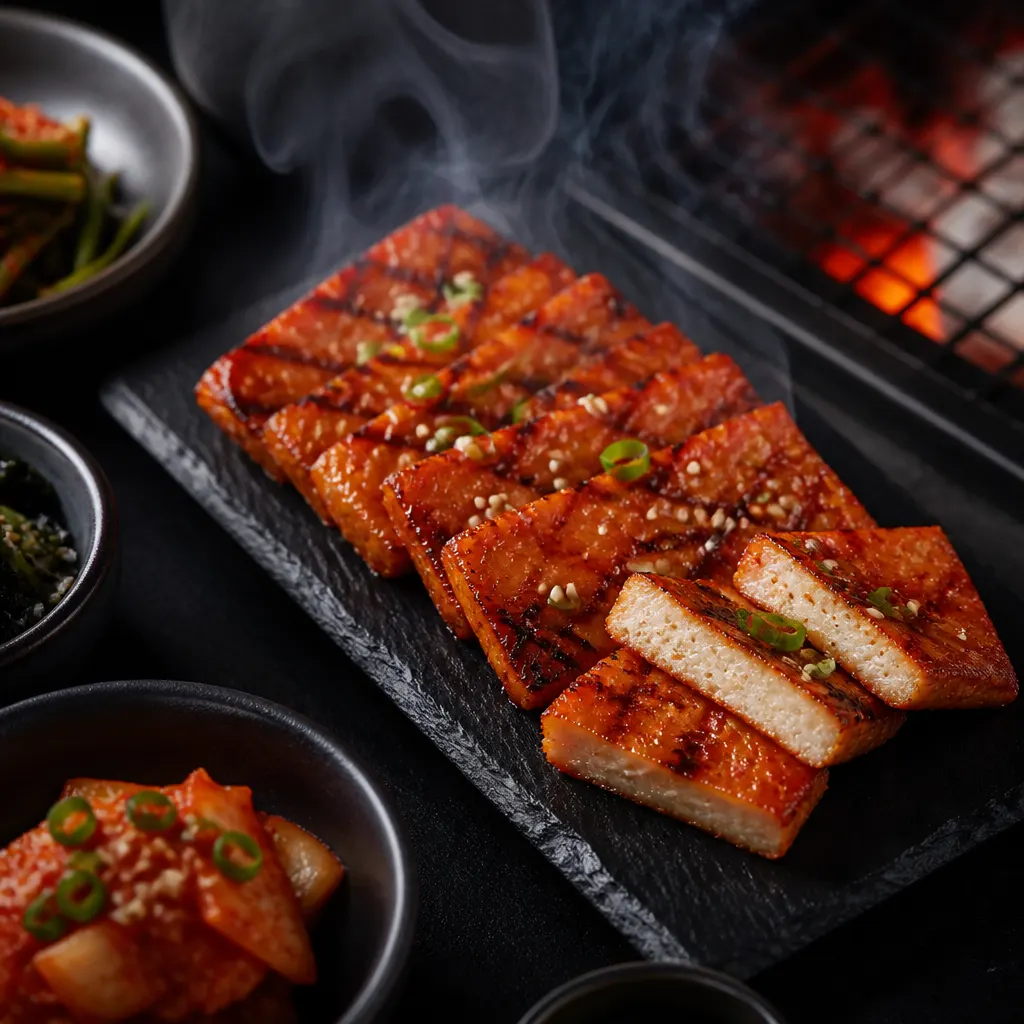
House-Smoked Eomuk (Korean Fish Cake)
Genuine culinary craft — firm white fish pureed with starch and aromatics into a springy paste, formed, then smoked instead of the usual fry or steam. The smoke gives it a depth no store-bought version has. Opens up a whole world (eomuk-tang soup, skewers, stir-fries) once you can make the cakes yourself.
Cook Mode
One step at a time, big text, timers, and your screen stays awake. 0/8 steps done.
Ingredients
Tap to tick off · 0/11 gathered
Method
- 15 min
Begin by chilling 1.5 lbs of firm white fish (pollock or cod) until it is near-freezing but not solid. Place the cold fish into a food processor and pulse until it begins to break down, then add 1 egg white, 3 tbsp potato starch, 2 tbsp mirin, 1 tbsp sugar, 1 tbsp grated garlic, 1 tsp grated ginger, and 1 tsp salt. Process on high for 2-3 minutes until the mixture transforms into a homogenous, sticky, and highly elastic paste; this friction-sensitive process requires the fish to stay below 40°F to ensure the proteins emulsify correctly rather than breaking.
Why it matters
Keeping the fish cold during the high-speed blending prevents the proteins from denaturing prematurely, ensuring the signature springy texture.
Common mistake
Using room-temperature fish, which results in a grainy, mushy texture instead of a firm snap.
- 5 min
Transfer the fish paste to a chilled mixing bowl and add 0.25 grated onion (squeezed dry to remove excess moisture) and 2 minced scallions. Use a spatula to fold these aromatics into the paste by hand until evenly distributed, taking care not to overwork the mix which could introduce too much air and create a spongy rather than dense cake.
Why it matters
Hand-folding ensures the delicate scallions and onion retain their integrity and don't turn into a watery slurry that ruins the paste consistency.
Common mistake
Failing to squeeze the onion dry, which adds unmeasured liquid that prevents the cakes from setting properly.
- 10 min
Lightly coat your hands and a parchment-lined tray with neutral oil to prevent sticking. Portion the paste into balls and flatten them into oval cakes approximately 1/2 inch thick; uniform thickness is critical for even heat penetration in the smoker. Aim for consistent shapes to ensure they all reach the food safety threshold simultaneously.
Why it matters
Consistent thickness ensures that every cake reaches the safe internal temperature at the exact same time.
Common mistake
Making the cakes too thick in the center, leading to an undercooked core while the exterior gets rubbery.
- 30 min
Place the formed cakes on a wire cooling rack and let them rest uncovered in a cool, breezy area (or refrigerated) for 30 minutes. This air-drying phase allows the proteins on the surface to knit together into a tacky layer called a pellicle; this layer is what the smoke compounds will bond to, providing the deep bronze color and smoky flavor.
Why it matters
Without a pellicle, smoke will not adhere evenly to the wet surface, resulting in a splotchy appearance and weak flavor profile.
Common mistake
Skipping the air-dry rest, which leads to 'crying' where the fish releases moisture and pushes the smoke off.
- 225°F20 min
Preheat your smoker to 225°F using alder or apple wood; these delicate woods are chosen because their mild, slightly sweet phenols complement the lean white fish without overpowering the ginger and mirin. Ensure you have a clean, blue smoke rolling before adding the fish cakes to avoid depositing bitter creosote on the delicate protein.
Why it matters
Using a mild wood like alder prevents the fish from tasting like ash, while a stable 225°F avoids the 'danger zone' for bacterial growth.
Common mistake
Using heavy woods like hickory or mesquite which will completely mask the flavor of the seafood.
- 145°F35 min
Arrange the cakes on the grates with at least one inch of space between them to allow for total airflow. Smoke at 225°F for 30 to 35 minutes until the cakes feel firm to the touch and spring back when pressed; use an instant-read thermometer to verify an internal temperature of 145°F, passing the food safety threshold for seafood while maintaining moisture.
Why it matters
Smoking at 225°F provides enough heat to set the starch and protein matrix while infusing the fat-soluble smoke compounds into the oil-coated surface.
Common mistake
Overcooking the cakes until they become dry and lose their 'bouncy' Korean eomuk texture.
- 10 min
Remove the cakes from the smoker and let them rest on a wire rack for 10 minutes. During this time, the internal temperature will stabilize and the starch will fully retrograde, locking in the juice and ensuring the cakes maintain their shape when sliced or added to hot broths like eomuk-tang.
Why it matters
A brief rest allows the proteins to relax slightly, improving the final bite and mouthfeel.
Common mistake
Slicing immediately, which can cause steam to escape and result in a drier product.
The finished eomuk can be served warm as a snack, sliced into strips for a spicy stir-fry with gochugaru and soy, or threaded onto skewers for a traditional fish cake soup. If not using immediately, cool completely and refrigerate; the smoke flavor will actually intensify and mellow over the first 24 hours in the fridge.
Why it matters
Properly smoked eomuk is a versatile base ingredient that adds a specialized depth of flavor to various Korean dishes.
Common mistake
Discarding leftovers too early; the smoky profile improves after a day of refrigeration.
Sauce It
Free Guide
5 Techniques Competition Smokers Use That Home Cooks Don't
Join the Guild email list and we'll send you the free guide — the exact moves that separate backyard cooks from competition pitmasters.
Cooks & Reviews
Guild members can rate this recipe, log their cooks and share photos.
Sign in to continueMember reviews
No reviews yet — be the first to rate this cook.
Ask the Pitmaster about this recipe
Substitutions, scaling, technique, troubleshooting — get answers grounded in this cook.
Sign in to try the AI Pitmaster on House-Smoked Eomuk (Korean Fish Cake). New members get 3 free questions.
Sign in to tryComments(0)
Loading comments…