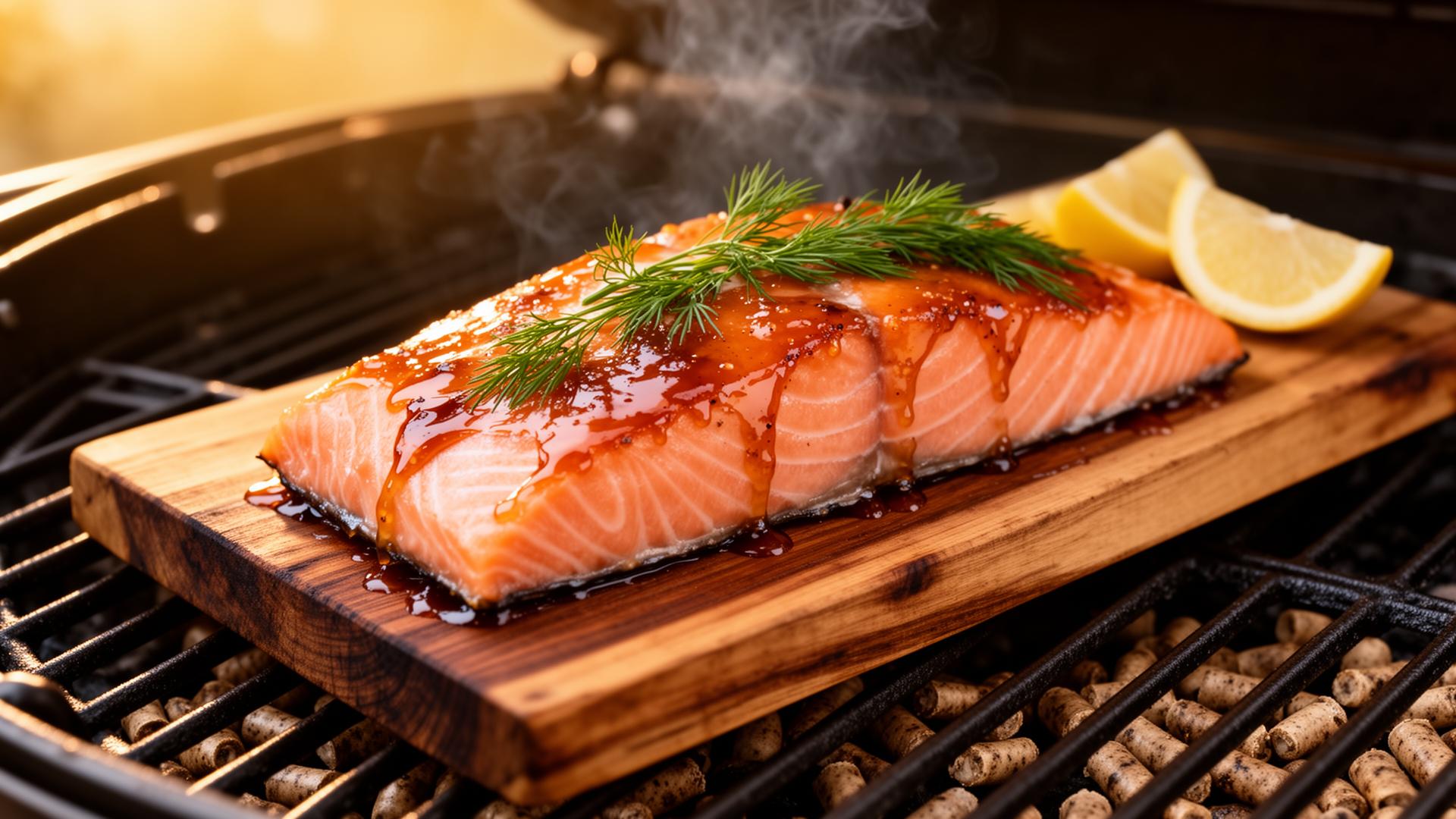
GMG Sweet Pellet Smoked Salmon
Cold-cured then slow-smoked over sweet fruit pellets. Buttery, mahogany lacquer, dinner-party ready.
Cook Mode
One step at a time, big text, timers, and your screen stays awake. 0/8 steps done.
Ingredients
Tap to tick off · 0/5 gathered
Method
- 10 min
In a medium mixing bowl, combine 1 cup of brown sugar, 0.5 cup of kosher salt, and 1 tbsp of cracked black pepper. Mix thoroughly until the cure is uniform in color; the sugar provides sweetness and aids in the Maillard reaction, while the salt is essential for denaturing proteins and drawing out moisture to inhibit bacterial growth. This 2:1 sugar-to-salt ratio is the gold standard for Pacific Northwest-style smoked salmon, providing a balance of savory-sweet flavor and firm texture.
Why it matters
The cure is a food safety necessity that also draws out water to concentrate the salmon's natural oils.
Common mistake
Using table salt instead of kosher salt, which results in an aggressively over-salted product due to crystal density.
- 8h
Lay the 2 lb Atlantic salmon side on a rimmed baking sheet or in a large glass dish. Pack the prepared dry cure mixture heavily over the flesh side of the fish, ensuring the entire surface is covered. Cover it tightly with plastic wrap and refrigerate for 8 hours. During this time, the salt penetrates the flesh and the osmotic pressure pulls moisture out of the fish, creating a concentrated brine within the dish that cures the protein throughout.
Why it matters
The cure transforms the salmon's texture from soft/flaky to firm/silky while ensuring safety during low-temp smoking.
Common mistake
Curing for too short a time, which leaves the center of the fillet raw and unprotected from bacteria.
- 2h
Remove the salmon from the refrigerator and rinse it thoroughly under cold water to remove all excess salt and sugar crystals. Pat it dry with paper towels, then place it on a wire cooling rack set over a baking sheet. Return the salmon to the refrigerator uncovered for 2 hours. This airflow creates a 'pellicle'—a thin, tacky layer on the surface of the meat—which is crucial for smoke adhesion and prevents 'albumin' (unsightly white protein) from weeping out during the cook.
Why it matters
Without a tacky pellicle, the smoke compounds cannot properly bond to the surface of the fish.
Common mistake
Skipping the air-drying phase, which leads to a wet surface that repels smoke and looks muddy.
- 150°F20 min
Preheat your pellet grill (Green Mountain Grill or similar) to 150°F using a blend of Alder and Cherry pellets. This low temperature keeps the salmon within a range that gently renders fat without tightening the muscle fibers too quickly. Ensure your grates are clean and slightly oiled; use a water pan if your environment is particularly arid to maintain humidity within the chamber and prevent the salmon from drying out prematurely.
Why it matters
A stable, low temperature prevents the 'danger zone' issues while ensuring a buttery, non-chalky texture.
Common mistake
Starting the smoke at too high a temp, which causes the salmon to 'sqeeze' out its fats and proteins.
- 150°F5h
Place the salmon skin-side down on the grates. Smoke at 150°F for approximately 5 hours. Starting at the two-hour mark, begin lightly brushing the surface with 0.25 cup of maple syrup every 60 minutes. This builds a mahogany lacquer that complements the smoke profile of the Alder and Cherry. Use a high-quality instant-read thermometer to monitor the internal temperature; you are aiming for an IT of 140°F-145°F to ensure the fish is pasteurized but remains moist.
Why it matters
The low-and-slow approach allows smoke particles to penetrate deep into the flesh for a consistent flavor profile.
Common mistake
Opening the lid too often to glaze, which causes temperature swings that extend the cook indefinitely.
- 140°F
Pull the salmon from the smoker once the thickest part of the fillet reaches 140°F. Because salmon is relatively thin compared to a brisket, carryover cooking will be minimal, but it will likely reach 145°F as it rests. This is the sweet spot for food safety and culinary quality. The surface should be mahogany in color and tacky to the touch from the maple reduction.
Why it matters
Hitting the target internal temperature ensures the fish is safe to eat while maintaining its buttery fat content.
Common mistake
Overcooking the salmon beyond 155°F IT, which results in a dry, crumbly, and 'fishy' tasting product.
- 12h
Allow the salmon to cool to room temperature on the counter for 30 minutes, then wrap it in butcher paper or plastic wrap and refrigerate. While tempting to eat warm, smoked salmon's flavor profile only truly 'sets' after a 12-hour rest in the fridge. This allows the smoke phenols to move from the surface into the center of the meat, mellowing the harshness and balancing the sweetness of the maple glaze.
Why it matters
Resting cold allows the smoke and cure to integrate, significantly improving the depth of flavor.
Common mistake
Eating the salmon immediately, which often tastes overly smoky and 'ashy' on the surface.
- 10 min
Bring the salmon out of the refrigerator and slice it thinly against the grain using a sharp slicing knife. For a dinner party presentation, serve with lemon wedges, capers, and red onion. The skin should peel away easily from the meat at this stage. Ensure the salmon is handled with clean utensils to maintain its shelf life, which is typically 7-10 days if properly cured and refrigerated.
Why it matters
Proper slicing technique preserves the delicate texture achieved through the 14-hour process.
Common mistake
Using a dull knife that tears the flesh rather than slicing cleanly through the chilled proteins.
Sauce It
Cooks & Reviews
Guild members can rate this recipe, log their cooks and share photos.
Sign in to continueMember reviews
No reviews yet — be the first to rate this cook.
Ask the Pitmaster about this recipe
Substitutions, scaling, technique, troubleshooting — get answers grounded in this cook.
Sign in to try the AI Pitmaster on GMG Sweet Pellet Smoked Salmon. New members get 3 free questions.
Sign in to tryComments(0)
Loading comments…