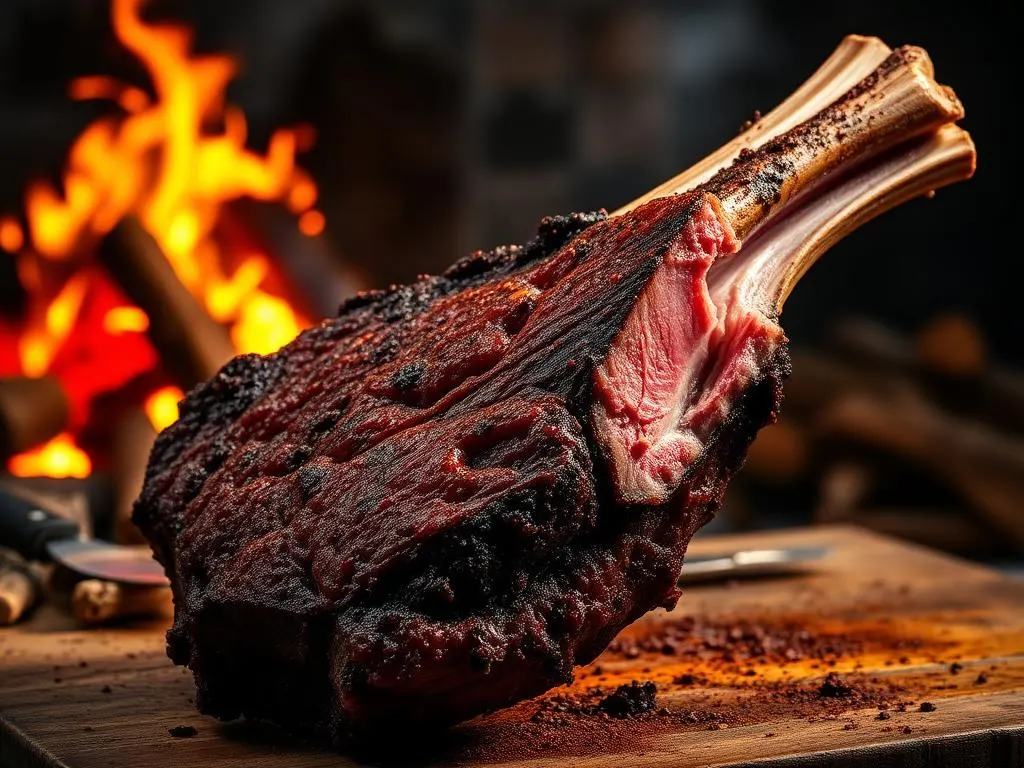
Costela Fogo de Chão — Smoked Brazilian Beef Ribs
The crown of gaucho cooking. Traditionally a giant slab of beef ribs is staked beside an open fire and cooked for half a day, fogo de chão means fire on the ground. We're translating that patience to the smoker. Coarse salt, oak smoke, and the discipline to leave it alone for twelve hours. The reward is beef that pulls apart in strands.
Cook Mode
One step at a time, big text, timers, and your screen stays awake. 0/7 steps done.
Ingredients
Tap to tick off · 0/3 gathered
- — MAIN —
Method
- 20 min
Begin with a 7 lbs full plate of beef ribs or bone-in beef rib slab. Unlike brisket, you want to leave the fat cap largely intact as it provides essential insulation during a 12-hour cook. Remove the silver skin from the bone side using a butter knife and paper towel for grip to ensure smoke and salt can penetrate from both sides. This ensures that the 'Costela' remains succulent and allows the rendering fat to baste the meat fibers throughout the long exposure to heat.
Why it matters
Exposing the bone by removing the membrane allows for better salt penetration and prevents a rubbery texture on the bottom of the rib.
Common mistake
Trimming too much fat from the top, which leads to the meat drying out during the marathon smoke session.
- 4h
Apply 0.25 cup of coarse rock salt (sal grosso) and 1 tbsp coarse black pepper across all surfaces of the meat. In the Gaucho tradition, the rock salt is the star; it creates a dry brine effect that draws moisture out, dissolves the salt, and then pulls that seasoned brine back deep into the muscle tissues. Ensure an even coating of the large crystals, pressing them firmly into the fat and meat. This must be done at least 4 hours before smoking, or ideally overnight in the refrigerator, to allow the salt to equilibrate.
Why it matters
Coarse rock salt dissolves slowly, creating a deeply seasoned interior and a superior crust that standard table salt cannot replicate.
Common mistake
Using fine salt in the same volume as rock salt, which will result in an inedibly salty piece of meat.
- 250°F1h
Set up your smoker for indirect cooking at a target temperature of 250°F using oak and a hint of hickory. The goal is a clean, blue smoke; thick white smoke will turn the heavy salt crust bitter. Ensure your water pan is full to maintain a high-humidity environment, which helps the smoke particles adhere to the meat and prevents the edges of the 7 lb slab from crisping too early. For a true 'Fogo de Chão' flavor profile, the oak provides the foundational strength while the hickory adds a punch of traditional BBQ aroma.
Why it matters
A stable, humid environment is critical for managing the long 12-hour window and preventing the meat from entering the danger zone for too long.
Common mistake
Starting the cook before the fire has settled, leading to creosote buildup on the salt crust.
- 250°F6h
Place the ribs bone-side down on the grate. This orientation allows the bones to act as a heat shield for the delicate meat while the fat cap renders from the top down. Maintain 250°F and resist the urge to open the lid for at least the first 5 to 6 hours. You are looking for the salt and fat to consolidate into a dark, mahogany bark. Because this is a thick plate of ribs, the meat will stay in the 40-140°F range for some time, so consistent heat is vital for food safety.
Why it matters
Bone-down positioning protects the meat from drying out while the fat renders through the protein fibers.
Common mistake
Opening the lid frequently to 'check' the ribs, which drops the temperature and adds hours to the cook time.
- 203°F5h
As the internal temperature hits approximately 165°F, the 'stall' will occur as evaporative cooling offsets the smoker's heat. If the bark is sufficiently dark and set, wrap the ribs tightly in peach butcher paper. This is a competition-grade technique that breathes better than foil, preserving the integrity of that rock-salt crust while speeding up the transition through the stall. Continue smoking until the internal temperature reaches a target of 203°F in the thickest part of the meat between the bones.
Why it matters
Wrapping prevents the meat from stalling for so long that it becomes dry and allows the connective tissue to fully gelatinize.
Common mistake
Wrapping too early before the bark has hardened, resulting in a 'mushy' surface texture.
- 2h
Once the probe slides into the meat with zero resistance (like warm butter) at 203°F, remove the ribs from the smoker. Keep them in the butcher paper and wrap them in an additional layer of towels or place them in an insulated cooler. Rest the ribs for at least 60 to 120 minutes. This allows the internal juices to redistribute and the temperature to come down slowly, preventing the moisture from rushing out when you finally slice into the slab. This carryover period finishes the tenderization process.
Why it matters
Resting allows the muscle fibers to relax and reabsorb moisture, ensuring the meat is tender rather than stringy.
Common mistake
Slicing the meat immediately after it leaves the smoker, which causes all the internal juices to purge onto the cutting board.
- 15 min
Unwrap the ribs and use a brush to gently knock off any excessive large chunks of rock salt that haven't dissolved. Slice between the bones to serve as massive individual 'dinosaur' ribs, or pull the meat away from the bone in the traditional gaucho style where it should shred into long, beefy strands. Serve immediately while the rendered fat is still warm and translucent. The flavor should be pure beef and smoke, accented by the sharp mineral hit of the salt crust.
Why it matters
Proper slicing preserves the visual 'wow' factor of the smoke ring and the structural integrity of the rib.
Common mistake
Failing to remove the largest exterior salt crystals, which can be unpleasantly crunchy for guests.
5 more steps locked
You've seen the ingredients and the first two steps. Pit Members get every step, every temp, every glaze — plus the Cook Monitor and Pitmaster AI.
See Membership OptionsAlready a member? Sign in.
Sauce It
Cooks & Reviews
Guild members can rate this recipe, log their cooks and share photos.
Sign in to continueMember reviews
No reviews yet — be the first to rate this cook.
Ask the Pitmaster about this recipe
Substitutions, scaling, technique, troubleshooting — get answers grounded in this cook.
Sign in to try the AI Pitmaster on Costela Fogo de Chão — Smoked Brazilian Beef Ribs. New members get 3 free questions.
Sign in to tryComments(0)
Loading comments…