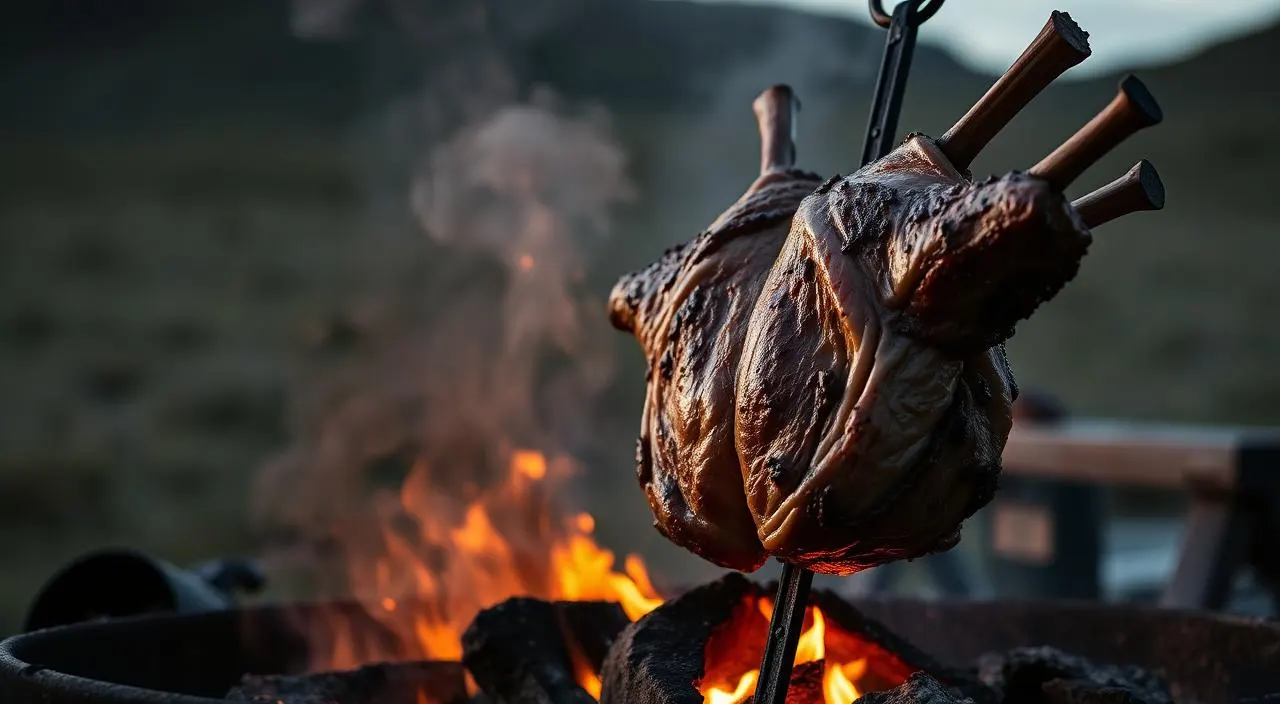
Cordero al Asador — Patagonian Butterflied Lamb on a Cross-Stake
This is Patagonian gaucho cooking at its most elemental. A whole butterflied lamb spread on a cross-shaped iron stake, driven into the earth at an angle toward an open wood fire, slowly cooking for 5 to 6 hours. If you don't have the cross-stake setup, the grill method gets you there.
Cook Mode
One step at a time, big text, timers, and your screen stays awake. 0/7 steps done.
Ingredients
Tap to tick off · 0/7 gathered
Method
- 30 min
Begin by cleaning the 20 to 25 lb butterflied lamb, removing any excess loose fat but keeping the surface fat intact to protect the meat. Prepare the 'salmuera' (basting brine) by mixing 0.5 cup coarse salt into 1 cup warm water until dissolved, then whisking in 0.25 cup vegetable oil, 10 cloves of minced garlic, 1 tbsp dried oregano, and 1 tbsp ground cumin. This solution serves as both the primary seasoning and a hydrating lacquer that prevents the surface from drying during the long exposure to open-air heat.
Why it matters
A warm brine ensures the salt and aromatics are fully integrated for consistent seasoning across the entire carcass.
Common mistake
Using cold water, which fails to dissolve the salt crystals and results in uneven seasoning.
- 275°F30 min
Spread the butterflied lamb flat on the iron cross-stake, ensuring the rib cage is facing toward what will be the fire. Use the cross-members and adjustable wires to secure the legs and spine tightly so the meat does not slip as it relaxes during the cook. If using a smoker or grill instead, prepare it for indirect cooking by establishing a two-zone setup, targeting an ambient temperature of 275°F using oak for that traditional robust smoke profile.
Why it matters
Proper mounting prevents the weight of the lamb from causing it to slump or fall into the coals as the connective tissue breaks down.
Common mistake
Failing to secure the legs tightly enough, leading to the lamb falling off the cross mid-cook.
- 275°F2h
Position the lamb approximately 3 feet from the fire at a 45-degree angle (or place it bone-side down on the grill grate). This phase focuses on heating the bones, which act as conductors to cook the meat from the inside out. Maintain your fire or smoker at 275°F. Monitor the meat closely during these first two hours to ensure the surface temperature doesn't rise too quickly, keeping it out of the 40-140°F danger zone efficiently while building a foundation of smoke.
Why it matters
Cooking bone-side first protects the delicate meat from direct heat and allows the thermal mass of the bone to assist in even cooking.
Common mistake
Placing the meat-side toward the heat first, which seizes the muscles and results in a tough texture.
- 275°F2h
Every 30 to 45 minutes, generously apply the garlic-cumin salmuera using a brush or a bundle of herbs. Shake the mixture before each application to ensure the oil and spices haven't settled. If using the cross method, rotate the stake 180 degrees if one side is coloring faster than the other. On a grill, rotate the meat to ensure the areas closest to the heat source are swapped. The goal is a steady, rhythmic application of moisture and salt to build a deeply flavored crust.
Why it matters
Frequent basting creates a saline barrier that slows evaporation, allowing the internal temperature to rise without the exterior turning into jerky.
Common mistake
Basting too infrequently, allowing the thin flank areas to become brittle and overly salty.
- 175°F1h 30m
Once the bone side is well-colored and the internal temperature reaches approximately 150°F, flip the lamb to face the meat-side towards the heat. Continue basting with the remaining salmuera. Watch for the fat to begin rendering and bubbling. You are looking for a deep mahogany color and charred spots where the fat has 'fried' on the surface. Continue cooking until the thickest part of the shoulder reaches an internal temperature of 170°F to 180°F, which ensures the collagen in these hard-working muscles has fully melted.
Why it matters
Flipping late in the cook allows you to crisp the fat cap and develop the Maillard reaction without burning the exterior.
Common mistake
Pulling the lamb at standard 'medium-rare' temps; lamb shoulder requires higher temps to break down tough connective tissue.
- 30 min
Remove the lamb from the cross or grill and place it on a large carving board or a clean, insulated surface. Cover loosely with foil—do not wrap it tightly, as you don't want to steam off the crisp skin you've worked to create. Let the meat rest for at least 20 to 30 minutes. During this time, carry-over cooking will finish the center, and the internal juices will redistribute from the center back toward the surface fibers, ensuring every bite is succulent.
Why it matters
Resting prevents the juices from purging onto the cutting board, which would leave the meat dry and fibrous.
Common mistake
Cutting into the lamb immediately, causing an immediate loss of internal moisture.
- 15 min
Carve the lamb by first separating the limbs and then slicing the meat against the grain. Ensure every guest receives a mix of the crispy exterior bark and the tender, juicy interior meat. Serve with any remaining juices from the carving board drizzled over the top. The meat should pull easily from the bone but still retain enough structure to be sliced cleanly. Offer traditional chimichurri on the side to provide an acidic counterpoint to the rich, smoky lamb fat.
Why it matters
Slicing against the grain breaks up the muscle fibers, making the meat feel significantly more tender in the mouth.
Common mistake
Slicing with the grain, which makes even a perfectly smoked lamb feel chewy.
Sauce It
Free Guide
5 Techniques Competition Smokers Use That Home Cooks Don't
Join the Guild email list and we'll send you the free guide — the exact moves that separate backyard cooks from competition pitmasters.
Cooks & Reviews
Guild members can rate this recipe, log their cooks and share photos.
Sign in to continueMember reviews
No reviews yet — be the first to rate this cook.
Ask the Pitmaster about this recipe
Substitutions, scaling, technique, troubleshooting — get answers grounded in this cook.
Sign in to try the AI Pitmaster on Cordero al Asador — Patagonian Butterflied Lamb on a Cross-Stake. New members get 3 free questions.
Sign in to tryComments(0)
Loading comments…