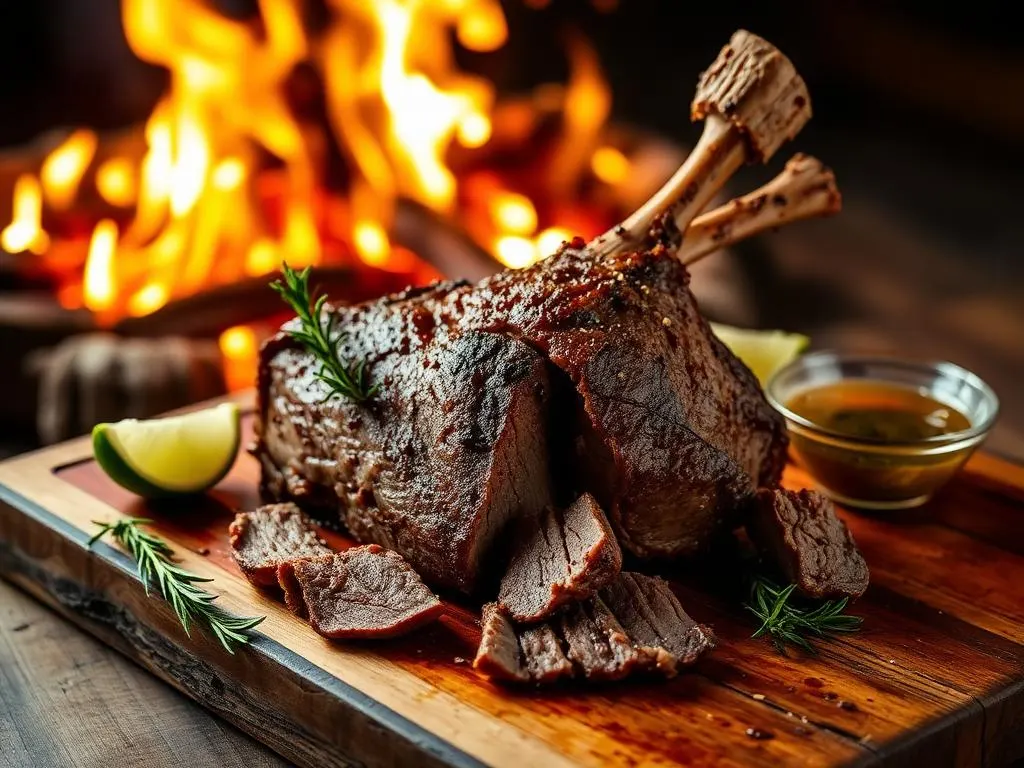
Cordeiro Gaúcho — Smoked Brazilian Lamb
Down in the gaucho south, lamb is king right alongside beef. A whole shoulder or leg gets marinated in garlic, rosemary, and wine, then cooked low over fire until it falls off the bone. This is the cut that shows you understand fire beyond beef, lamb fat behaves differently and demands a steadier hand.
Cook Mode
One step at a time, big text, timers, and your screen stays awake. 0/8 steps done.
Ingredients
Tap to tick off · 0/9 gathered
- — MAIN —
- — MARINADE —
Method
- 15 min
Begin with the 6 lbs bone-in lamb shoulder or leg. Unlike beef, lamb has a dense, waxy subcutaneous fat cap called the 'fell' which can prevent smoke and marinade penetration. Score the fat in a crosshatch pattern, cutting roughly 1/4 inch deep but not into the muscle fibers. This increased surface area allows the marinade to migrate deeper into the connective tissues and helps the fat render more efficiently during the long smoke.
Why it matters
Scoring creates channels for the marinade to bypass the waxy fat layer and reach the collagen-rich shoulder meat.
Common mistake
Cutting too deep into the meat which causes moisture to escape during the cook.
- 24h
Prepare the marinade by combining 1 head of crushed garlic, 0.5 cup white wine, 0.25 cup lime juice, 0.25 cup olive oil, 3 tbsp chopped fresh rosemary, 2 tbsp coarse salt, 1 tbsp black pepper, and 2 crushed bay leaves. Massage this mixture thoroughly into the scores and crevices of the lamb. The acidity of the wine and lime juice acts as a denaturant, breaking down tough surface proteins, while the salt initiates a dry-brine effect, pulling moisture out and then re-absorbing the garlic and rosemary infusions back into the cellular structure.
Why it matters
The high salt and acid content prevents bacterial growth while deeply seasoning the interior of the dense shoulder.
Common mistake
Using a reactive metal bowl for the marinade which can impart a metallic taste due to the lime and wine acidity.
- 2h
Remove the lamb from the marinade bag and pat the surface slightly dry with paper towels, leaving the garlic and rosemary bits attached. Place the lamb on a wire rack in the refrigerator for 2 hours. This airflow allows the 0.25 cup olive oil and meat proteins to form a tacky surface called a pellicle. The pellicle is critical for smoke adhesion; smoke particles are attracted to tacky surfaces and will bounce off wet ones, leading to poor color and flavor development.
Why it matters
A dry, tacky surface is required for the phenolic compounds in the oak and cherry smoke to bond with the meat.
Common mistake
Putting a wet, dripping wet shoulder directly onto the smoker, which results in grey, 'boiled' looking meat.
- 250°F45 min
Preheat your smoker to a steady 250°F using a base of oak wood for strength and a few chunks of cherry for a deep reddish-mahogany hue. Lamb fat has a higher melting point than beef fat and can turn 'lanolin' or waxy if the fire isn't clean. Clean blue smoke is mandatory here; white, billowy smoke will trap bitter creosote in the lamb's distinctive fat, ruining the delicate flavor of the wine and rosemary.
Why it matters
A steady temperature ensures the fat renders out slowly without scorching the rosemary and garlic on the surface.
Common mistake
Managing a 'dirty' fire that deposits heavy soot on the lamb, which interacts poorly with the lamb's natural fats.
- 165°F4h
Place the lamb on the grates, fat side up. This allows the rendering fat to wash over the shoulder, self-basting it with the garlic and wine aromatics. Monitor the internal temperature until it reaches the 160°F–165°F range. During this phase, the lamb will absorb the majority of its smoke profile. Ensure you stay out of the 'Danger Zone' (40°F-140°F) within the first 4 hours to satisfy food safety protocols for large cuts.
Why it matters
The fat-up orientation utilizes gravity to keep the shoulder from drying out during the long transition to the stall.
Common mistake
Opening the lid too frequently, which fluctuates the temperature and prevents the lamb fat from rendering properly.
- 195°F2h
Once the internal temperature plateaus (the 'stall'), typically around 165°F, you may choose to wrap the lamb in heavy-duty aluminum foil or peach butcher paper. If using foil, add a small splash of white wine to the package to create a braising environment. Continue cooking at 250°F until the internal temperature reaches 195°F. The goal is to reach a temperature where the collagen fully converts to gelatin, making the shoulder 'probe tender' like butter.
Why it matters
Wrapping accelerates the cook by preventing evaporative cooling, ensuring the meat becomes tender before it dries out.
Common mistake
Pulling the meat based solely on time rather than the 'probe tender' tactile feel in the thickest part of the shoulder.
- 1h
Remove the lamb from the smoker and let it rest, still wrapped, for 45 to 60 minutes. The internal temperature will likely carry over to 200°F before slowly dropping. During this rest, the muscle fibers relax and reabsorb the rendered fats and juices. If you cut into it too early, the moisture will rush out onto the cutting board, leaving the meat fibers dry and stringy.
Why it matters
Resting allows for the redistribution of moisture and ensures the meat remains succulent when pulled.
Common mistake
Resting for less than 20 minutes, which causes all the flavorful juice to be lost upon carving.
- 15 min
Unwrap the lamb, catching any accumulated juices to pour back over the meat. Use two forks or gloved hands to pull the meat into large chunks rather than fine shreds, or slice against the grain if the structure allows. The bone should pull away cleanly with no meat sticking to it. Serve immediately with traditional Brazilian sides like farofa (toasted cassava flour) and vinagrete (acidic vegetable relish) to cut through the rich, smoky lamb fat.
Why it matters
Hand-pulling preserves the texture of the shoulder better than mechanical slicing.
Common mistake
Discarding the 'liquid gold' juices found in the foil wrap.
6 more steps locked
You've seen the ingredients and the first two steps. Pit Members get every step, every temp, every glaze — plus the Cook Monitor and Pitmaster AI.
See Membership OptionsAlready a member? Sign in.
Sauce It
Free Guide
5 Techniques Competition Smokers Use That Home Cooks Don't
Join the Guild email list and we'll send you the free guide — the exact moves that separate backyard cooks from competition pitmasters.
Cooks & Reviews
Guild members can rate this recipe, log their cooks and share photos.
Sign in to continueMember reviews
No reviews yet — be the first to rate this cook.
Ask the Pitmaster about this recipe
Substitutions, scaling, technique, troubleshooting — get answers grounded in this cook.
Sign in to try the AI Pitmaster on Cordeiro Gaúcho — Smoked Brazilian Lamb. New members get 3 free questions.
Sign in to tryComments(0)
Loading comments…