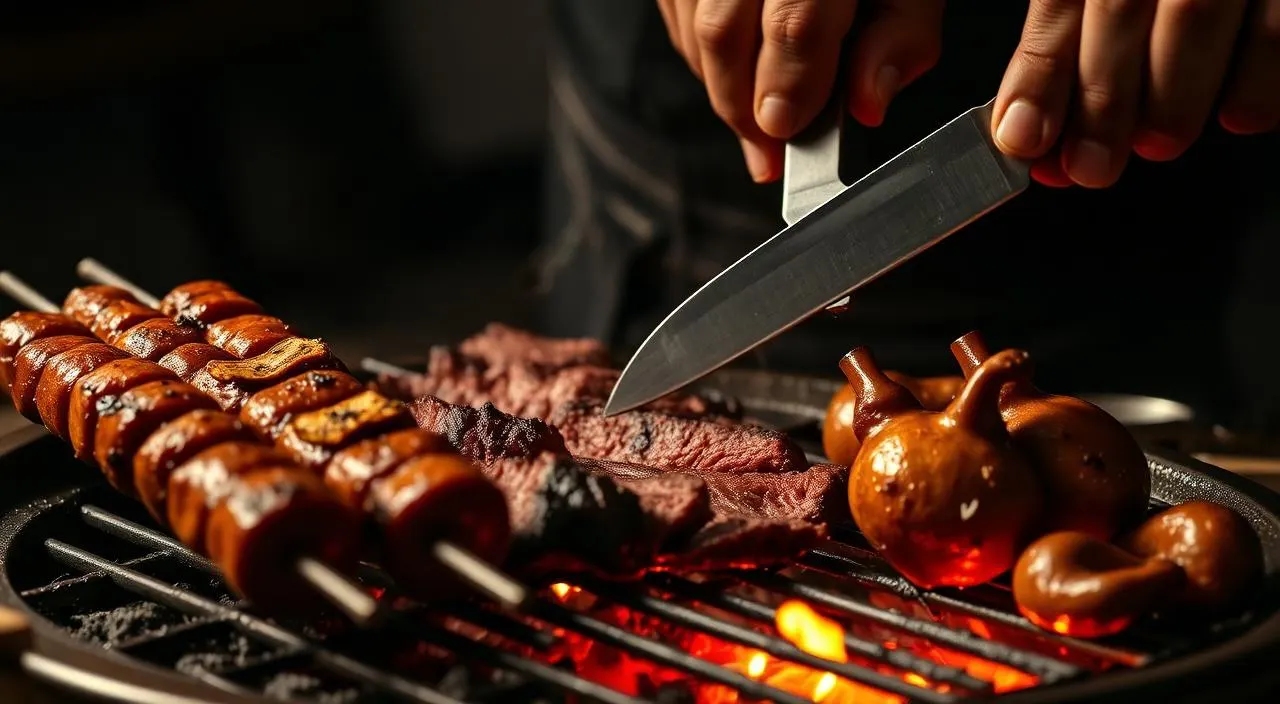
Churrasco Gaucho — The Full Brazilian Mixed Grill
This isn't one recipe — it's a philosophy. The churrasco spread is a rotating parade of meats on skewers, carved tableside with a sharp knife. Linguiça (Brazilian sausage), fraldinha (flank steak), and coração de frango (chicken hearts) are the three classics covered here.
Cook Mode
One step at a time, big text, timers, and your screen stays awake. 0/8 steps done.
Ingredients
Tap to tick off · 0/8 gathered
- — LINGUIÇA (Brazilian Sausage) —
- — FRALDINHA (Flank Steak) —
- — CORAÇÃO DE FRANGO (Chicken Hearts) —
Method
- 20 min
Begin by cleaning the 1.5 lbs of chicken hearts, removing any excess fat or arterial tubes. For the 2 lbs of flank steak (fraldinha), trim any heavy silver skin but leave the surface marble intact. Ensure the 2 lbs of linguiça links are separated but the casings remain fully intact to preserve juices. Keeping the meats cold during this preparation phase is critical for both food safety (staying below 40°F) and for achieving a cleaner sear later.
Why it matters
Proper trimming and cleaning ensure uniform heat penetration and a pleasant texture for every bite.
Common mistake
Leaving too much silver skin on the flank steak, which results in a chewy, unpleasant mouthfeel.
- 30 min
In a large mixing bowl, combine the 1.5 lbs of cleaned chicken hearts with 0.25 cup olive oil, 4 cloves of minced garlic, 1 tbsp coarse salt, 1 tbsp black pepper, and 1 tsp dried thyme. Toss thoroughly to ensure each heart is coated. Allow the hearts to marinate in the refrigerator for at least 30 minutes; the oil helps the garlic and thyme aromatics penetrate the muscle fibers while the salt begins the seasoning process.
Why it matters
The marinade acts as a flavor carrier through the high-heat cook, preventing the delicate hearts from drying out.
Common mistake
Using too much garlic which can burn over high heat and become bitter.
- 15 min
Thread the 2 lbs of linguiça on wide, flat skewers. For the 2 lbs of flank steak, apply the 3 tbsp coarse salt and 1 tbsp black pepper liberally to all sides, then fold the meat into a 'C-shape' and pierce through both ends to create a thick, juicy bundle on the skewer. Finally, thread 6 to 8 marinated chicken hearts per skewer, packed tightly together to prevent rotation. High-quality skewers are essential to support the weight and allow for even rotation during the sear.
Why it matters
Skewering correctly prevents 'spinning' on the spit, ensuring all sides of the meat receive equal radiant heat.
Common mistake
Skewering the hearts too loosely, which causes them to dry out and rotate independently of the skewer.
- 500°F15 min
Preheat your smoker to a target temperature of 500°F using oak pellets for a clean, traditional campfire smoke. If using a pellet grill, ensure your heat deflector is removed or set to 'direct flame' if applicable to mimic the Gaucho open-fire style. The high heat is necessary to render the fat in the sausage and create the signature bark on the flank steak without overcooking the center.
Why it matters
A true churrasco requires intense radiant heat to achieve Maillard reaction browning while maintaining a juicy interior.
Common mistake
Starting the cook before the smoker has fully recovered to 500°F, leading to gray, steamed meat.
- 500°F25 min
Place skewers over the direct heat zone. The linguiça will take approximately 20 minutes; rotate it every 4 minutes until the skins are crisp and taut. The fraldinha requires rotation every 5 minutes to develop a thick crust while keeping the interior medium-rare. Monitor the chicken hearts closely; they only need 3 to 4 minutes per side. The goal is a deep mahogany char on the outside of all proteins while maintaining different internal target temperatures.
Why it matters
Frequent rotation mimics a rotisserie, distributing melting fats over the surface of the meat to basting it naturally.
Common mistake
Leaving the lid open for too long, which drops the ambient temperature and slows the rendering of the sausage fat.
- 130°F5 min
Using a high-quality instant-read thermometer, check doneness across all three proteins. Pull the linguiça once it hits 160°F to ensure food safety for the pork blend. The fraldinha (flank steak) should be pulled at an internal temperature of 130°F—the carryover heat will bring it to a perfect 135°F medium-rare. The chicken hearts are best pulled when firm to the touch with a slight char, reaching an internal temp of 165°F. Move skewers to a cooler part of the grill if they finish early.
Why it matters
Precise temperature monitoring prevents the notorious 'meat stall' or the leather-like texture of overcooked flank.
Common mistake
Neglecting the carryover heat, which can easily push a medium-rare steak into well-done during the rest.
- 10 min
Transfer the finished skewers to a warm platter. For the flank steak specifically, the fibers must relax to reabsorb the internal juices; if you cut immediately, the juice will flood the cutting board and leave the meat dry. Let the sausage and steak rest for 10 minutes. The chicken hearts can be served almost immediately, but a 3-minute rest allows the garlic oil to settle.
Why it matters
Resting allows the internal pressure of the meat to stabilize, guaranteeing a juicy tableside carving experience.
Common mistake
Tenting the meat too tightly with foil, which steams the crisp exterior and ruins the bark.
- 5 min
Following Gaucho tradition, hold the fraldinha skewer vertically and use a very sharp knife to shave thin slices directly onto the guest's plate. Serve the linguiça links whole or sliced diagonally for maximum surface area. The chicken hearts are served directly from the skewer. Accompany the meal with farofa or chimichurri to cut through the richness of the rendered animal fats.
Why it matters
Thin, vertical slicing against the grain is the only way to ensure the long fibers of flank steak are tender enough to eat.
Common mistake
Slicing with the grain, making the flank steak nearly impossible to chew.
Sauce It
Cooks & Reviews
Guild members can rate this recipe, log their cooks and share photos.
Sign in to continueMember reviews
No reviews yet — be the first to rate this cook.
Ask the Pitmaster about this recipe
Substitutions, scaling, technique, troubleshooting — get answers grounded in this cook.
Sign in to try the AI Pitmaster on Churrasco Gaucho — The Full Brazilian Mixed Grill. New members get 3 free questions.
Sign in to tryComments(0)
Loading comments…