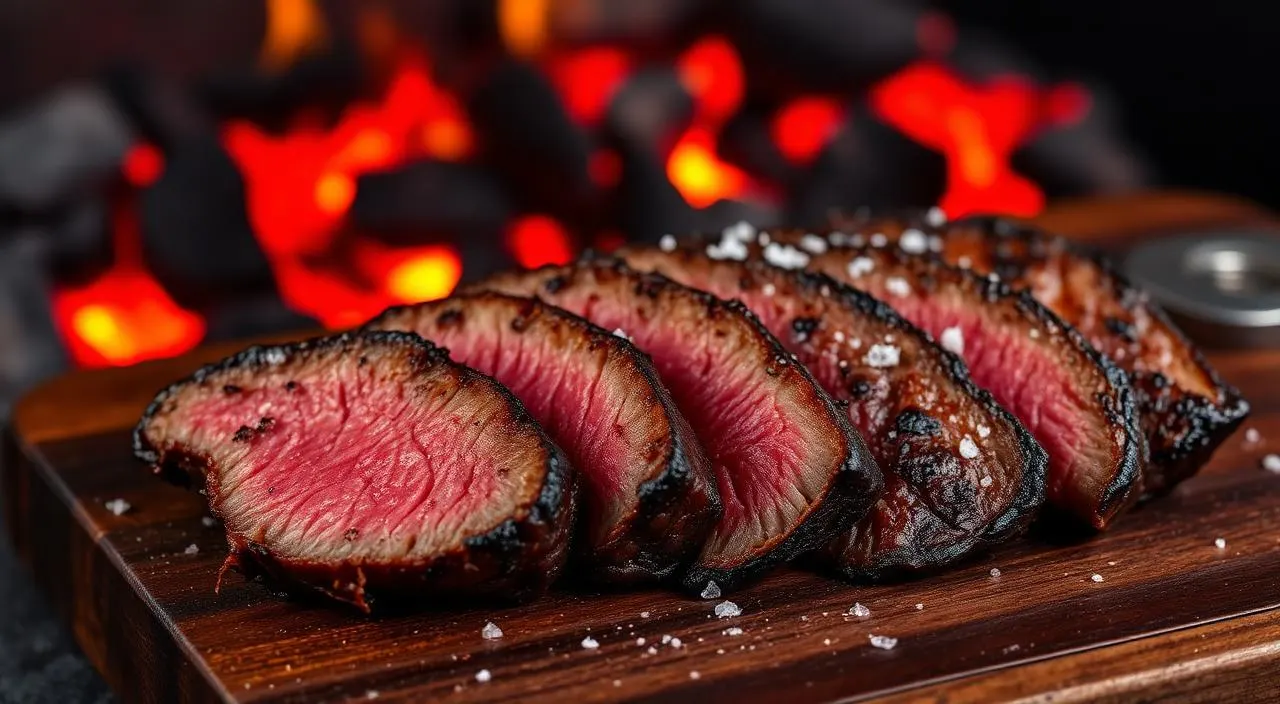
Carne Asada Uruguaya — Skirt Steak, Salt Only
Uruguay takes an almost confrontational stance on beef — no marinades, no rubs, no sauces. Just coarse salt and direct heat. The quality of the beef is the whole show, so don't buy anything but the best you can find.
Cook Mode
One step at a time, big text, timers, and your screen stays awake. 0/7 steps done.
Ingredients
Tap to tick off · 0/3 gathered
Method
- 15 min
Begin with 2 lbs of outside skirt steak, which is thicker and more uniform than inside skirt. Use a sharp boning knife to remove the thick silver skin (connective tissue) from both sides of the meat. Leaving silver skin on results in a leathery, inedible barrier that prevents heat penetration and salt absorption. Ensure the steak is of uniform thickness so it cooks evenly across the entire length of the muscle.
Why it matters
Silver skin does not render and will make an otherwise tender cut feel tough and chewy.
Common mistake
Using inside skirt steak, which is much thinner and prone to overcooking before a crust can form.
- 45 min
Apply the 2 tbsp of coarse sea salt or rock salt generously to both sides of the steak. In the Uruguayan tradition, the salt serves both as a seasoning and a structural tool to draw moisture to the surface where it can interact with the heat. Let the salted meat sit at room temperature for at least 45 minutes; this allows the salt to dissolve into a brine and re-absorb into the muscle fibers, seasoning the center of the meat.
Why it matters
The salt needs time to penetrate the protein; surface salting immediately before cooking often results in the salt falling off into the fire.
Common mistake
Using fine table salt which over-salts the meat and lacks the textural crunch of traditional rock salt.
- 600°F20 min
Fill your grill chimney with hardwood lump charcoal and light it without the use of chemical starters. Once the coals are fully ashed over and glowing red, spread them into a dense, even layer. You are aiming for a surface temperature of 600°F. Test the heat by holding your hand 3 inches above the grate; you should be forced to pull away in less than 2 seconds. Clean the grates thoroughly with a wire brush to prevent sticking.
Why it matters
Extreme direct heat is required to trigger the Maillard reaction on a thin cut before the interior exceeds medium-rare.
Common mistake
Cooking over charcoal that hasn't fully ashed over, leading to acrid 'dirty' smoke flavors.
- 600°F4 min
Place the 2 lbs of skirt steak directly over the hottest part of the coals. Close the lid if using a kettle grill to prevent flare-ups, but stay present. Sear the first side for approximately 3 to 4 minutes until a deep, dark brown crust forms. Flip the steak only once using tongs. As the meat hits the grate, it will undergo rapid protein denaturation; avoid moving it for the first 2 minutes to ensure the crust sets properly.
Why it matters
The high heat creates a charred exterior that provides the only flavor profile in this salt-only recipe.
Common mistake
Flipping the meat too early or too often, which prevents a proper crust from developing.
- 130°F4 min
Continue cooking the second side for another 3 to 4 minutes. Use an instant-read thermometer to check the thickest part of the steak. For a traditional Uruguayan medium-rare, pull the meat when the internal temperature hits 125°F to 130°F. Because the grill temperature is so high (600°F), carryover cooking will be significant, raising the internal temperature another 5°F to 10°F during the rest phase.
Why it matters
Skirt steak becomes incredibly rubbery and tough if cooked past medium (150°F+).
Common mistake
Relying on time or 'feel' instead of a calibrated thermometer on such a high-velocity cook.
- 10 min
Transfer the steak to a warm cutting board or a heated platter. Do not tent tightly with foil, as this will steam the crust and make it soggy; instead, drape it loosely with a single sheet of foil. Let the meat rest for a full 10 minutes. During this time, the muscle fibers relax and reabsorb the juices that were pushed to the center during the sear, ensuring the moisture stays in the meat when sliced.
Why it matters
Slicing immediately will result in all the flavorful juices running out onto the board, leaving the meat dry.
Common mistake
Cutting the meat too soon due to hunger, ruining the texture of the entire cook.
- 5 min
Identify the grain of the skirt steak—the long muscle fibers run horizontally across the width of the steak. Rotate the steak and slice crosswise into thin strips (roughly 1/4 inch thick) at a 45-degree angle. By cutting through the fibers rather than parallel to them, you are manually shortening the protein strands, making the chew effortless. Serve immediately while the fat is still warm and translucent.
Why it matters
The fiber structure of skirt steak is very coarse; slicing with the grain makes the meat impossible to chew.
Common mistake
Slicing the steak lengthwise, which follows the muscle fibers and results in a 'stringy' texture.
Sauce It
Cooks & Reviews
Guild members can rate this recipe, log their cooks and share photos.
Sign in to continueMember reviews
No reviews yet — be the first to rate this cook.
Ask the Pitmaster about this recipe
Substitutions, scaling, technique, troubleshooting — get answers grounded in this cook.
Sign in to try the AI Pitmaster on Carne Asada Uruguaya — Skirt Steak, Salt Only. New members get 3 free questions.
Sign in to tryComments(0)
Loading comments…