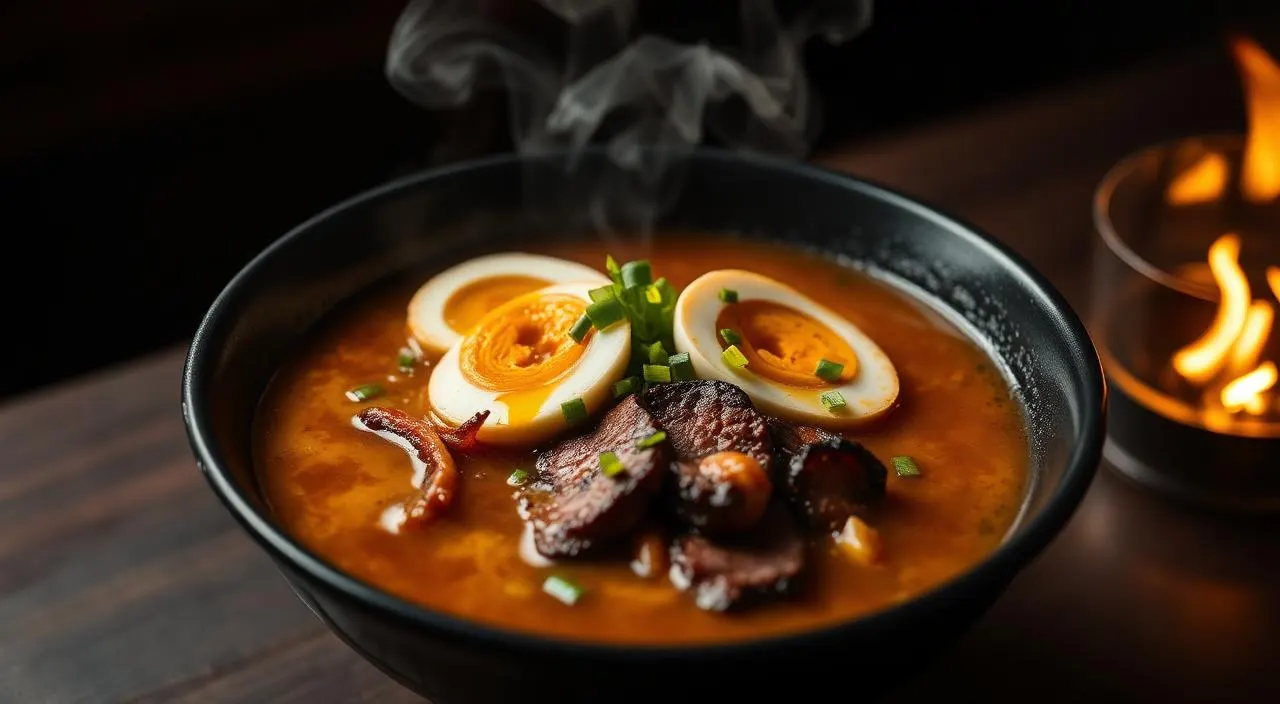
Brazilian BBQ Ramen
This one takes work but it's one of the most impressive things you can put in front of someone. Tonkotsu-style broth built from smoked picanha bones and beef fat, topped with thin-sliced churrasco beef, marinated eggs, and Brazilian chimichurri oil.
Cook Mode
One step at a time, big text, timers, and your screen stays awake. 0/7 steps done.
Ingredients
Tap to tick off · 0/20 gathered
- — SMOKED BEEF BROTH —
- — CHURRASCO BEEF TOPPING —
- — MARINATED EGGS (make ahead) —
- — CHIMICHURRI OIL —
- — TO SERVE —
Method
- 20 min
Begin by coating 3 to 4 lbs of picanha trim bones in 1 tbsp vegetable oil. This oil acts as a heat conductor to ensure even browning. Place the bones on a wire rack to allow maximum airflow. While the smoker preheats, char the halved white onion, 6 garlic cloves, and 2-inch ginger piece in a dry pan or over a gas flame until the surfaces are blackened; this caramelization adds the deep 'char' flavor essential to a Brazilian-style broth.
Why it matters
Charring the aromatics and oiling the bones creates a foundational depth that raw ingredients cannot achieve.
Common mistake
Using wet bones which will steam rather than brown, resulting in a cloudy, dull broth.
- 250°F2h
Load the bones into the smoker at 250°F using oak or hickory. Smoke for 120 minutes until the bones have transformed from pale to a deep mahogany color. You are not only rendering the recursive beef fat from the picanha trim but also infusing the marrow with smoke particles that will eventually emulsify into your broth. The 250°F temp is low enough to prevent the fat from scorching while high enough to trigger the Maillard reaction.
Why it matters
Smoking the bones allows the smoke flavor to be chemically bound to the fat, which becomes the 'smoke carrier' for the entire ramen bowl.
Common mistake
Pulling the bones too early before they reach a dark, toasted color.
- 210°F6h
Transfer the smoked bones and charred aromatics into a large stockpot with 11 cups of water. Bring to a hard boil for 20 minutes to begin the emulsification of fats and collagen, then reduce to a steady simmer. Skim any grey foam or impurities that rise to the top within the first hour. Maintain the simmer for 4 to 6 hours, ensuring the liquid reduces slightly to concentrate the smoky beef profile. This ensures you move through the 40-140°F danger zone quickly for food safety.
Why it matters
A long simmer is required to break down the collagen in the beef bones into gelatin, providing the creamy mouthfeel typical of high-end ramen.
Common mistake
Boiling too hard for the entire duration, which can make the broth overly bitter and unpleasantly greasy.
- 4h 10m
Boil 4 large eggs for exactly 6.5 minutes to achieve a 'jammy' yolk. Immediately shock them in an ice bath for 10 minutes to stop the cooking process and prevent a grey sulfur ring from forming around the yolk. Peel carefully and submerge in a marinade of 0.25 cup soy sauce, 0.25 cup water, 1 tbsp sugar, and 1 tsp sesame oil. Cure in the refrigerator for at least 4 hours. The salt in the soy sauce will slightly cure the yolk, giving it a custard-like texture.
Why it matters
The marinade seasons the egg through osmosis, transforming a simple boiled egg into a concentrated umami bomb.
Common mistake
Skipping the ice bath, which results in hard-cooked yolks that won't meld with the broth.
- 130°F15 min
Season 1 lb of flat iron or flank steak heavily with 2 tbsp coarse salt and 1 tsp black pepper. In Brazilian churrasco style, the coarse salt is functional, creating a crust. Grill over high direct heat (or sear in the smoker if it has a sear station) for about 4 minutes per side. Aim for an internal temperature of 130°F to 135°F for medium-rare. The high heat is necessary to mimic the open-fire pits of a Brazilian steakhouse.
Why it matters
The aggressive salt crust provides the necessary contrast to the rich, creamy broth.
Common mistake
Overcooking the beef; because it is sliced thin for ramen, it will continue to warm in the hot broth.
- 10 min
Allow the beef to rest for at least 10 minutes before slicing to prevent the juices from leaking onto the board. During this time, whisk 0.25 cup olive oil, 2 tbsp parsley, 1 clove minced garlic, 1 tsp red wine vinegar, and a pinch of red pepper flakes to create the Chimichurri Oil. This oil acts as the 'aromatic fat' (mayu) often found in ramen, but with a South American flavor profile.
Why it matters
Resting allows the muscle fibers to relax and reabsorb moisture, ensuring the steak is tender when bitten alongside noodles.
Common mistake
Slicing the beef too soon, which results in dry meat and a messy presentation.
- 165°F5 min
Strain the broth through a fine-mesh sieve and discard the solids. Season the liquid with 2 tbsp soy sauce and 1 tbsp sesame oil, adding salt to taste until the smoky notes pop. To serve, place cooked ramen noodles in a deep bowl, ladle 12-16 oz of scorching hot broth over them, and top with thin slices of the rested beef, two marinated egg halves, and a generous drizzle of the Chimichurri oil. Serve immediately while the broth is above 165°F for the best experience.
Why it matters
Final seasoning must happen after the long simmer to account for water reduction and salt concentration.
Common mistake
Serving in cold bowls, which causes the broth temperature to drop rapidly and the beef fat to congeal.
Sauce It
Cooks & Reviews
Guild members can rate this recipe, log their cooks and share photos.
Sign in to continueMember reviews
No reviews yet — be the first to rate this cook.
Ask the Pitmaster about this recipe
Substitutions, scaling, technique, troubleshooting — get answers grounded in this cook.
Sign in to try the AI Pitmaster on Brazilian BBQ Ramen. New members get 3 free questions.
Sign in to tryComments(0)
Loading comments…