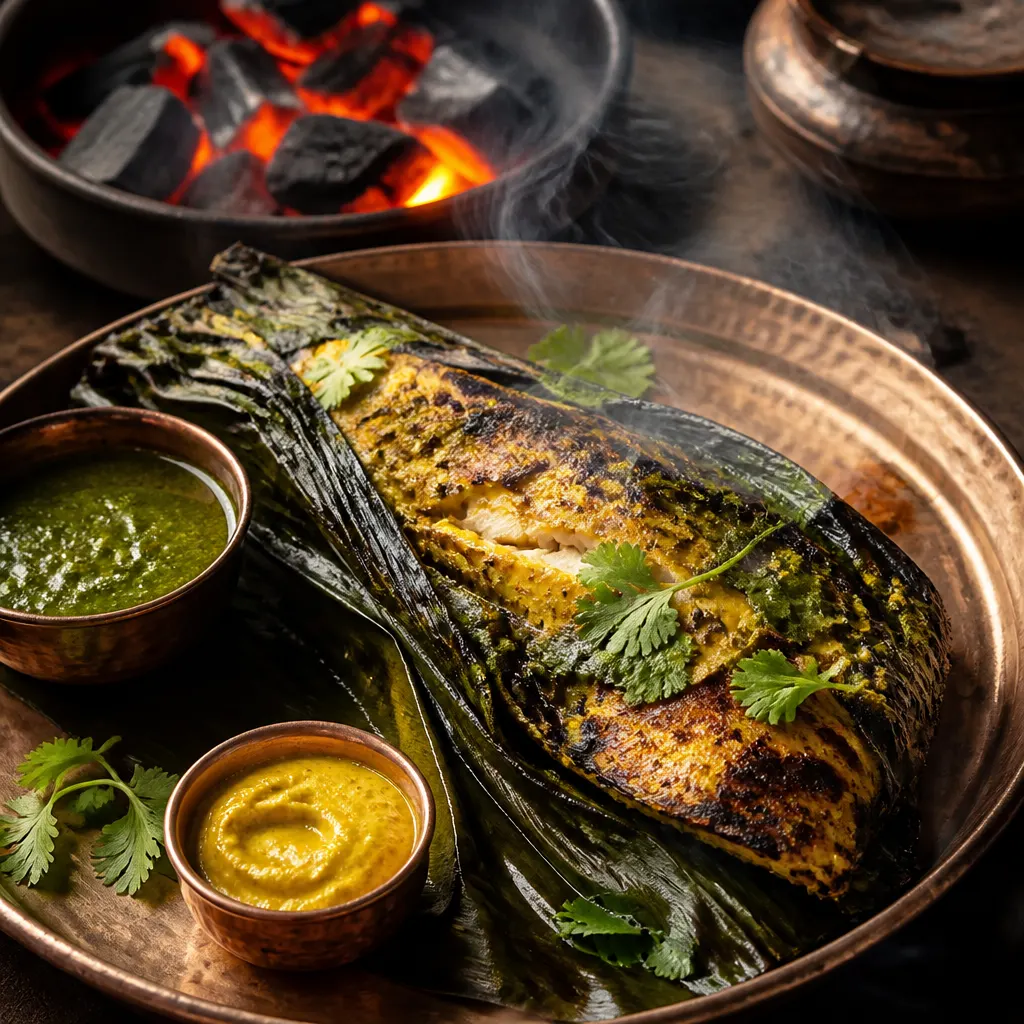
Banana-Leaf Smoked Fish Tikka with Mustard
Bengali fish cooking is built on mustard — the pungent, sinus-clearing kasundi paste — and this banana-leaf smoke pairs that tradition with a careful, restaurant-tier wrap on the smoker.
Cook Mode
One step at a time, big text, timers, and your screen stays awake. 0/7 steps done.
Ingredients
Tap to tick off · 0/10 gathered
Method
- 15 min
Begin by creating the 'Kasundi' style marinade. Drain the 3 tbsp of soaked brown mustard seeds and combine them in a high-speed blender with 1 tbsp yellow mustard seeds, 2 fresh green chilies, 1 tsp turmeric, 1 tsp salt, 3 tbsp pungent mustard oil, and 1 tbsp lime juice. Blend until a thick, uniform paste forms. The mustard oil provides the essential fat phase that will trap the alder smoke later, while the sulfur compounds in the mustard seeds provide the signature Bengali pungency. Ensure the paste is smooth to allow for even enzyme penetration during the marination phase.
Why it matters
The high fat content from the mustard oil acts as a solvent for both the spice heat and the subsequent smoke particles.
Common mistake
Using standard vegetable oil instead of kachi ghani mustard oil, which results in a loss of the authentic sinus-clearing profile.
- 40°F2h
Pat the 1.5 lbs of firm white fish steaks (cod, halibut, or hilsa) completely dry to prevent the marinade from sliding off. Apply a generous, even coating of the mustard paste to all sides of the fish. Place the coated fish in a glass or ceramic dish—avoid metal to prevent reactive off-flavors from the lime juice—and refrigerate for 1 to 2 hours. This time allows the salt and acid to begin denaturing the surface proteins, which helps the marinade 'set' and ensures the flavor is seasoned deeply into the flesh rather than just sitting on the surface.
Why it matters
Cold marination ensures the fish remains below the 40°F danger zone while the salt and acid work to season the interior.
Common mistake
Marinating for over 4 hours, which can cause the delicate fish proteins to become mushy due to the lime juice acidity.
- 20 min
Prepare the banana leaves by wiping them clean and gently passing them over an open flame or a hot burner until they turn glossy and become pliable. This 'wilting' process breaks down the cellular structure of the leaf, preventing it from cracking when folded. Place a fish steak in the center of a leaf piece and fold into a tight, rectangular parcel. Secure the seams with kitchen twine or toothpicks. The leaf acts as a semi-permeable membrane that protects the fish from direct heat while allowing alder smoke to slowly permeate through the fibers.
Why it matters
A well-sealed parcel creates a micro-steaming environment that keeps the fish moist while the leaf oils contribute a tea-like aroma.
Common mistake
Failing to soften the leaves, which leads to cracks that allow the flavorful mustard juices to leak out into the smoker.
- 250°F30 min
Preheat your smoker to a steady 250°F using Alder wood. Alder is the preferred wood for this Bengali preparation because its light, sweet smoke profile does not overwhelm the delicate white fish or the sharp, volatile mustard oils. Ensure you have a clean, blue smoke (TBS - Thin Blue Smoke) before adding the fish. Heavy, white 'smoldering' smoke will deposit bitter creosote on the banana leaves, which can migrate into the fish and ruin the balance of the dish.
Why it matters
Maintaining a stable 250°F ensures the fish reaches its safety temp quickly enough to bypass the bacterial growth zone without toughening the proteins.
Common mistake
Using heavy woods like hickory or mesquite which will clash and overpower the delicate mustard seeds and banana leaf fragrance.
- 250°F40 min
Place the leaf-wrapped parcels directly on the grill grates, seam-side down to start. Smoke for 30 to 40 minutes. Look for the banana leaves to transition from a vibrant green to a dull, charred olive color. The internal temperature of the fish is the only true measure of success; use an instant-read thermometer to penetrate through the leaf into the thickest part of the steak. You are looking for an internal temperature of 140°F. The mustard oils inside the leaf will begin to sizzle, effectively 'frying' the surface of the fish inside the steam-filled parcel.
Why it matters
Smoking at 250°F provides enough thermal energy to activate the mustard heat while the leaf prevents the smoke from becoming acrid.
Common mistake
Relying on time alone rather than internal temperature, leading to either rubbery overcooked fish or unsafe undercooked centers.
- 145°F5 min
Remove the parcels from the smoker once they hit 140°F and let them rest, unopened, for 5 minutes. During this time, carryover cooking will bring the internal temperature to a perfect 145°F, and the juices will redistribute throughout the flake of the fish. This brief rest also allows the pressure inside the parcel to equalize, ensuring that when the guest opens the leaf, they are met with a concentrated puff of mustard and alder-scented steam rather than a messy liquid spill.
Why it matters
Resting allows the protein fibers to relax and reabsorb the emulsified mustard oil/juice mixture for a more succulent mouthfeel.
Common mistake
Opening the parcels immediately, which causes a rapid loss of aromatics and crucial moisture.
- 5 min
Serve the parcels closed on individual plates to provide a sensory experience for the guest. Instruct diners to carefully cut the twine and peel back the leaves. Finish the dish immediately with a fresh squeeze of lime wedges and a heavy dusting of chopped fresh cilantro. The fresh acidity of the lime cuts through the heavy fat of the mustard oil, and the cilantro provides a bright, herbaceous counterpoint to the deep, smoky notes of the charred banana leaf.
Why it matters
The final hit of acid (lime) reinforces the flavors that were muted during the high-temperature smoking process.
Common mistake
Discarding the flavorful mustard paste 'crust' formed on the fish; this is the most flavor-dense part of the dish.
Sauce It
Cooks & Reviews
Guild members can rate this recipe, log their cooks and share photos.
Sign in to continueMember reviews
No reviews yet — be the first to rate this cook.
Ask the Pitmaster about this recipe
Substitutions, scaling, technique, troubleshooting — get answers grounded in this cook.
Sign in to try the AI Pitmaster on Banana-Leaf Smoked Fish Tikka with Mustard. New members get 3 free questions.
Sign in to tryComments(0)
Loading comments…