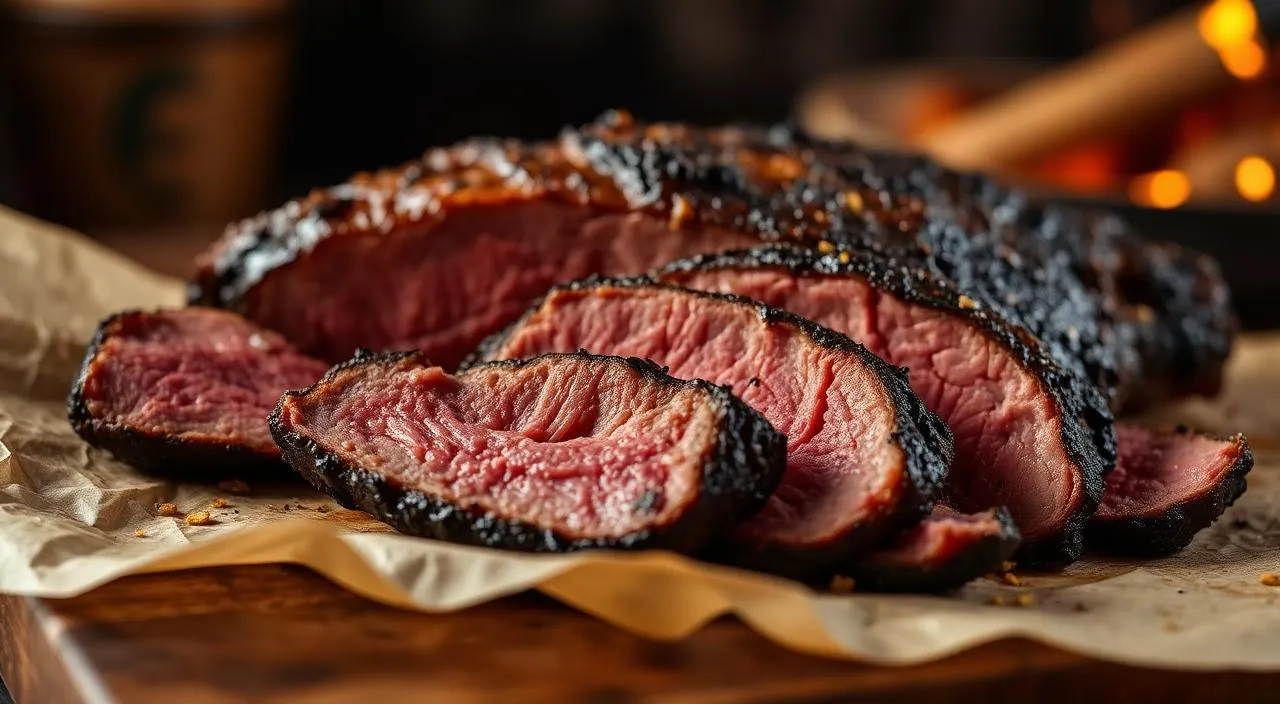
Ají Amarillo Smoked Brisket
Texas brisket technique gets a Peruvian soul. The ají amarillo adds a fruity, medium heat to the bark that you won't find in any Central Texas BBQ joint. Slice it the same way — against the grain, pencil-thick, let it fall.
Cook Mode
One step at a time, big text, timers, and your screen stays awake. 0/9 steps done.
Ingredients
Tap to tick off · 0/9 gathered
- — RUB —
- — BRISKET —
Method
- 45 min
Begin with the 13 lb whole packer brisket. Trim the fat cap to a uniform 1/4 inch thickness; any thinner and the meat will dry out, any thicker and the fat won't render. Remove the hard, waxy kernel of fat between the point and the flat to ensure even heat penetration. This structural prep allows the smoke to circulate around the protein efficiently and ensures every bite has the correct fat-to-meat ratio.
Why it matters
Uniform trimming ensures the brisket cooks at a consistent rate and prevents pools of rendered fat from washing away your bark.
Common mistake
Leaving the silver skin on the meat side, which acts as a barrier to smoke and seasoning penetration.
- 20 min
Combine 3 tbsp ají amarillo paste, 1 tbsp vegetable oil, 2 tbsp coarse salt, 2 tbsp coarse black pepper, 1 tbsp ground cumin, 1 tbsp smoked paprika, and 1 tsp garlic powder into a thick emulsion. Slather this paste over the entire brisket, ensuring the fruity heat of the ají amarillo is worked into every crevice. The oil and paste act as a superior binder compared to mustard, locking the spices against the muscle fibers for a complex, Peruvian-influenced flavor profile.
Why it matters
The salt in the rub needs time to denature the surface proteins and pull moisture out, which then creates the concentrated brine that forms the bark.
Common mistake
Using table salt instead of coarse salt, which leads to an overly salty exterior due to the higher surface area.
- 24h
Place the rubbed brisket on a wire rack over a sheet tray and refrigerate uncovered for 12 to 24 hours. This serves two purposes: it allows the salt to penetrate deep into the 13 lb roast for internal seasoning, and it allows the surface to air-dry. This dry environment is critical for the development of a 'tacky' surface that smoke particles can easily adhere to once it hits the pit.
Why it matters
A dry, tacky surface is the foundation of a professional bark; wet meat simply steams in the smoker.
Common mistake
Covering the meat with plastic wrap, which traps moisture and prevents the pellicle from forming.
- 250°F1h
Fire your smoker using post oak or oak wood, targeting a steady 250°F. Ensure you have achieved 'blue smoke'—a nearly invisible, translucent exhaust. Heavy white smoke contains creosote, which will impart a bitter, metallic taste that ruins the delicate fruity notes of the ají amarillo. Let the cooker's heavy steel soak up the heat for at least 30 minutes before introducing the meat to prevent temperature swings.
Why it matters
A stabilized pit ensures the meat doesn't spend too much time in the 40-140°F danger zone where bacteria can multiply.
Common mistake
Putting the meat on before the fire is clean, leading to a soot-covered, bitter brisket.
- 250°F7h
Place the brisket in the smoker with the fat-cap facing your heat source (usually fat-cap up in most offsets). Smoke for approximately 6 to 8 hours. During this phase, the fat begins to render and the spices fuse with the proteins. Do not open the lid frequently; every time you 'peek,' you lose the humidity and heat necessary to break down the tough connective tissues in the packer.
Why it matters
The first few hours are when the majority of the smoke ring and flavor profile are established.
Common mistake
Spritzing too early, which can wash away the rub before the bark has set.
- 165°F1h
Once the internal temperature reaches approximately 165°F and the bark is dark and 'set' (it shouldn't come off when touched), wrap the brisket tightly in pink butcher paper. This technique, known as the 'Texas Crutch,' helps the meat push through the stall—the point where evaporative cooling stops the temperature rise—while still allowing the meat to breathe so the bark doesn't turn mushy.
Why it matters
Wrapping protects the meat from drying out during the long transition from collagen to gelatin.
Common mistake
Wrapping based on time rather than visual bark confirmation and internal temperature.
- 203°F5h
Return the wrapped brisket to the smoker and continue cooking. You are looking for a final internal temperature between 200°F and 203°F in the thickest part of the flat. However, temperature is only a guide; use a probe to feel the texture. It should slide into the meat with the resistance of warm butter. This indicates that the tough collagen has fully liquified into rich gelatin.
Why it matters
Properly rendered collagen is the difference between a tough, rubbery brisket and one that is 'probe-tender.'
Common mistake
Pulling the brisket too early because it reached a specific temperature without checking for tenderness.
- 2h
Remove the brisket from the smoker and let it rest, still wrapped, in an insulated cooler for at least 2 hours (up to 4). Large cuts like a 13 lb brisket undergo significant carryover cooking. Resting allows the internal pressure to drop and the juices to redistribute from the center back to the edges. If you slice it immediately, the moisture will pour out, leaving you with dry meat.
Why it matters
The rest is the most important step for moisture retention; it allows the fibers to relax and reabsorb fat.
Common mistake
Resting for less than an hour, causing the brisket to bleed out on the cutting board.
- 15 min
Unwrap the brisket and identify the grain of the flat. Slice against the grain into pencil-thick strips (approx 1/4 inch). When you reach the point (the thicker, fattier end), rotate the brisket 90 degrees to continue slicing against the grain of that specific muscle. Serve immediately while the fat is warm and translucent. The result should be a smoky, tender beef with a distinct Peruvian ají amarillo kick.
Why it matters
Slicing against the grain is mandatory to shorten the muscle fibers, making the meat easy to chew.
Common mistake
Slicing with the grain, which makes even the most tender brisket feel tough and stringy.
7 more steps locked
You've seen the ingredients and the first two steps. Pit Members get every step, every temp, every glaze — plus the Cook Monitor and Pitmaster AI.
See Membership OptionsAlready a member? Sign in.
Sauce It
Cooks & Reviews
Guild members can rate this recipe, log their cooks and share photos.
Sign in to continueMember reviews
No reviews yet — be the first to rate this cook.
Ask the Pitmaster about this recipe
Substitutions, scaling, technique, troubleshooting — get answers grounded in this cook.
Sign in to try the AI Pitmaster on Ají Amarillo Smoked Brisket. New members get 3 free questions.
Sign in to tryComments(0)
Loading comments…